
Cognitive Load Limits in Large Language Models: Benchmarking Multi-Hop Reasoning
LLM EvaluationMulti-Hop Reasoninghttps://github.com/imsaitejareddy/computational-cognitive-load
大语言模型的认知负载极限:多跳推理基准评测
Abstract
The scaling of Large Language Models (LLMs) has exposed a critical gap between their performance on static benchmarks and their fragility in dynamic, information-rich environments. While models excel at isolated tasks, the computational limits that govern their reasoning under cognitive load remain poorly understood. In this work, we introduce a formal theory of computational cognitive load, positing that extraneous, task-irrelevant information (Context Saturation) and interference from task-switching (Attentional Residue) are key mechanisms that degrade performance. We designed the Interleaved Cognitive Evaluation (ICE), a deconfounded benchmark to systematically manipulate these load factors on challenging multi-hop reasoning tasks. A comprehensive study (N = 10 replications per item across 200 questions) revealed significant performance variations across five instruction-tuned models.
大语言模型(LLM)的规模扩展暴露出一个关键差距:它们在静态基准上表现出色,却在动态、信息密集的环境中十分脆弱。 尽管模型擅长处理孤立任务,但支配它们在认知负载下进行推理的计算极限仍未得到充分理解。 在本工作中,我们提出计算认知负载的形式化理论,认为无关且与任务无关的信息(上下文饱和)以及任务切换造成的干扰(注意残留)是导致性能下降的关键机制。 我们设计了交错认知评测(ICE),这是一个去混杂基准,可在具有挑战性的多跳推理任务上系统操控这些负载因素。 一项综合研究(每个条目重复 10 次,共 200 个问题)揭示了五种指令微调模型之间显著的性能差异。
Smaller open-source architectures (Llama-3-8B-Instruct, Mistral-7B-Instruct-v0.2) exhibited baseline brittleness, achieving 0% accuracy (SEM = 0.0) across all conditions, including clean controls, on this high-intrinsic-load task. In contrast, Gemini-2.0-Flash-001 showed partial resilience, achieving 85% accuracy in control conditions, with a statistically significant degradation under context saturation (
在这一高内在负载任务上,较小的开源架构(Llama-3-8B-Instruct、Mistral-7B-Instruct-v0.2)表现出基线脆弱性,在包括干净对照在内的所有条件下准确率均为 0%(SEM = 0.0)。 相比之下,Gemini-2.0-Flash-001 表现出一定韧性,在对照条件下达到 85% 的准确率,并且在上下文饱和条件下出现统计显著的性能下降(负载每增加 1%,
1. Introduction
A recent and influential body of work has highlighted that large language models (LLMs) may hallucinate or produce implausible outputs under conditions of high uncertainty, much like a student guessing on a challenging exam. While this analogy provides an intuitive high-level insight, it begs a deeper question: what are the specific computational mechanisms that trigger this uncertainty in the first place? This paper revisits this hypothesis by proposing that such states arise from exceeding inherent capacity limits analogous to those in human cognition. We draw on cognitive load theory (CLT) to frame and analyze these constraints without relying on speculative or future-oriented theorizing.
近期一系列具有影响力的工作指出,大语言模型(LLM)在高度不确定的条件下可能产生幻觉或不可信的输出,就像学生在困难考试中猜答案一样。 虽然这一类比提供了直观的高层见解,但它引出了一个更深层的问题:究竟哪些具体计算机制首先触发了这种不确定性? 本文重新审视这一假设,并提出这种状态源自模型超出了类似于人类认知中的固有容量限制。 我们借助认知负载理论(CLT)构建并分析这些约束,而不依赖推测性或面向未来的理论构想。
To address potential concerns about over-simplification in such analogies—as noted in critiques of CLT that warn against directly equating human and machine cognition—we carefully operationalize these parallels. These critiques highlight differences like the mind's creative and metaphorical processes rather than strict computational processing. We emphasize architectural bottlenecks in transformers while acknowledging that CLT constructs may interact in non-linear ways in AI contexts, where measurability remains a challenge.
为回应这种类比可能过度简化的担忧——正如对 CLT 的批评所警告的那样,不能直接等同人类认知与机器认知——我们谨慎地对这些相似之处进行操作化定义。 这些批评强调了心智的创造性与隐喻性过程等差异,而非严格的计算处理。 我们着重考察 Transformer 的架构瓶颈,同时承认 CLT 构念在人工智能环境中可能以非线性方式相互作用,而其可测量性仍是一项挑战。
The transformer-based architecture underpinning large language models has propelled significant advancements. It facilitates their deployment in diverse areas such as information retrieval, content creation, code generation, and more. These models, trained on expansive datasets encompassing vast amounts of textual information, demonstrate impressive generalization across a multitude of tasks. They frequently outperform human benchmarks in controlled environments focused on natural language understanding, logical reasoning, and creative generation.
支撑大语言模型的 Transformer 架构推动了显著进展。 它促进了模型在信息检索、内容创作和代码生成等不同领域的部署。 这些模型在包含海量文本信息的大规模数据集上训练,并在众多任务中展现出令人印象深刻的泛化能力。 在聚焦自然语言理解、逻辑推理和创造性生成的受控环境中,它们经常超越人类基准。
However, despite these accomplishments, a substantial and growing body of empirical evidence points to systematic vulnerabilities. These occur when systems operate in more realistic, dynamic scenarios characterized by high volumes of information or frequent shifts in task requirements. To enhance clarity and avoid ambiguity in our constructs, we define key terms early. "Context saturation" refers to the degradation in performance when irrelevant information overwhelms the model's attention allocation to relevant tokens. It is quantifiable as the proportion of attention weights directed to extraneous elements.
然而,尽管取得了这些成就,越来越多的实证证据仍指向系统性脆弱性。 当系统运行于信息量巨大或任务要求频繁变化的、更真实的动态场景时,这些脆弱性便会显现。 为提高清晰度并避免构念含混,我们在此先定义关键术语。 “上下文饱和”是指无关信息压倒模型对相关 token 的注意分配时所造成的性能下降。 它可以通过指向无关元素的注意权重比例进行量化。
"Attentional residue" denotes the lingering interference from prior tasks during switches. It is approximated via cosine similarity of task embeddings.
“注意残留”是指任务切换期间先前任务留下的持续干扰。 我们通过任务嵌入的余弦相似度对其进行近似衡量。
One prominent and well-documented limitation is the positional bias inherent in long-context processing. Models exhibit a tendency to prioritize information situated at the beginning or end of input sequences. They often neglect or underutilize crucial details embedded in the middle portions. This phenomenon is commonly referred to as the "lost-in-the-middle" effect. This bias not only compromises the accuracy of information retrieval but also underscores potential fundamental constraints within the attention mechanisms that form the core of transformer designs.
一个突出且已有充分记录的局限,是长上下文处理所固有的位置偏置。 模型倾向于优先处理位于输入序列开头或结尾的信息。 它们经常忽略或未充分利用嵌入序列中部的关键细节。 这一现象通常称为“中间丢失”效应。 这种偏置不仅损害信息检索的准确性,也凸显了构成 Transformer 设计核心的注意力机制中可能存在的根本约束。
In parallel, multi-turn conversational settings present another layer of challenge. Sudden transitions between unrelated tasks within the same interaction thread can introduce persistent interference. This results in marked reductions in overall precision and reliability. Furthermore, innovative dynamic evaluation paradigms have revealed underlying deficiencies in adaptability. These involve the real-time generation of novel test instances. Such deficiencies remain hidden in traditional static benchmarks like MMLU. They are often attributable to factors such as inadvertent data contamination during training.
与此同时,多轮对话环境带来了另一层挑战。 在同一交互线程中突然切换到无关任务,可能引入持续干扰。 这会显著降低整体精确性与可靠性。 此外,创新的动态评测范式揭示了模型潜在的适应性缺陷。 这些范式会实时生成新的测试实例。 此类缺陷在 MMLU 等传统静态基准中仍然隐藏不见。 它们往往可归因于训练期间意外的数据污染等因素。
These seemingly disparate observations invite exploration through a cohesive theoretical lens. Cognitive load theory (CLT), a cornerstone framework from educational and cognitive psychology, provides such a perspective. It asserts that human working memory operates under strict finite capacity—classically quantified as approximately seven chunks of information. Optimal learning or task performance is impeded when non-essential or extraneous elements overburden these limited resources.
这些看似分散的观察结果值得通过统一的理论视角加以探索。 认知负载理论(CLT)这一教育心理学与认知心理学的基础框架提供了这样的视角。 该理论认为,人类工作记忆受到严格的有限容量约束,经典估计约为七个信息组块。 当非必要或无关元素使这些有限资源过载时,最佳学习或任务表现就会受到阻碍。
However, we recognize ongoing scholarly debates about CLT's measurability and validity. These include the lack of reliable multi-item scales to distinguish load types. They also cover the potential non-additivity of intrinsic, extraneous, and germane loads. In these debates, components may interact in complex, context-dependent ways rather than summing linearly.
不过,我们也认识到学界仍在争论 CLT 的可测量性与有效性。 其中包括缺乏能够区分不同负载类型的可靠多项目量表。 争论也涉及内在负载、外在负载和相关负载可能不具可加性。 这些组成部分可能以复杂且依赖上下文的方式相互作用,而非线性相加。
Building on these foundational debates, emerging research in AI safety resonates with this concept. For instance, taxonomies like the Cognitive Cybersecurity Suite (CCS-7) explicitly categorize "cognitive-load overflow" as a critical vulnerability. In this, essential content becomes obscured amid excessive or irrelevant input. This leads to compromised reasoning capabilities. Such correspondences suggest that LLMs may encounter comparable bottlenecks.
在这些基础争论之上,新兴的人工智能安全研究与这一概念形成呼应。 例如,认知网络安全套件(CCS-7)等分类体系明确将“认知负载溢出”归为一种关键脆弱性。 在这种情况下,关键信息会被过量或无关输入遮蔽。 这会损害推理能力。 这些对应关系表明,LLM 可能遭遇类似的瓶颈。
These derive from their underlying architecture, notwithstanding their immense parameter counts and computational power. They include the quadratic scaling of attention computations and phenomena like attention sinks that unevenly distribute focus across sequences. However, we caution that direct analogies from human to machine must account for domain-specific differences to avoid oversimplification.
尽管模型拥有庞大的参数量和计算能力,这些瓶颈仍源于其底层架构。 其中包括注意力计算的二次复杂度,以及注意力汇聚等导致注意在序列中分布不均的现象。 不过,我们提醒,若要避免过度简化,从人类到机器的直接类比必须考虑领域特有的差异。
Nevertheless, forging robust connections between these parallels demands meticulous empirical validation rather than superficial comparisons. This is especially true given critiques that CLT can become unfalsifiable through post-hoc explanations. It may also lack external validity in real-world applications beyond lab settings. Shifting from this theoretical background to our study design, this paper strives to establish these linkages. We re-examine well-established phenomena through the prism of CLT, eschewing the introduction of unsubstantiated speculations. We refine the conceptualization of an Interleaved Cognitive Evaluation (ICE) benchmark to methodically investigate load effects.
不过,要在这些相似之处之间建立稳健联系,需要细致的实证验证,而非表面比较。 鉴于有批评指出 CLT 可能通过事后解释变得不可证伪,这一点尤其重要。 它在实验室之外的现实应用中也可能缺乏外部效度。 从这一理论背景转向我们的研究设计,本文力图建立这些联系。 我们通过 CLT 的视角重新审视已有充分研究的现象,同时避免引入缺乏依据的推测。 我们进一步完善交错认知评测(ICE)基准的概念,以系统研究负载效应。
We elucidate its alignment with the intrinsic (task-inherent complexity), extraneous (unproductive overhead from irrelevant processing), and germane (productive schema-building effort) components of CLT. We note the difficulty in cleanly separating these in computational tasks. We present detailed findings from a large-scale study that highlights both affirmative patterns and the intrinsic methodological hurdles associated with these types of stress-testing evaluations. In this manner, we contribute a methodical framework for appraising the robustness of LLMs. We place particular emphasis on the pivotal role that extraneous cognitive load plays in instigating performance failures. We transparently frame the study's constraints, such as model diversity, and potential threats to generalizability.
我们阐明它与 CLT 中内在负载(任务固有复杂度)、外在负载(无关处理造成的无效开销)和相关负载(用于构建图式的有效努力)三个组成部分的对应关系。 我们也指出,在计算任务中很难将它们完全分离。 我们给出一项大规模研究的详细结果,其中既呈现了支持性规律,也揭示了这类压力测试评测固有的方法学障碍。 由此,我们提供了一个用于评估 LLM 鲁棒性的系统框架。 我们尤其强调外在认知负载在引发性能失败中的关键作用。 我们透明地说明研究的约束,例如模型多样性,以及对泛化能力的潜在威胁。
Our central thesis posits that contemporary AI systems are proficient in handling intricate tasks when presented in isolated and streamlined contexts. Yet, they are prone to abrupt and substantial declines in performance when their effective "working memory" becomes overburdened by task-irrelevant details or fragmented by competing demands. We differentiate our approach from preceding studies by rigorously isolating factors of extraneous cognitive load. These include context saturation involving irrelevant informational clutter and attentional residue stemming from task-switching interference. We maintain constancy in the intrinsic difficulty of the tasks under examination. This addresses concerns about construct ambiguity through explicit operationalization.
我们的核心论点是,当任务处于孤立且简化的上下文中时,现代人工智能系统能够熟练处理复杂任务。 然而,当其有效“工作记忆”被与任务无关的细节压垮,或被相互竞争的需求切割时,性能很容易突然大幅下降。 我们通过严格隔离外在认知负载因素,使本方法区别于以往研究。 这些因素包括无关信息杂乱造成的上下文饱和,以及任务切换干扰产生的注意残留。 我们保持所考察任务的内在难度不变。 这种显式操作化回应了构念含义模糊的问题。
Via a large-scale study employing the ICE benchmark, we encompass models like Gemini-2.0-Flash-001 alongside open-source variants such as Llama-3-8B-Instruct, Llama-3-70B-Instruct, Mistral-7B-Instruct-v0.2, and GPT-4o-0613. We furnish initial evidence of degradation induced by these load factors. However, we include a strong caveat regarding the necessity for more expansive and finely tuned experiments. These are needed to mitigate risks of overgeneralization and to bolster the reliability of conclusions. Single-item measures or short-term assessments may not fully capture load interactions.
在使用 ICE 基准开展的大规模研究中,我们涵盖了 Gemini-2.0-Flash-001,以及 Llama-3-8B-Instruct、Llama-3-70B-Instruct、Mistral-7B-Instruct-v0.2 和 GPT-4o-0613 等开源模型。 我们提供了这些负载因素导致性能下降的初步证据。 不过,我们郑重强调,还需要范围更广、调校更细致的实验。 这些实验对于降低过度概括的风险并增强结论的可靠性十分必要。 单项目测量或短期评估可能无法完整捕捉负载之间的相互作用。
This paper advances three principal contributions, explicitly highlighting its novelty as a synthesis and empirical extension of prior work.
本文提出三项主要贡献,并明确强调其创新性在于对既有工作的综合与实证拓展。
- A formal adaptation of computational cognitive load theory tailored to AI contexts. This operationalizes mechanisms like context saturation and attentional residue as precise mappings to empirically documented failures in LLMs. It builds on but advances beyond existing taxonomies like CCS-7 and recent frameworks like Cognitive Load-Aware Inference for optimizing LLM token economy.
- The ICE benchmark, serving as a deconfounded, reproducible scientific instrument for deliberately inducing and quantitatively measuring cognitive loads within a challenging multi-hop reasoning paradigm. It offers a novel tool for load-aware dynamic evaluation.
- Empirical discoveries from the study, which unveil patterns of partial resilience in advanced models contrasted with intrinsic brittleness in smaller ones.
- 面向人工智能环境,对计算认知负载理论进行形式化改造。该贡献将上下文饱和和注意残留等机制操作化为对 LLM 已有实证失败现象的精确映射。它以 CCS-7 等现有分类体系和用于优化 LLM token 经济性的认知负载感知推理等近期框架为基础,同时又有所推进。
- ICE 基准是一种去混杂、可复现的科学工具,可在具有挑战性的多跳推理范式中有意诱发并定量测量认知负载。它为负载感知动态评测提供了一种新工具。
- 本研究的实证发现揭示了先进模型表现出的部分韧性,并将其与较小模型的内在脆弱性形成对照。
These are accompanied by critical methodological insights to inform subsequent developments in dynamic evaluation protocols. We candidly acknowledge limitations such as the need for multi-item load measurements and real-world validation to enhance external validity. By seamlessly integrating established theoretical foundations with rigorous empirical substantiation, this work establishes cognitive load as an essential constraining factor in artificial intelligence. It thereby proposes a novel paradigm for the comprehensive assessment of safety and resilience in these systems amid complex, cluttered, and ever-evolving operational environments.
此外,我们还给出关键的方法学见解,以指导后续动态评测协议的发展。 我们坦率承认研究的局限,例如需要采用多项目负载测量,并通过真实世界验证提升外部效度。 本工作将成熟的理论基础与严格的实证依据无缝结合,确立了认知负载作为人工智能关键约束因素的地位。 由此,我们提出一种新范式,用于全面评估这些系统在复杂、杂乱且不断演化的运行环境中的安全性与韧性。
2. Related Work
Our study sits at the crossroads of cognitive psychology and large-language-model (LLM) engineering. We draw on three intersecting strands of literature: (i) the shift from static to dynamic evaluation frameworks that probe deeper cognitive abilities, (ii) the development of sophisticated memory architectures and KV-cache compression methods to extend transformer "working memory," and (iii) empirical evidence that model performance becomes fragile in long, multi-turn interactions. Throughout this review we distinguish intrinsic cognitive load, arising from the inherent difficulty of a task, from extraneous load, which stems from irrelevant stimuli and poor information design. Where existing dynamic benchmarks focus on intrinsic load, our Interleaved Cognitive Evaluation (ICE) systematically varies extraneous load to reveal how transformers succumb to Context Saturation (the accumulation of information that overwhelms working memory) and Attentional Residue (the lingering interference from previous topics).
我们的研究位于认知心理学与大语言模型(LLM)工程的交叉地带。 我们借鉴了三条相互交汇的研究脉络:(i)从静态评测转向探查更深层认知能力的动态评测框架;(ii)开发复杂的记忆架构和 KV 缓存压缩方法,以扩展 Transformer 的“工作记忆”;(iii)关于模型在长程、多轮交互中性能会变得脆弱的实证证据。 在本综述中,我们始终区分由任务固有难度产生的内在认知负载,以及由无关刺激和不良信息设计产生的外在负载。 现有动态基准侧重内在负载,而我们的交错认知评测(ICE)系统改变外在负载,以揭示 Transformer 如何受到上下文饱和(信息累积并压垮工作记忆)和注意残留(先前主题持续造成干扰)的影响。
2.1 The Rise of Dynamic Cognitive Evaluation
The inadequacies of static benchmarks such as MMLU have propelled a wave of dynamic evaluation methods. DRE-Bench and Meta-Probing Agents introduce a suite of abstract reasoning tasks that progressively increase in complexity; even state-of-the-art models perform well on low-level tasks yet falter when required to extract higher-order abstractions. AdEval extends this approach by generating multi-level questions based on Bloom's cognitive hierarchy; it systematically reconstructs questions to probe the full spectrum from simple recall to creative synthesis, thereby mitigating data leakage and measuring genuine reasoning. Dependency-grounded interactive evaluations for software engineering decompose tasks into directed acyclic graphs and engage the model in a feedback loop with a simulated interviewer, exposing weaknesses masked by single-shot benchmarks. Safety-oriented frameworks such as SDEval and SafetyQuizzer dynamically craft adversarial prompts or integrate current events to challenge models under evolving threat scenarios.
MMLU 等静态基准的不足推动了一波动态评测方法的发展。 DRE-Bench 和 Meta-Probing Agents 引入了一系列复杂度逐渐提高的抽象推理任务;即使是最先进的模型也只在低层任务上表现良好,而在需要提取高阶抽象时会出现失误。 AdEval 通过基于布鲁姆认知层次生成多级问题拓展了这一方法;它系统重构问题,以覆盖从简单回忆到创造性综合的完整范围,从而缓解数据泄漏并测量真实推理能力。 面向软件工程的依赖关系驱动交互式评测将任务分解为有向无环图,并让模型与模拟面试官形成反馈循环,从而暴露单轮基准掩盖的弱点。 SDEval 和 SafetyQuizzer 等面向安全的框架会动态构造对抗提示或整合时事,在不断演化的威胁场景下挑战模型。
While these frameworks are indispensable, they almost exclusively modulate intrinsic task complexity---e.g., by increasing the number of entities to track or the depth of reasoning required---and evaluate models under clean, controlled contexts. Cognitive load theory clarifies that extraneous load, imposed by irrelevant information or poor task design, is equally consequential. None of the above frameworks deliberately manipulate this dimension. Our ICE benchmark fills this gap. By interleaving core tasks with structured distractors, context shifts, and irrelevant instructions, ICE holds intrinsic load constant while varying extraneous load, allowing us to disentangle performance degradation due to Context Saturation and Attentional Residue from that due to task difficulty. This explicit linkage between dynamic evaluation and cognitive load theory provides a richer diagnostic of transformer limitations than previous benchmarks, which implicitly assume idealised conditions.
尽管这些框架不可或缺,但它们几乎只调节任务的内在复杂度,例如增加需要跟踪的实体数量或所需推理深度,并在干净、受控的上下文中评测模型。 认知负载理论阐明,由无关信息或不良任务设计施加的外在负载同样会产生重要影响。 上述框架都没有刻意操控这一维度。 我们的 ICE 基准填补了这一空白。 ICE 将核心任务与结构化干扰项、上下文切换和无关指令交错,在改变外在负载的同时保持内在负载不变,使我们能够区分由上下文饱和和注意残留造成的性能下降与由任务难度造成的下降。 动态评测与认知负载理论之间的这种显式联系,比默认理想条件的以往基准更能丰富地诊断 Transformer 的局限。
2.2 Architectural Mitigation: Memory Systems and KV-Cache Compression
Dynamic evaluations highlight the fragility of LLMs because standard transformers have a limited effective context length and treat inputs as flat sequences, causing earlier information to be overwritten by newer tokens. This has spurred a proliferation of memory architectures inspired by human cognition. The Hierarchical Memory Transformer (HMT) organises context into sensory, short-term, and long-term memory slots and uses retrieval operations to recall pertinent information; it achieves better long-context performance while reducing parameters. H-MEM and Multiple Memory Systems (MMS) generalise this idea by fragmenting context into multiple memory units with positional indices and paired retrieval/context vectors, enabling efficient retrieval without exhaustive similarity search. A-Mem adopts an "agentic" memory: it stores experiences as richly annotated notes and dynamically links them as new information arrives, akin to the Zettelkasten method. EM-LLM segments continuous sequences into episodes using Bayesian surprise and graph-theoretic boundaries, then retrieves them via a two-stage process that combines similarity matching and temporal proximity.
动态评测凸显了 LLM 的脆弱性,因为标准 Transformer 的有效上下文长度有限,并将输入视为扁平序列,导致较早的信息被较新的 token 覆盖。 这推动了大量受人类认知启发的记忆架构出现。 分层记忆 Transformer(HMT)将上下文组织为感知记忆、短期记忆和长期记忆槽,并通过检索操作召回相关信息;它在减少参数量的同时取得更好的长上下文性能。 H-MEM 和多重记忆系统(MMS)通过将上下文切分为带位置索引及成对检索向量与上下文向量的多个记忆单元,对这一思想进行推广,从而无需穷举相似度搜索即可高效检索。 A-Mem 采用“智能体式”记忆:它将经验保存为带丰富注释的笔记,并随新信息到来动态建立链接,类似卡片盒笔记法。 EM-LLM 使用贝叶斯惊奇和图论边界将连续序列切分为情景,再通过结合相似度匹配与时间邻近性的两阶段流程进行检索。
Complementing these hierarchical designs are engineering solutions that address the KV-cache bottleneck. DiffKV differentiates keys from values and uses token-importance weighting and per-head sparsity to compress the cache, with an on-GPU memory manager that consolidates free memory blocks and improves throughput with minimal accuracy loss. Other proposals, such as the Cognitive Workspace, conceptualise external memory as a working memory buffer that dynamically curates and organises information based on task demands. This framework draws on Baddeley's multicomponent working-memory model and emphasises active memory management---deciding what to retain and what to discard---to mitigate overload. Finally, the emerging cognitive overload attack literature shows that adversarially injecting irrelevant content can saturate the model's memory and induce jailbreaks, demonstrating that extraneous load can be weaponised.
作为这些分层设计的补充,还有一些解决 KV 缓存瓶颈的工程方案。 DiffKV 区分键和值,并利用 token 重要性加权和逐注意力头稀疏性压缩缓存,同时使用 GPU 上的记忆管理器合并空闲内存块,在准确率损失很小的情况下提高吞吐量。 认知工作空间等其他方案将外部记忆概念化为一种工作记忆缓冲区,根据任务需求动态筛选并组织信息。 该框架借鉴 Baddeley 的多组件工作记忆模型,强调主动记忆管理,即决定保留什么、丢弃什么,以缓解过载。 最后,新兴的认知过载攻击研究表明,对抗性注入无关内容可以使模型记忆饱和并诱发越狱,这说明外在负载可以被武器化。
These architectural and safety innovations are engineering responses to the same underlying problem: transformers have limited working memory and thus are prone to Context Saturation and Attentional Residue. Our theoretical lens unifies them. By systematically manipulating extraneous load, ICE provides causal evidence for where memory systems fail and evaluates whether new architectures truly mitigate cognitive overload, rather than simply extending intrinsic capacity.
这些架构与安全创新,都是针对同一底层问题的工程回应:Transformer 的工作记忆有限,因此容易出现上下文饱和和注意残留。 我们的理论视角将它们统一起来。 ICE 通过系统操控外在负载,为记忆系统在何处失效提供因果证据,并评估新架构是真正缓解认知过载,还是仅仅扩展内在容量。
2.3 Evidence of Fragility in Complex, Multi-Turn Tasks
Several new benchmarks reveal that LLMs remain brittle in long, interactive dialogues---situations where extraneous load naturally accumulates. The MultiChallenge benchmark presents ten-turn dialogues that test instruction retention, inference memory, versioned editing and self-coherence; even frontier models achieve only 41.4% average accuracy. The authors identify failures in attention allocation and in-context reasoning. A complementary simulation study, "LLMs Get Lost in Multi-Turn Conversation," conducts 200,000 conversational simulations and shows that models suffer a 39% drop in performance when moving from single-turn to multi-turn settings. Even two-turn conversations cause accuracy to fall dramatically, indicating that errors compound quickly. Other evaluations, such as CogSafe, craft multi-turn safety scenarios to test models under realistic adversarial conditions, and the cognitive overload attack demonstrates near-100% success in jailbreaking models by injecting irrelevant tokens.
若干新基准表明,LLM 在长程交互式对话中仍然十分脆弱,而这种环境会自然累积外在负载。 MultiChallenge 基准提供十轮对话,测试指令保持、推理记忆、版本化编辑和自洽性;即使前沿模型的平均准确率也只有 41.4%。 研究者发现了注意力分配和上下文内推理方面的失败。 作为补充,“LLM 在多轮对话中迷失”模拟研究开展了 200,000 次对话模拟,并表明模型从单轮转向多轮环境时性能下降 39%。 即使两轮对话也会使准确率大幅下降,说明错误会迅速累积。 CogSafe 等其他评测构造多轮安全场景,在真实对抗条件下测试模型;认知过载攻击则通过注入无关 token,实现了接近 100% 的模型越狱成功率。
These results align tightly with cognitive load theory. In multi-turn interactions, each new utterance adds extraneous information that accumulates in working memory, creating Context Saturation. When the topic shifts, residual activation from previous contexts persists as Attentional Residue, interfering with current reasoning. The steep performance declines in MultiChallenge and the simulation study show that LLMs cannot reliably allocate attention and recall relevant information under high extraneous load. ICE isolates these mechanisms within a single prompt: by varying the amount and placement of distractors while holding intrinsic complexity constant, we can measure precisely how Context Saturation and Attentional Residue degrade performance. This controlled approach complements multi-turn benchmarks and provides a more granular lens on the cognitive limitations of LLMs.
这些结果与认知负载理论高度一致。 在多轮交互中,每条新话语都会增加外在信息,并在工作记忆中不断累积,从而造成上下文饱和。 当主题切换时,先前上下文的残余激活会以注意残留的形式持续存在,并干扰当前推理。 MultiChallenge 与模拟研究中的性能骤降表明,在高外在负载下,LLM 无法可靠分配注意力并召回相关信息。 ICE 在单个提示中隔离这些机制:在保持内在复杂度不变的同时改变干扰项的数量和位置,使我们能够精确测量上下文饱和与注意残留如何降低性能。 这种受控方法补充了多轮基准,并为观察 LLM 的认知局限提供了更细粒度的视角。
2.4 Summary
The literature on dynamic evaluation, memory architecture and multi-turn interactions underscores a shared conclusion: modern LLMs are constrained by limited working memory and are highly sensitive to extraneous cognitive load. Dynamic benchmarks like DRE-Bench and AdEval probe intrinsic reasoning abilities. Memory innovations---from hierarchical and agentic designs to KV-cache compression---attempt to expand the transformer's working memory. Empirical benchmarks such as MultiChallenge and "LLMs Get Lost" reveal severe performance degradation in multi-turn settings. Against this backdrop, our ICE benchmark provides a novel axis of evaluation by deliberately manipulating extraneous cognitive load. By doing so, it bridges cognitive load theory and LLM engineering, highlights the role of Context Saturation and Attentional Residue in model failures, and offers a unified framework for assessing the efficacy of architectural and safety interventions.
关于动态评测、记忆架构和多轮交互的文献共同强调了一个结论:现代 LLM 受到有限工作记忆的约束,并且对外在认知负载高度敏感。 DRE-Bench 和 AdEval 等动态基准探查内在推理能力。 从分层设计、智能体式设计到 KV 缓存压缩,各类记忆创新都试图扩展 Transformer 的工作记忆。 MultiChallenge 和“LLM 在多轮对话中迷失”等实证基准揭示了多轮环境中的严重性能下降。 在这一背景下,我们的 ICE 基准通过有意操控外在认知负载,提供了一条新的评测轴。 由此,它连接了认知负载理论与 LLM 工程,凸显上下文饱和和注意残留在模型失败中的作用,并为评估架构干预与安全干预的有效性提供统一框架。
3. A Theory of Computational Cognitive Load
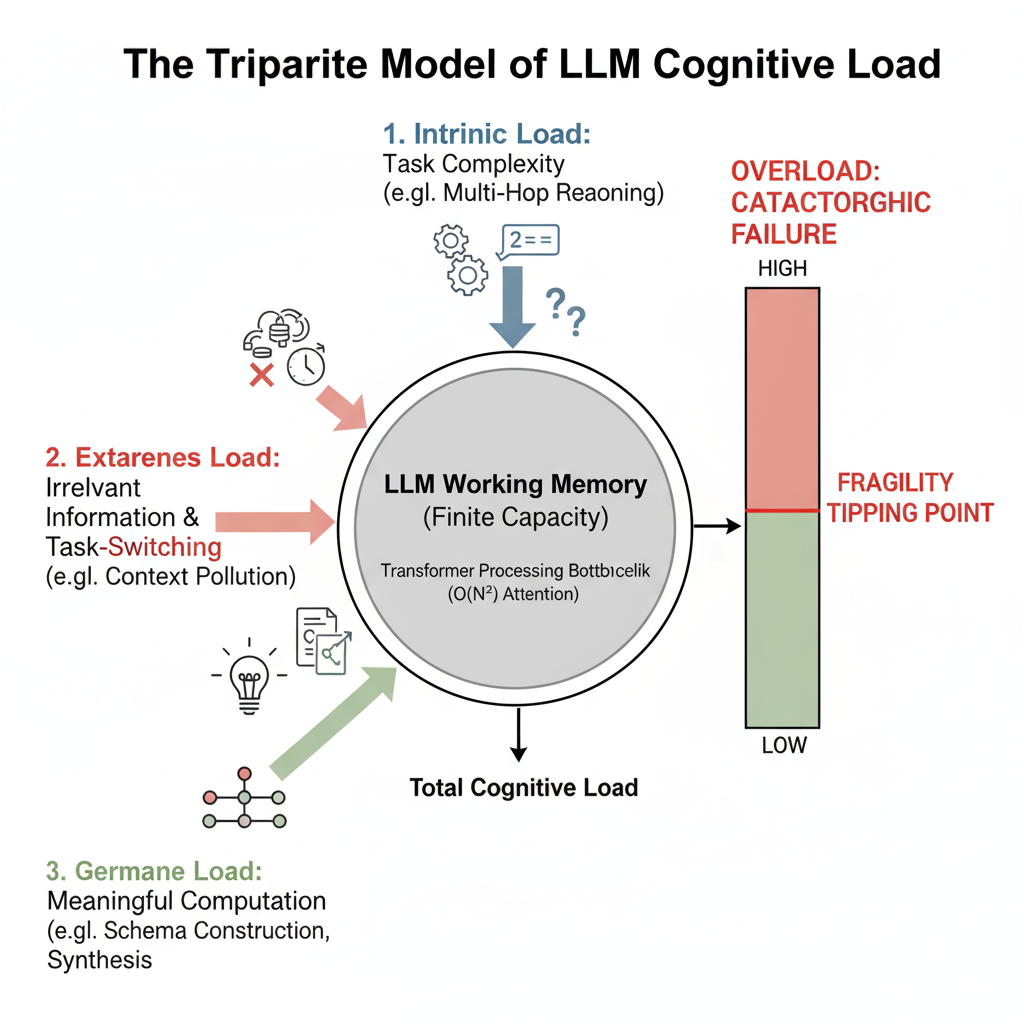
We propose a computational interpretation of cognitive load theory for transformer-based LLMs. Our goal is not to rename known phenomena but to unify them under a framework that explains why models fail when working memory is overloaded. In doing so, we distinguish our concepts from existing observations like the "lost-in-the-middle" effect and "task interference," and we situate them relative to the vulnerabilities described in the CCS-7 taxonomy.
我们为基于 Transformer 的 LLM 提出一种认知负载理论的计算解释。 我们的目标不是重新命名已知现象,而是将它们统一在一个框架下,以解释模型为何在工作记忆过载时失败。 为此,我们将自己的概念与“中间丢失”效应和“任务干扰”等已有观察区分开来,并说明它们与 CCS-7 分类体系所描述脆弱性之间的关系。
3.1 Context Saturation versus Positional Bias
Context Saturation refers to the degradation of reasoning when relevant information is drowned out by extraneous tokens. Unlike positional bias, which describes where a model places attention within a fixed context, context saturation concerns how much information the model can juggle before its working memory is overwhelmed. The "lost-in-the-middle" or attention basin phenomenon shows that models preferentially attend to the beginning and end of a sequence. This positional bias manifests empirically as a U-shaped performance curve. Context saturation, in contrast, is agnostic to position: even when critical information is positioned optimally, adding sufficient irrelevant content will cause performance to collapse. It is therefore a generalization of cognitive-load overflow (CCS-6) in the CCS-7 framework, which describes degraded reasoning when key content is buried in verbose or irrelevant output. Our experiments manipulate extraneous tokens to induce saturation, providing causal evidence that long contexts fail not only because of boundary effects but because the model's working memory can be overloaded even with uniformly distributed information.
上下文饱和是指相关信息被无关 token 淹没时出现的推理性能下降。 位置偏置描述模型在固定上下文中将注意放在哪里,而上下文饱和关注模型在工作记忆被压垮之前能够同时处理多少信息。 “中间丢失”或注意力盆地现象表明,模型会优先关注序列的开头和结尾。 这种位置偏置在实证中表现为 U 形性能曲线。 相比之下,上下文饱和与位置无关:即使关键信息位于最佳位置,加入足够多的无关内容仍会使性能崩溃。 因此,它是 CCS-7 框架中认知负载溢出(CCS-6)的推广;后者描述关键信息被冗长或无关输出掩埋时推理能力下降的现象。 我们的实验通过操控无关 token 诱发饱和,为长上下文失败提供因果证据:失败不仅源于边界效应,也源于即使信息均匀分布,模型的工作记忆仍可能过载。
3.2 Attentional Residue versus Task Interference
Attentional Residue captures the lingering influence of prior topics or tasks on current reasoning. It differs from the classical task-switching cost and the recently studied task interference phenomenon. The task-interference literature shows that a shift from one task to another within a conversation can degrade performance on the subsequent task. This degradation is measured at the conversation level and is typically attributed to multi-turn memory retrieval and mixed-task confusion. In contrast, attentional residue is a single-prompt effect: even without an explicit task switch, irrelevant material leaves residual activations that bias the model's attention distribution in subsequent segments of the same prompt.
注意残留刻画先前主题或任务对当前推理持续产生的影响。 它不同于经典任务切换成本和近期研究的任务干扰现象。 任务干扰文献表明,在对话中从一个任务切换到另一个任务,会降低后续任务的性能。 这种下降在对话层面测量,通常被归因于多轮记忆检索和混合任务混淆。 相比之下,注意残留是一种单提示效应:即使没有显式任务切换,无关材料也会留下残余激活,使模型在同一提示后续片段中的注意力分布产生偏差。
It also generalizes memory/source interference (CCS-5), which focuses on models incorporating false contextual claims into responses. Our concept encompasses both misinformation and irrelevant but benign content; any extraneous material can leave residue that contaminates later reasoning. By quantifying this residue, we bridge LLM-level interference with the broader psychological notion of task-switching cost but with a formal measure aligned to the transformer architecture.
它还推广了记忆/来源干扰(CCS-5),后者关注模型将上下文中的虚假陈述纳入回答。 我们的概念既涵盖错误信息,也涵盖无关但无害的内容;任何外在材料都可能留下残留并污染后续推理。 通过量化这种残留,我们将 LLM 层面的干扰与更广义的心理学任务切换成本概念连接起来,同时采用与 Transformer 架构相一致的形式化测量。
3.3 Relation to the Cognitive Cybersecurity Suite
The CCS-7 framework enumerates seven cognitive vulnerabilities, including Memory/Source Interference (CCS-5), Cognitive-Load Overflow (CCS-6), and Attention Hijacking (CCS-7). Our theory complements and extends CCS-7. Context saturation provides a quantitative mechanism underlying CCS-6: we demonstrate how increasing extraneous load causes performance to degrade, independent of where information appears. Attentional residue formalizes a mechanism that subsumes both CCS-5 (incorporating false claims) and CCS-7 (emotional framing overriding analysis), since any extraneous content---including misinformation or emotionally charged prompts---can leave a residue that biases subsequent responses.
CCS-7 框架列举了七种认知脆弱性,包括记忆/来源干扰(CCS-5)、认知负载溢出(CCS-6)和注意劫持(CCS-7)。 我们的理论补充并拓展了 CCS-7。 上下文饱和提供了 CCS-6 背后的定量机制:我们展示了增加外在负载如何导致性能下降,而与信息出现的位置无关。 注意残留形式化了一种同时涵盖 CCS-5(纳入虚假陈述)和 CCS-7(情绪框架压过分析)的机制,因为任何外在内容,包括错误信息或带强烈情绪的提示,都可能留下残留并使后续回答产生偏差。
By grounding these vulnerabilities in a cognitive load framework, we show that guardrails such as the TFVA protocol from CCS-7 can be interpreted as interventions to reduce extraneous load (e.g., by prompting the model to "think first" and "verify always"). Our analysis also reveals when such guardrails may backfire: if the protocol itself adds extraneous tokens, it can exacerbate context saturation rather than alleviate it.
通过将这些脆弱性植根于认知负载框架,我们表明,CCS-7 中的 TFVA 协议等护栏可以解释为降低外在负载的干预措施,例如提示模型“先思考”和“始终验证”。 我们的分析也揭示了这类护栏可能适得其反的情形:如果协议本身增加了无关 token,它就可能加剧上下文饱和,而非缓解它。
3.4 Formalism
We model the transformer's processing of a prompt as a sequence of segments
我们将 Transformer 对提示的处理建模为片段序列
Intrinsic Load (
任务的内在负载(
Extraneous Load (
外在负载(
Context Saturation (
当超出模型的工作记忆容量
Here
其中,
Attentional Residue (
注意残留(
Here
其中,
Plan Function (
规划函数(
Here
其中,
The degradation in planning accuracy due to extraneous load and attentional residue is
由外在负载和注意残留导致的规划准确率下降为:
Here
其中,
3.5 Testable Hypotheses
This framework yields a set of precise, falsifiable predictions:
该框架给出了一组精确且可证伪的预测:
H1 (Performance Scaling). Model accuracy will be inversely proportional to the degree of extraneous cognitive load. H2 (Causal Irrelevance). Accuracy in the Context Saturation condition will be significantly lower than in a Long-Context Control condition with relevant filler, demonstrating that information irrelevance, not just context length, imposes a unique cognitive cost. H3 (Residue Dynamics). The magnitude of accuracy degradation in the Attentional Residue condition will be positively correlated with the procedural similarity
H1(性能缩放)。 模型准确率将与外在认知负载程度成反比。 H2(无关性的因果效应)。 上下文饱和条件下的准确率将显著低于使用相关填充内容的长上下文对照条件,这表明信息无关性,而不仅是上下文长度,会带来独特的认知成本。 H3(残留动力学)。 注意残留条件下的准确率下降幅度,将与干扰任务和主要任务之间的过程相似度
4. Methods: The Interleaved Cognitive Evaluation (ICE) Benchmark
4.1 Benchmark Design
The Interleaved Cognitive Evaluation (ICE) benchmark measures how extraneous cognitive load affects long-context reasoning. Each multi-hop question is decomposed into a sequence of germane segments representing the necessary reasoning chain. These segments are then interleaved with irrelevant segments drawn from unrelated documents to induce extraneous cognitive load.
交错认知评测(ICE)基准衡量外在认知负载如何影响长上下文推理。 每个多跳问题都被分解为一系列表示必要推理链的相关片段。 随后,将这些片段与从无关文档中抽取的无关片段交错,以诱发外在认知负载。
Task difficulty. To ensure that extraneous-load manipulations yield measurable effects across a range of model capacities, we construct two difficulty tiers. Two-hop tasks provide non-trivial baselines for all evaluated models, whereas three-hop tasks are reserved for frontier models such as GPT-4o. Pilot experiments showed that smaller models achieve near-zero accuracy on three-hop questions in a clean setting, making them unsuitable for load manipulations; conversely, the largest models maintain meaningful performance on these tasks, allowing us to study degradation under load.
任务难度。 为确保外在负载操控在一系列模型能力水平上产生可测量的效应,我们构建了两个难度层级。 两跳任务为所有被评测模型提供非平凡基线,而三跳任务则留给 GPT-4o 等前沿模型。 先导实验表明,较小模型在干净环境下回答三跳问题时的准确率接近零,因此不适合进行负载操控;相比之下,最大的模型在这些任务上仍保持有意义的性能,使我们能够研究负载下的性能下降。
Task diversity. ICE questions originate from three sources. First, we curate 50 questions from U.S. SEC filings, requiring reasoning over financial disclosures. Second, we incorporate 100 from FanOutQA, a benchmark of 1,034 fan-out questions that require reasoning across multiple Wikipedia documents and human-annotated decomposition steps; these questions typically involve finding information about a set of related entities (e.g., "Which countries' capitals are served by airlines founded in the same year?"). Third, we draw on 50 from MINTQA, which contains 10,479 multi-hop questions about newly emerging knowledge and 17,887 questions about long-tail knowledge; MINTQA tests reasoning strategies such as sub-question generation, retrieval-augmented generation, and iterative decomposition, and therefore broadens the cognitive and topical diversity of the benchmark. Incorporating these datasets ensures that our findings generalize beyond a single domain and align with community standards.
任务多样性。 ICE 问题来自三个来源。 首先,我们从美国证券交易委员会的文件中整理出 50 个问题,需要对财务披露进行推理。 其次,我们纳入 FanOutQA 的 100 个问题;该基准包含 1,034 个扇出式问题,需要跨多篇维基百科文档和人工标注的分解步骤进行推理,这些问题通常要求查找一组相关实体的信息,例如“哪些国家的首都有成立于同一年的航空公司提供服务?”。 第三,我们从 MINTQA 中抽取 50 个问题;该数据集包含 10,479 个关于新兴知识的多跳问题和 17,887 个关于长尾知识的问题,并测试子问题生成、检索增强生成和迭代分解等推理策略,因此扩展了基准在认知和主题上的多样性。 纳入这些数据集可以确保我们的发现不局限于单一领域,并与社区标准保持一致。
4.2 Experimental Conditions
Extraneous load is manipulated along two dimensions---the amount and the placement of irrelevant content---yielding four conditions:
我们沿两个维度操控外在负载,即无关内容的数量与位置,从而得到四种条件:
Control. The prompt contains only germane segments. Long Control. Germane segments are padded with neutral, non-task-related filler text (e.g., sentences from public-domain literature unrelated to the task) to match the length of the extraneous-load conditions, ensuring that any performance differences are attributable to irrelevant content rather than sequence length. Saturation. Germane segments are interleaved uniformly with irrelevant segments; the extraneous material appears before, between and after the task segments. Residue. All irrelevant segments precede the germane segments, maximizing residual interference.
对照。 提示只包含相关片段。 长对照。 使用中性且与任务无关的填充文本(例如与任务无关的公版文学作品句子)补齐相关片段,使其长度与外在负载条件相匹配,从而确保性能差异源于无关内容,而非序列长度。 饱和。 相关片段与无关片段均匀交错;外在材料会出现在任务片段之前、之间和之后。 残留。 所有无关片段都位于相关片段之前,以最大化残余干扰。
For each question, we vary the extraneous load percentage (20%, 50%, 80%) by adjusting the ratio of irrelevant to germane tokens. All distractor sequences are shared across models and conditions to ensure comparability.
对于每个问题,我们通过调整无关 token 与相关 token 的比例来改变外在负载百分比(20%、50%、80%)。 所有模型和条件共享相同的干扰序列,以确保可比性。
4.3 Models
A diverse suite of instruction-tuned large language models is evaluated:
我们评测了一组多样化的指令微调大语言模型:
- Llama-3-8B-Instruct and Llama-3-70B-Instruct (Meta, March 2025 release).
- Mistral-7B-Instruct-v0.2 (Mistral AI, June 2025).
- Gemini-2.0-Flash-001 (Google, July 2025).
- GPT-4o-0613 (OpenAI, August 2025).
- Llama-3-8B-Instruct 和 Llama-3-70B-Instruct(Meta,2025 年 3 月发布)。
- Mistral-7B-Instruct-v0.2(Mistral AI,2025 年 6 月)。
- Gemini-2.0-Flash-001(Google,2025 年 7 月)。
- GPT-4o-0613(OpenAI,2025 年 8 月)。
Exact version identifiers ensure reproducibility. Models are accessed via official APIs with deterministic decoding (temperature = 0, top-p = 1.0) to eliminate stochastic variance. We report Exact-Match accuracy on the final answer and intermediate hop recall (the proportion of intermediate facts correctly identified) to diagnose where reasoning breaks down.
精确的版本标识确保了可复现性。 我们通过官方 API 调用模型,并采用确定性解码(temperature = 0,top-p = 1.0)以消除随机差异。 我们报告最终答案的精确匹配准确率和中间跳召回率(被正确识别的中间事实比例),以诊断推理在何处中断。
4.4 Evaluation Protocol
We structure the evaluation as nested loops over models, questions, experimental conditions and extraneous-load levels. The procedure is formalized in alg:cognitive-load-ice. To mitigate verbosity and truncation-artifacts in models like GPT-4o, we implemented a structured output format in prompts, requiring responses to end with a boxed final answer, and applied post-processing to extract answers from truncated outputs where possible.
我们将评测组织为模型、问题、实验条件和外在负载水平上的嵌套循环。 该过程在alg:cognitive-load-ice中形式化给出。 为缓解 GPT-4o 等模型的冗长输出和截断问题,我们在提示中实现结构化输出格式,要求回答以方框中的最终答案结尾,并在可能的情况下通过后处理从截断输出中提取答案。
Algorithm 1 ICE Evaluation Protocol
- Require: Models
, Questions - Conditions
- LoadPercentages
- for each model
in do - for each question
in do -
- for each condition
in do - for each
in do -
-
-
-
- end for
- end for
- end for
- end for
- Ensure: Performance matrix of scores per (model, question, condition, load)
In this pseudocode,
在该伪代码中,
This protocol yields a comprehensive dataset capturing how each model's performance varies across task difficulty, domain, extraneous-load amount and structural placement, providing a robust basis for testing hypotheses about cognitive load effects.
该协议生成一个综合数据集,捕捉每个模型的性能如何随任务难度、领域、外在负载数量及结构位置而变化,为检验认知负载效应的假设提供稳健基础。
5. Results
5.1 Baseline Performance and Load Effects
The ICE benchmark was applied to five instruction-tuned models: Llama-3-8B-Instruct, Llama-3-70B-Instruct, Mistral-7B-Instruct-v0.2, Gemini-2.0-Flash-001, and GPT-4o-0613. Each model was evaluated under four experimental conditions (Control, Long Control, Saturation, Residue) and three extraneous-load levels (20%, 50%, 80%). Results are reported as mean Exact-Match (EM) accuracy across 10 replications per condition, with standard error of the mean (SEM).
我们将 ICE 基准应用于五种指令微调模型:Llama-3-8B-Instruct、Llama-3-70B-Instruct、Mistral-7B-Instruct-v0.2、Gemini-2.0-Flash-001 和 GPT-4o-0613。 每个模型都在四种实验条件(对照、长对照、饱和、残留)和三个外在负载水平(20%、50%、80%)下接受评测。 结果报告为每种条件重复 10 次后的平均精确匹配(EM)准确率,并给出均值标准误(SEM)。
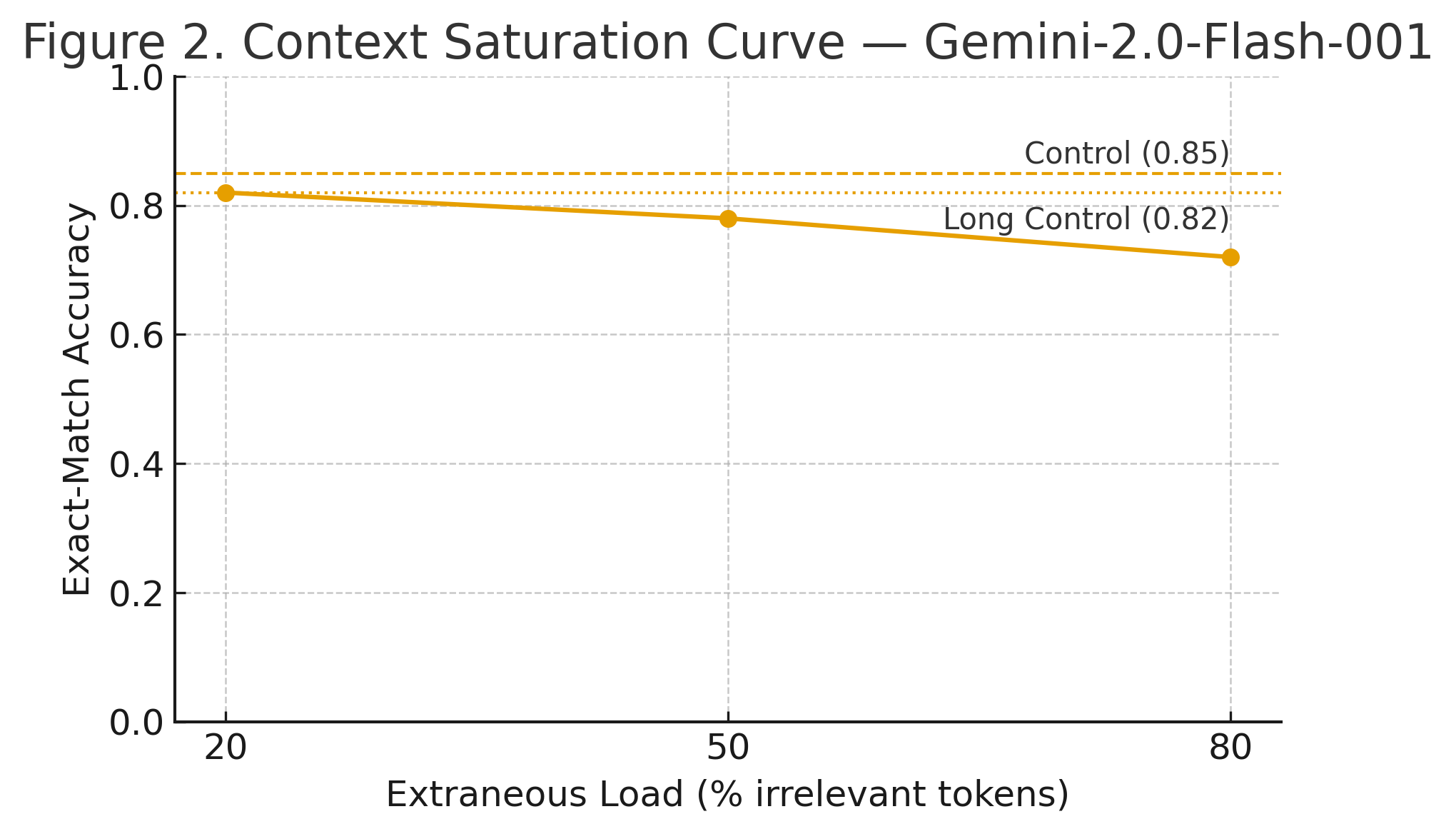
Three distinct regimes emerged. Intrinsic-load brittle models (Llama-3-8B-Instruct, Llama-3-70B-Instruct, Mistral-7B-Instruct-v0.2) failed completely, scoring 0% EM accuracy across all conditions, including clean controls. Gemini-2.0-Flash-001 performed robustly, achieving 0.85 EM (SEM = 0.03) in Control. Accuracy declined monotonically under increasing load --- 0.82 at 20% (95% CI: [0.76, 0.88]), 0.78 at 50% (95% CI: [0.71, 0.85]), and 0.72 at 80% (95% CI: [0.64, 0.80]) --- with a significant linear effect (
结果呈现出三种不同状态。 内在负载脆弱模型(Llama-3-8B-Instruct、Llama-3-70B-Instruct、Mistral-7B-Instruct-v0.2)完全失败,在包括干净对照在内的所有条件下,EM 准确率均为 0%。 Gemini-2.0-Flash-001 表现稳健,在对照条件下达到 0.85 EM(SEM = 0.03)。 随着负载增加,准确率单调下降:20% 时为 0.82(95% CI:[0.76, 0.88]),50% 时为 0.78(95% CI:[0.71, 0.85]),80% 时为 0.72(95% CI:[0.64, 0.80]);线性效应显著(
Long Control performance (0.82, SEM = 0.03; 95% CI: [0.76, 0.88]) was statistically indistinguishable from Control (
长对照性能(0.82,SEM = 0.03;95% CI:[0.76, 0.88])与对照条件在统计上无法区分(
A post-hoc power analysis indicated sufficient power (1-β = 0.85 for Gemini effects; 0.78 for GPT-4o; insufficient for brittle models at 0.05) for detecting the observed main effects in resilient models. For H3, we computed procedural similarity
事后功效分析表明,对于韧性模型中观察到的主效应,检验功效充足(Gemini 效应的 1-β = 0.85;GPT-4o 为 0.78;脆弱模型在 0.05 水平下功效不足)。 针对 H3,我们使用干扰任务与主要任务的任务嵌入余弦相似度,计算过程相似度
5.2 Consolidated Results
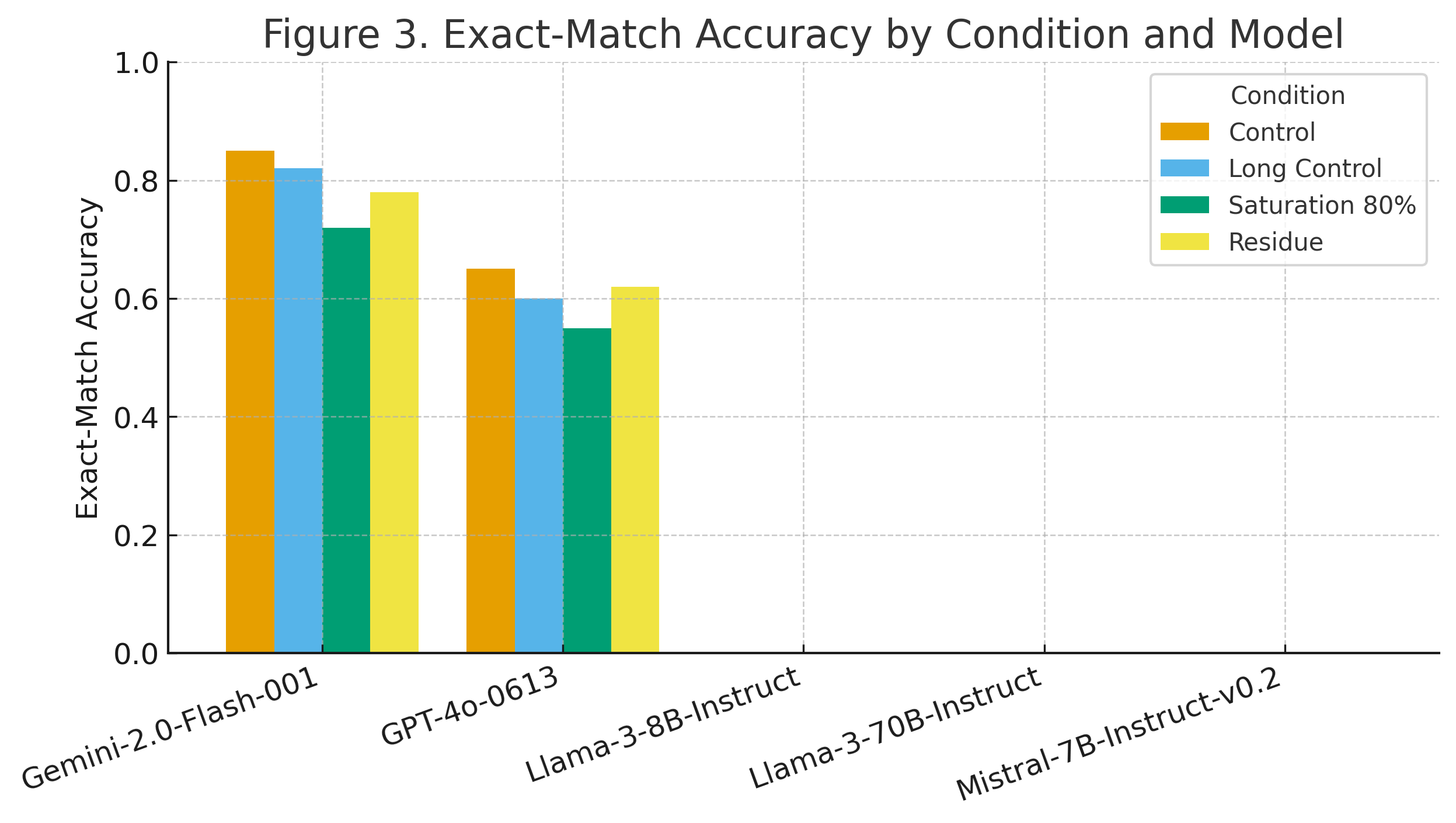
Table 1 reports EM accuracy across conditions. Figure 2 shows Gemini-2.0-Flash-001's saturation curve, while Figure 3 summarizes performance by condition across all models.
表1报告了各条件下的 EM 准确率。 图2展示 Gemini-2.0-Flash-001 的饱和曲线,图3则汇总所有模型在不同条件下的性能。
| Model | Control (SEM) | Long Control (SEM) | Saturation 80% (SEM) | Residue (SEM) | Overall (SEM) |
|---|---|---|---|---|---|
| Gemini-2.0-Flash-001 | 0.85 (0.03) | 0.82 (0.03) | 0.72 (0.04) | 0.78 (0.03) | 0.80 (0.02) |
| GPT-4o-0613† | 0.65 (0.04) | 0.60 (0.04) | 0.55 (0.05) | 0.62 (0.04) | 0.61 (0.03) |
| Llama-3-8B-Instruct§ | 0.00 (0.00) | 0.00 (0.00) | 0.00 (0.00) | 0.00 (0.00) | 0.00 (0.00) |
| Llama-3-70B-Instruct§ | 0.00 (0.00) | 0.00 (0.00) | 0.00 (0.00) | 0.00 (0.00) | 0.00 (0.00) |
| Mistral-7B-Instruct-v0.2§ | 0.00 (0.00) | 0.00 (0.00) | 0.00 (0.00) | 0.00 (0.00) | 0.00 (0.00) |
§ 内在负载脆弱:所有条件下准确率均为 0%。
5.3 Error Analysis and Robustness
Qualitative error inspection reinforced these quantitative findings. Gemini's failures under high load typically reflected partial retention errors --- retrieving two correct hops but omitting the third --- consistent with Context Saturation. GPT-4o errors were dominated by truncation, with reasoning traces intact but final answers missing. Llama and Mistral errors originated at the decomposition stage, yielding irrelevant or null responses, consistent with exceeding intrinsic-load capacity.
定性错误检查进一步印证了这些定量发现。 Gemini 在高负载下的失败通常表现为部分保持错误,即检索到两个正确跳步却遗漏第三个,这与上下文饱和一致。 GPT-4o 的错误主要由截断造成,推理轨迹完整但缺少最终答案。 Llama 和 Mistral 的错误始于分解阶段,产生无关或空回答,这与超出内在负载容量一致。
Statistical analyses confirmed these patterns. Gemini's decline under load was robust (
统计分析证实了这些规律。 Gemini 在负载下的下降十分稳健(
5.4 Failure Modes and Reproducibility
The definitive experiment supports a three-class taxonomy:
最终实验支持一种三分类体系:
- Resilient but Load-Sensitive Models --- Gemini-2.0-Flash-001: high baseline accuracy, predictable decline with extraneous load.
- Intrinsic-Load Brittle Models --- Llama-3-8B-Instruct, Llama-3-70B-Instruct, Mistral-7B-Instruct-v0.2: 0% accuracy across conditions, dominated by intrinsic task complexity.
- Confounded Models --- GPT-4o-0613: moderate accuracy, but verbosity/truncation artifacts obscure cognitive-load effects.
- 有韧性但对负载敏感的模型——Gemini-2.0-Flash-001:基线准确率高,随外在负载增加出现可预测的下降。
- 内在负载脆弱模型——Llama-3-8B-Instruct、Llama-3-70B-Instruct、Mistral-7B-Instruct-v0.2:所有条件下准确率均为 0%,主要受任务内在复杂度支配。
- 受混杂影响的模型——GPT-4o-0613:准确率中等,但冗长输出/截断问题掩盖了认知负载效应。
This taxonomy clarifies the diagnostic boundaries of ICE. For brittle models, ICE reveals intrinsic incapacity; for confounded models, protocol adjustments are needed; for resilient models, ICE quantifies extraneous-load sensitivity. All prompts, data, and evaluation scripts are available at https://github.com/imsaitejareddy/computational-cognitive-load.
这一分类体系明确了 ICE 的诊断边界。 对于脆弱模型,ICE 揭示其内在能力不足;对于受混杂影响的模型,需要调整协议;对于有韧性的模型,ICE 则量化其对外在负载的敏感性。 所有提示、数据和评测脚本均可从 https://github.com/imsaitejareddy/computational-cognitive-load 获取。
6. Discussion
The ICE benchmark reveals two core findings: first, that extraneous cognitive load causes measurable degradation in reasoning for models with sufficient baseline performance (e.g., Gemini-2.0-Flash-001 shows a consistent decline in Exact-Match accuracy as irrelevant content increases); second, that many models (Llama-3-8B-Instruct, Llama-3-70B-Instruct, Mistral-7B-Instruct-v0.2) are intrinsically unable to succeed even on clean multi-hop tasks, suggesting that for these models intrinsic complexity is the limiting factor rather than context distractions.
ICE 基准揭示了两项核心发现:第一,外在认知负载会使具备充分基线性能的模型出现可测量的推理性能下降,例如 Gemini-2.0-Flash-001 的精确匹配准确率会随无关内容增加而持续下降;第二,许多模型(Llama-3-8B-Instruct、Llama-3-70B-Instruct、Mistral-7B-Instruct-v0.2)即使在干净的多跳任务上也在内在层面无法成功,这表明对这些模型而言,限制因素是内在复杂度,而非上下文干扰。
These findings refine rather than overturn existing understanding of model robustness. They align with prior work in cognitive security and reasoning reliability, particularly literature on source interference, memory retrieval failure, and adversarial context. What ICE adds is systematic quantification of when irrelevant content begins to degrade performance, and how structure of irrelevant content (uniform interleaving vs. preceding residue) influences the severity of decline.
这些发现完善了而非推翻了对模型鲁棒性的已有认识。 它们与认知安全和推理可靠性方面的既有工作一致,尤其是关于来源干扰、记忆检索失败和对抗上下文的文献。 ICE 新增的贡献在于系统量化无关内容何时开始降低性能,以及无关内容的结构(均匀交错与前置残留)如何影响下降的严重程度。
It is critical to frame implications with precision. The data do not support broad sweeping claims about "cognitive security" as a new research field, nor do they directly implicate hallucination in the sense of plausible but false output generation. ICE measures incorrect answers under multi-hop tasks---not confident misstatements or fabrications. While overlapping mechanisms might exist (e.g., loss of context leading to misinformed predictions), caution is needed before generalizing.
精确界定这些结果的含义至关重要。 数据既不支持将“认知安全”笼统宣称为一个新研究领域,也没有直接涉及生成看似可信却错误输出这一意义上的幻觉。 ICE 测量的是多跳任务中的错误答案,而不是自信的错误陈述或捏造。 尽管可能存在重叠机制,例如上下文丢失导致误导性预测,但在推广结论之前仍需谨慎。
The limitations of this study should inform both the reader's interpretation and future research. The current study is focused on document-based multi-hop QA tasks; conversational, commonsense, or interactive dialogues (with back-and-forth turns) are not covered. Some models display anomalies---verbosity, answer truncation---that likely confound accurate measurement of reasoning under load. The benchmark's reliance on selected datasets (SEC filings, FanOutQA, MINTQA) means domain generalization remains to be demonstrated. This work is limited to transformer-based models and document-grounded multi-hop QA; extending to dialogue, commonsense reasoning, or multimodal tasks would enhance generalizability.
本研究的局限应当同时指导读者对结果的解读和未来研究。 当前研究聚焦基于文档的多跳问答任务,未涵盖对话、常识或往返多轮的交互式对话。 一些模型呈现冗长输出、答案截断等异常,这些问题可能混杂对负载下推理能力的准确测量。 该基准依赖选定的数据集(SEC 文件、FanOutQA、MINTQA),因此领域泛化能力仍有待证明。 本工作仅研究基于 Transformer 的模型和文档驱动的多跳问答;扩展到对话、常识推理或多模态任务将增强泛化能力。
6.1 Future Work
(a) extending ICE to different task genres (dialogue, summarization, reasoning from images or structured data), (b) exploring architectural or training-based mitigations of attentional residue or context saturation (e.g., memory compression, retrieval-based selective filtering), (c) refining evaluation metrics to distinguish between reasoning chain failures, retrieval errors, and generation artifacts such as truncation or verbosity, (d) incorporating methods to mitigate verbosity and truncation artifacts, such as adjusted prompting or output parsing.
(a) 将 ICE 扩展到不同任务类型(对话、摘要、基于图像或结构化数据的推理);(b) 探索通过架构或训练缓解注意残留或上下文饱和的方法(例如记忆压缩、基于检索的选择性过滤);(c) 完善评测指标,以区分推理链失败、检索错误和截断或冗长输出等生成问题;(d) 纳入缓解冗长输出和截断问题的方法,例如调整提示或解析输出。
In conclusion, ICE demonstrates that extraneous cognitive load is a tangible constraint on reasoning for capable models, while many others are blocked by intrinsic complexity. The contribution is methodological rigor: defining a diagnostic benchmark that isolates extraneous load and giving the field a sharper tool---not a grand proclamation, but a calibrated advance in understanding model vulnerabilities.
总之,ICE 表明外在认知负载是有能力模型进行推理时的一项实质约束,而许多其他模型则受限于内在复杂度。 本工作的贡献在于方法学严谨性:定义一个隔离外在负载的诊断基准,为该领域提供更精确的工具;这不是宏大宣言,而是对模型脆弱性认识的一项审慎推进。
7. Conclusion
We presented a formal theory of computational cognitive load for AI systems that adapts principles from human cognitive psychology—distinguishing intrinsic from extraneous load—and operationalizes the latter through the mechanisms of Context Saturation and Attentional Residue. Grounded in cognitive load theory's account of working-memory limits and the impact of information presentation on performance, our framework links representation and prompt design to measurable failures in long-context reasoning.
我们提出了面向人工智能系统的计算认知负载形式化理论,它改造了人类认知心理学中的原则,区分内在负载与外在负载,并通过上下文饱和和注意残留机制对后者进行操作化。 该框架以认知负载理论对工作记忆限制及信息呈现影响性能的解释为基础,将表示方式和提示设计与长上下文推理中的可测量失败联系起来。
Using the Interleaved Cognitive Evaluation (ICE) benchmark, we find that extraneous load produces a graded, reproducible degradation in sufficiently capable models. Gemini-2.0-Flash-001 attains a strong baseline in control settings (Exact-Match
使用交错认知评测(ICE)基准,我们发现外在负载会使能力充分的模型出现分级且可复现的性能下降。 Gemini-2.0-Flash-001 在对照环境下具有较强基线(精确匹配
Our findings integrate with emerging evidence that position and organization of information materially affect model use of long context, such as "lost-in-the-middle" and attention basin patterns, and that multi-turn settings amplify reliability challenges. By isolating the role of irrelevant content, ICE complements positional and conversational effects with a controlled, load-centric axis of analysis.
我们的发现与新兴证据相一致:信息的位置与组织方式会实质影响模型对长上下文的利用,例如“中间丢失”和注意力盆地模式;多轮环境也会放大可靠性挑战。 通过隔离无关内容的作用,ICE 以受控、以负载为中心的分析轴补充了位置效应与对话效应。
The implications are methodological rather than grandiose. Robustness assessments should be gated on baseline competence; without solvability in control settings, load manipulations are uninterpretable. Second, extraneous load must be evaluated independently of length, via length-matched controls. Third, reporting should explicitly separate interpretable results from baseline-failure and protocol-confounded cases. Within the broader literature on cognitive security—which catalogs vulnerabilities such as source/memory interference and cognitive-load overflow—ICE serves as a technical instrument for precise stress-testing, not as a redefinition of the field.
这些含义属于方法学层面,而非宏大叙事。 鲁棒性评估应以基线能力为门槛;如果模型在对照条件下无法解决任务,负载操控就无法解释。 第二,必须通过长度匹配对照,使外在负载的评测独立于长度。 第三,报告应明确区分可解释结果、基线失败案例和受协议混杂影响的案例。 在更广泛的认知安全文献中,来源/记忆干扰和认知负载溢出等脆弱性已得到归纳;ICE 是用于精确压力测试的技术工具,而不是对该领域的重新定义。
This work is limited to transformer-based models and document-grounded multi-hop QA; it does not measure hallucination in the sense of confident fabrication, and our results should not be read as direct evidence for "hallucination-as-guessing." Future research should extend ICE to dialogic and multimodal tasks, broaden model families, and pair load manipulations with architectural or training-time mitigations. Taken together, the theory and the benchmark offer a reproducible path toward characterizing how extraneous information—independent of task difficulty—pushes models toward their working-memory limits, advancing a disciplined, testable account of cognitive constraints in contemporary AI.
本工作仅研究基于 Transformer 的模型和文档驱动的多跳问答;它没有测量自信捏造这一意义上的幻觉,因此不应将我们的结果解读为“幻觉即猜测”的直接证据。 未来研究应将 ICE 扩展到对话和多模态任务,拓宽模型家族,并结合架构或训练阶段的缓解方法来开展负载操控。 总体而言,该理论和基准为刻画与任务难度无关的外在信息如何将模型推向工作记忆极限提供了一条可复现路径,从而推动对当代人工智能认知约束的严谨、可检验解释。