
EverMemOS: A Self-Organizing Memory Operating System for Structured Long-Horizon Reasoning
MemoryAgent8700+20+EverMindShanda GroupEverMemOS:用于结构化长程推理的自组织记忆操作系统
Abstract
Large Language Models (LLMs) are increasingly deployed as long-term interactive agents, yet their limited context windows make it difficult to sustain coherent behavior over extended interactions. Existing memory systems for LLMs often store isolated records and retrieve fragments, limiting their ability to consolidate evolving experience and resolve conflicts. We introduce EverMemOS, a self-organizing memory operating system that implements an engram-inspired lifecycle for computational memory. First, Episodic Trace Formation converts dialogue streams into MemCells that capture episodic traces, atomic facts, and time-bounded foresight. Second, Semantic Consolidation organizes MemCells into thematic MemScenes, distilling stable semantic structures and updating user profiles. Finally, Reconstructive Recollection performs MemScene-guided agentic retrieval to compose the necessary and sufficient context for downstream reasoning. Experiments on LoCoMo, LongMemEval, and PersonaMem-v2 show that EverMemOS significantly outperforms state-of-the-art methods on memory-augmented reasoning tasks. Our code is available at https://github.com/EverMind-AI/EverMemOS.
大语言模型(LLM)正越来越多地被部署为长期交互式智能体,但其有限的上下文窗口使它们难以在长时间交互中保持连贯行为。 现有 LLM 记忆系统通常存储孤立记录并检索片段,这限制了它们整合演化经验和解决冲突的能力。 我们提出 EverMemOS,这是一个自组织记忆操作系统,为计算记忆实现了受 engram 启发的生命周期。 首先,Episodic Trace Formation 将对话流转换为 MemCells,以捕获情景痕迹、原子事实和有时间边界的前瞻。 其次,Semantic Consolidation 将 MemCells 组织为主题化的 MemScenes,提炼稳定的语义结构并更新用户画像。 最后,Reconstructive Recollection 执行由 MemScene 引导的智能体式检索,以组合下游推理所需且充分的上下文。 在 LoCoMo、LongMemEval 和 PersonaMem-v2 上的实验表明,EverMemOS 在记忆增强推理任务上显著优于最先进方法。 我们的代码位于 https://github.com/EverMind-AI/EverMemOS。
1. Introduction
Large Language Models (LLMs) are increasingly deployed as long-term interactive agents rather than transient conversational tools. For providing better personalized services, LLM-based agents must maintain consistent personas and user models over extended interactions while continuously incorporating new constraints over extended timeframes, spanning days, months, or even years. To address this challenge, expanding context windows is a direct approach, but ultra-long contexts still degrade in performance (e.g., the "Lost-in-the-Middle" phenomenon) and incur prohibitive computational costs. Consequently, recent research has increasingly focused on constructing memory for LLMs that can both store past information and organize experiences into coherent, evolving structures that support long-horizon reasoning.
大语言模型(LLM)正越来越多地被部署为长期交互式智能体,而不是短暂的对话工具。 为了提供更好的个性化服务,基于 LLM 的智能体必须在长期交互中维持一致的人设和用户模型,同时在跨越数天、数月甚至数年的长时间范围内持续纳入新的约束。 为解决这一挑战,扩展上下文窗口是一种直接方法,但超长上下文仍会出现性能退化(例如“Lost-in-the-Middle”现象),并带来难以承受的计算成本。 因此,近期研究越来越关注为 LLM 构建记忆,使其既能存储过去信息,又能把经验组织成连贯、演化的结构,以支持长程推理。
Recently, a broad range of memory-augmented approaches have been proposed, including retrieval-based memory, trainable memory, and more recently Memory Operating Systems that unify storage, retrieval, filtering, and updating. However, enabling long-term consistency in reasoning remains challenging. While these methods improve scalability and modularity, most of them treat memory as flat collections of isolated records. As a result, many failures stem not from missing information but from poor integration, where fragmented experiences are not consolidated into higher-level semantic structures. Without consolidation and abstraction, agents may retrieve relevant facts yet fail to detect conflicts, maintain stable user models, or reason consistently over time. Therefore, a key limitation of existing memory methods is the absence of an explicit mechanism to transform fragmented episodic experiences into coherent and stable knowledge structures that support long-horizon reasoning.
最近,研究提出了大量记忆增强方法,包括基于检索的记忆、可训练记忆,以及更近期的把存储、检索、过滤和更新统一起来的 Memory Operating Systems。 然而,在推理中实现长期一致性仍然具有挑战性。 尽管这些方法提升了可扩展性和模块化程度,但其中大多数仍把记忆视为孤立记录的扁平集合。 因此,许多失败并非源于信息缺失,而是源于整合不足,即碎片化经验没有被巩固成更高层级的语义结构。 如果缺乏巩固和抽象,智能体可能检索到相关事实,却无法检测冲突、维持稳定的用户模型,或随时间进行一致推理。 因此,现有记忆方法的一个关键局限在于,它们缺乏显式机制来把碎片化情景经验转化为连贯且稳定的知识结构,以支持长程推理。
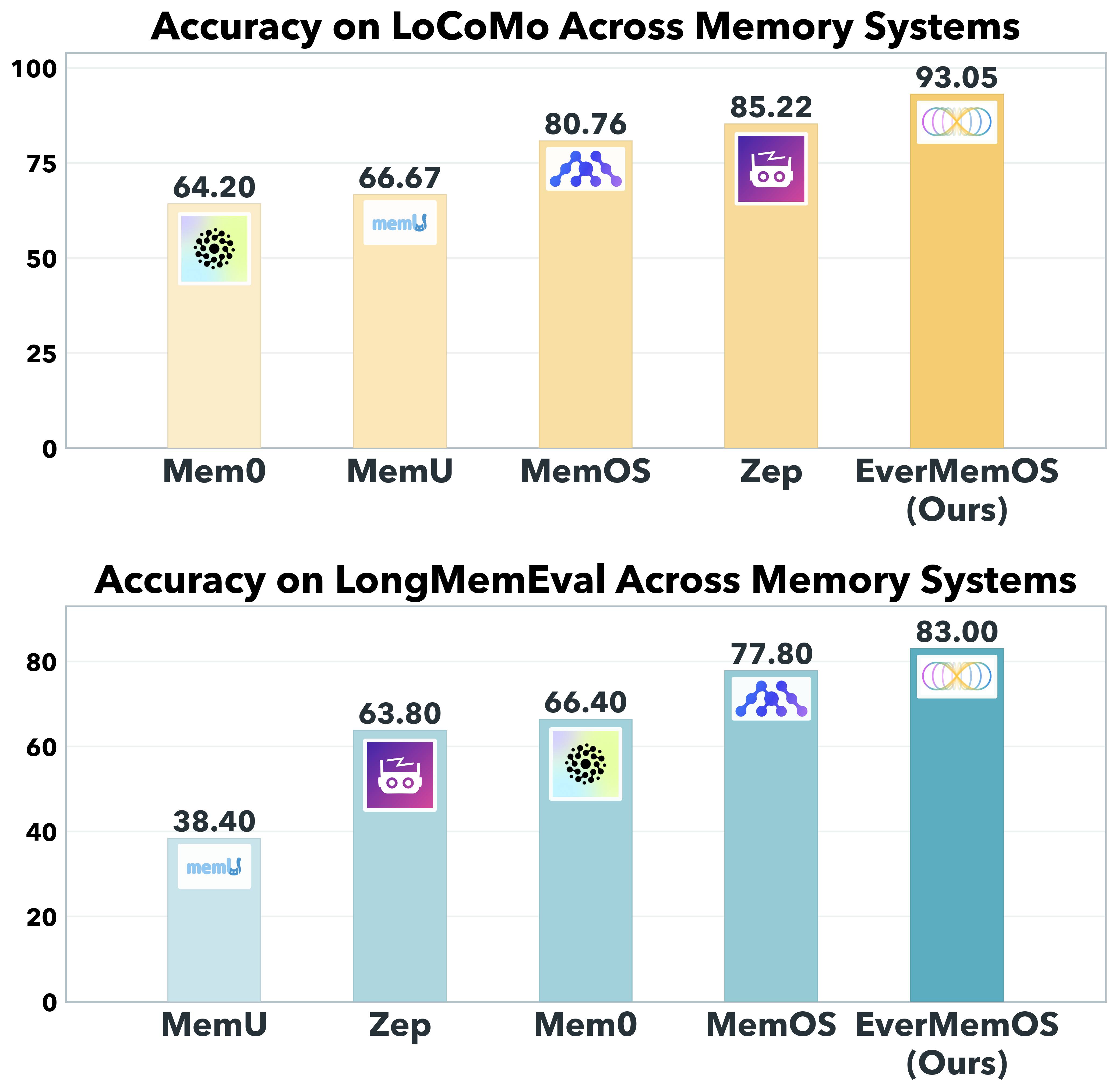
To address the above limitation, we propose EverMemOS, a unified and product-ready Memory Operating System that models memory as a dynamic lifecycle for long-term LLM-based agents. As shown in Figure 1, EverMemOS significantly outperforms the state-of-the-art memory methods for LLMs in experimental evaluation, relatively improving overall accuracy by 9.2% on LoCoMo and 6.7% on LongMemEval compared to the strongest baseline method. EverMemOS aims to transform fragmented episodic experiences into coherent and stable knowledge structures that support long-horizon reasoning through three phases. First, Episodic Trace Formation transforms the unbounded stream of interaction history into discrete, stable memory traces (termed MemCells). Second, Semantic Consolidation transforms MemCells into stable, scene-level structures (termed MemScenes) that support coherent aggregation, such as maintaining consistent user profiles across interactions. Finally, Reconstructive Recollection, guided by the principle of necessity and sufficiency, actively composes only the grounded context required for a given query and supports long-horizon reasoning, rather than indiscriminately retrieving all potentially relevant records.
为解决上述局限,我们提出 EverMemOS,这是一个统一且可产品化的记忆操作系统,将记忆建模为面向长期 LLM 智能体的动态生命周期。 如图1所示,在实验评估中,EverMemOS 显著优于最先进的 LLM 记忆方法;相比最强基线,它在 LoCoMo 上的 overall accuracy 相对提升 9.2%,在 LongMemEval 上相对提升 6.7%。 EverMemOS 旨在通过三个阶段,把碎片化情景经验转化为支持长程推理的连贯、稳定知识结构。 首先,Episodic Trace Formation 把无界的交互历史流转化为离散、稳定的记忆痕迹(称为 MemCells)。 其次,Semantic Consolidation 把 MemCells 转化为稳定的场景级结构(称为 MemScenes),以支持连贯聚合,例如在交互之间维持一致的用户画像。 最后,Reconstructive Recollection 在必要性与充分性原则引导下,主动组合给定查询所需的有根据上下文并支持长程推理,而不是不加区分地检索所有可能相关的记录。
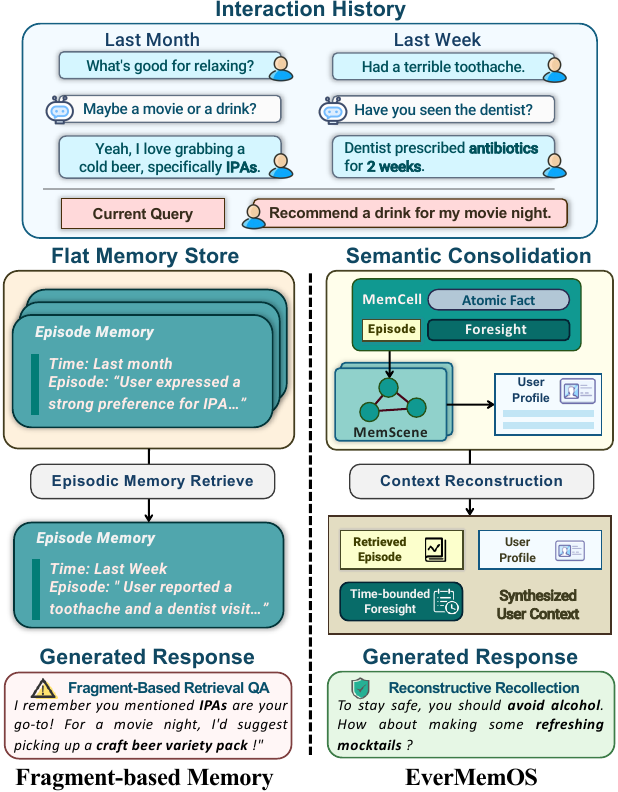
EverMemOS does not aim to simulate biological memory at the neural level. Instead, it draws on organizing principles from biological memory systems and translates them into a computational framework. Figure 2 illustrates the intuition behind EverMemOS. A fragment-based system may recall a user's preference for IPA and recommend an alcoholic drink, failing to account for a newly introduced constraint that the user is taking antibiotics. In contrast, EverMemOS consolidates these experiences into a coherent representation of the user's state, enabling the agent to safely recommend a non-alcoholic alternative. Although such foresight-oriented behaviors are not explicitly captured by existing benchmarks, they expose a fundamental limitation of fragment-based memory and motivate the system-level design of EverMemOS. Empirically, comprehensive experiments on three benchmarks for memory-augmented reasoning consistently indicate the superiority of EverMemOS, compared to the state-of-the-art methods.
EverMemOS 并不旨在从神经层面模拟生物记忆。 相反,它借鉴生物记忆系统中的组织原则,并将其转化为计算框架。 图2展示了 EverMemOS 背后的直觉。 基于片段的系统可能会回忆起用户偏好 IPA,并推荐含酒精饮料,却没有考虑用户正在服用抗生素这一新引入的约束。 相比之下,EverMemOS 会把这些经验巩固成对用户状态的连贯表示,使智能体能够安全地推荐非酒精替代品。 虽然这类面向前瞻的行为并未被现有基准显式捕获,但它们暴露了片段式记忆的根本局限,并激发了 EverMemOS 的系统级设计。 从经验上看,在三个记忆增强推理基准上的综合实验持续表明,EverMemOS 优于最先进方法。
Our contributions are summarized as follows:
- System Design: We introduce EverMemOS, a unified and product-ready Memory Operating System for LLMs that reconceptualizes memory as a lifecycle, shifting from passive storage of records to structured organization of experience.
- Innovative Method: We propose a three-phase method that can transform fragmented episodic experiences into coherent and stable knowledge structures that support long-horizon reasoning.
- Empirical Validation: Experimental results demonstrate that EverMemOS achieves state-of-the-art performance on multiple long-context benchmarks for memory-augmented reasoning, validating the effectiveness of lifecycle-based memory organization.
我们的贡献总结如下:
- 系统设计: 我们提出 EverMemOS,这是一个统一且可产品化的 LLM 记忆操作系统,它把记忆重新概念化为生命周期,从被动存储记录转向结构化组织经验。
- 创新方法: 我们提出一种三阶段方法,能够把碎片化情景经验转化为连贯且稳定的知识结构,以支持长程推理。
- 实证验证: 实验结果表明,EverMemOS 在多个用于记忆增强推理的长上下文基准上达到最先进性能,验证了基于生命周期的记忆组织的有效性。
2. Related Work
2.1 Memory Mechanisms in LLMs
Context Window Extension. Large language models (LLMs) are constrained by fixed-length context windows. Prior work extends context via sparse attention, recurrence, and length extrapolation. However, longer context does not guarantee effective utilization: the "Lost-in-the-Middle" phenomenon persists, suggesting context extension alone is insufficient for durable memory.
上下文窗口扩展。 大语言模型(LLM)受到固定长度上下文窗口的约束。 先前工作通过稀疏注意力、递归机制和长度外推来扩展上下文。 然而,更长的上下文并不保证有效利用:“Lost-in-the-Middle”现象仍然存在,这表明仅靠上下文扩展不足以形成持久记忆。
Retrieval-Augmented and Parametric Memory. Retrieval-augmented generation (RAG) externalizes memory to alleviate window limits, but its reliability depends on retrieval quality. Parametric approaches internalize information, yet often suffer from forgetting and instability. Hybrid approaches alleviate issues but lack a unified organizational principle for persistent memory.
检索增强与参数化记忆。 检索增强生成(RAG)把记忆外置以缓解窗口限制,但其可靠性取决于检索质量。 参数化方法把信息内化到模型中,却常常遭遇遗忘和不稳定。 混合方法缓解了部分问题,但缺乏用于持久记忆的统一组织原则。
2.2 Memory Systems
Early Computational Memory. Early differentiable memory systems (e.g., NTM/DNC/Key--Value memories) introduced external memory interaction, but scale poorly and are ill-suited to modern autoregressive LLMs.
早期计算记忆。 早期可微记忆系统(例如 NTM、DNC 和 Key--Value memories)引入了外部记忆交互,但扩展性较差,也不适合现代自回归 LLM。
Memory in LLM Agents. As LLM-based agents evolve, memory systems have shifted toward persistent state integration. Recent systems introduce episodic, semantic, and hierarchical task memory. However, many designs still rely on fragmented text units and limited consolidation, which can degrade long-horizon performance.
LLM 智能体中的记忆。 随着基于 LLM 的智能体不断演化,记忆系统已经转向持久状态整合。 近期系统引入了情景记忆、语义记忆和层级任务记忆。 然而,许多设计仍依赖碎片化文本单元和有限的巩固,这会削弱长程性能。
Memory Operating Systems. Recent work formalizes memory management as a system-level runtime. Some focus on lifecycle and capacity, such as Nemori's prediction-driven updates and MemoryOS's hierarchical control. Others, like Mem0 and Zep, prioritize structured fact maintenance via knowledge graphs, while MemOS targets unified scheduling across memory types. While these systems advance structural organization, they primarily focus on storage optimization or fact maintenance. EverMemOS distinguishes itself by implementing a three-phase memory lifecycle that transforms episodic traces into synthesized semantic structures for long-horizon reasoning.
记忆操作系统。 近期工作把记忆管理形式化为系统级运行时。 其中一些系统关注生命周期和容量,例如 Nemori 的预测驱动更新和 MemoryOS 的层级控制。 另一些系统,如 Mem0 和 Zep,优先通过知识图谱维护结构化事实,而 MemOS 旨在跨记忆类型进行统一调度。 虽然这些系统推进了结构化组织,但它们主要关注存储优化或事实维护。 EverMemOS 的区别在于,它实现了一个三阶段记忆生命周期,将情景痕迹转化为合成的语义结构以支持长程推理。
3. EverMemOS
3.1 Framework Overview
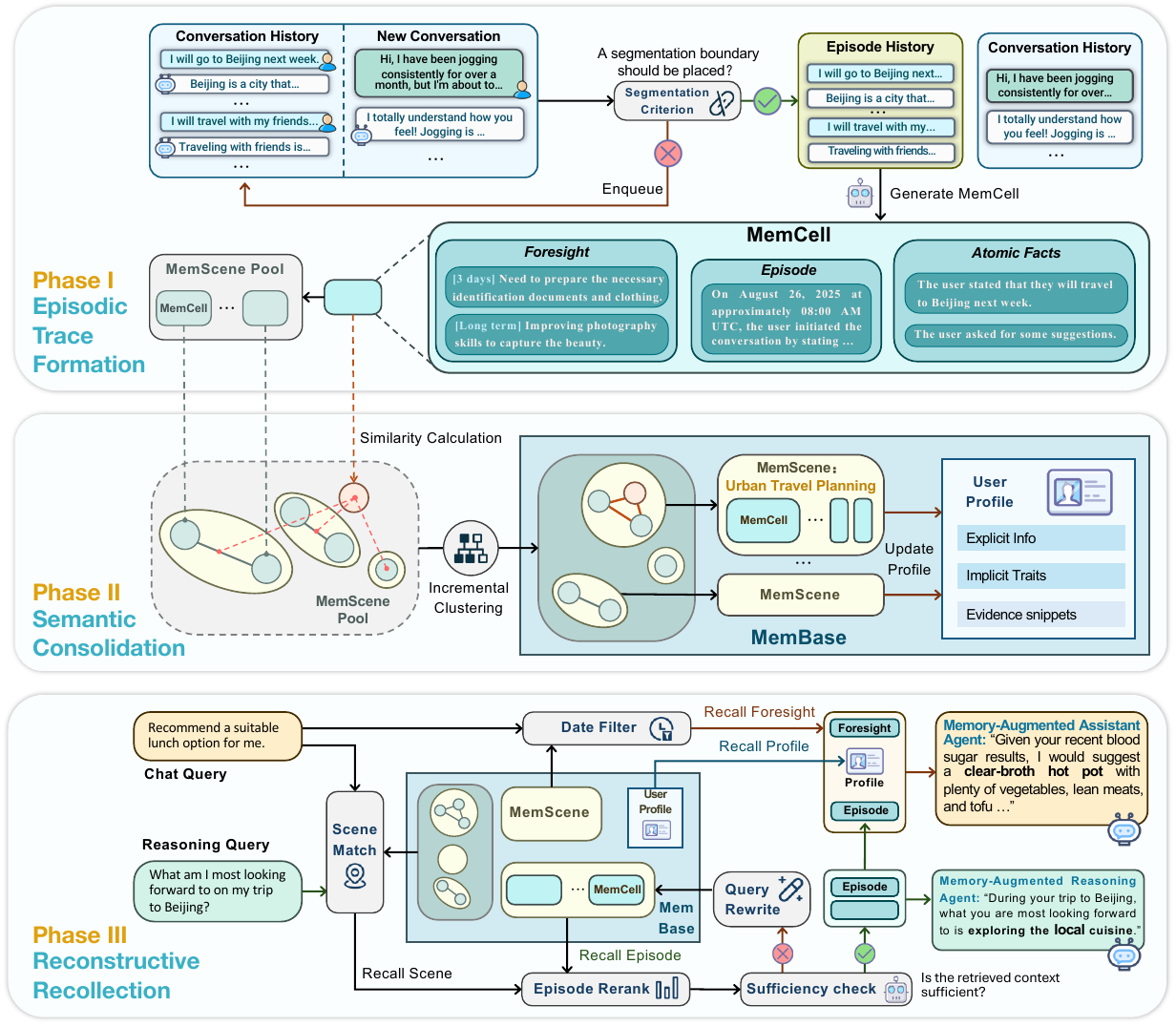
Drawing inspiration from the biological engram lifecycle, EverMemOS follows a three-phase workflow (Figure 3): (1) Episodic Trace Formation encodes interaction streams into MemCells; (2) Semantic Consolidation organizes MemCells into MemScenes and updates user profiles; and (3) Reconstructive Recollection performs MemScene-guided retrieval under the principle of necessity and sufficiency.
受生物 engram 生命周期启发,EverMemOS 遵循三阶段工作流(图3):(1) Episodic Trace Formation 将交互流编码为 MemCells;(2) Semantic Consolidation 将 MemCells 组织为 MemScenes 并更新用户画像;(3) Reconstructive Recollection 在必要性与充分性原则下执行由 MemScene 引导的检索。
3.2 Memory Primitives
At the core of EverMemOS is the MemCell, the atomic unit bridging low-level data and high-level semantics. Formally, a MemCell
(Episode): A concise third-person narrative of the event, serving as the semantic anchor. (Atomic Facts): Discrete, verifiable statements derived from for high-precision matching. (Foresight): Forward-looking inferences (prospections; e.g., plans and temporary states) annotated with validity intervals to support temporal awareness. (Metadata): Contextual grounding including timestamps and source pointers.
This structure turns memory from a static record (
EverMemOS 的核心是 MemCell,这是连接低层数据与高层语义的原子单元。 形式上,一个 MemCell
(Episode):事件的简洁第三人称叙述,作为语义锚点。 (Atomic Facts):从 派生出的离散、可验证陈述,用于高精度匹配。 (Foresight):带有有效区间 标注的前瞻性推断(prospection,例如计划和临时状态),用于支持时间感知。 (Metadata):包括时间戳和来源指针在内的上下文 grounding。
这一结构把记忆从静态记录(
3.3 Phase I: Episodic Trace Formation
Grounded in the engram concept, this first phase transforms the unbounded stream of interaction history
以 engram 概念为基础,第一阶段把无界的交互历史流
Contextual Segmentation To discretize continuous streams, a Semantic Boundary Detector processes interactions via a sliding window. Upon detecting a topic shift, accumulated turns are encapsulated as a raw episode history. We implement this step via LLM prompting; while boundary detection is not perfect, we find it robust in downstream evaluation (see Table 3).
上下文分段。 为了离散化连续流,Semantic Boundary Detector 通过滑动窗口处理交互。 一旦检测到话题转移,累积的轮次会被封装为原始的 episode history。 我们通过 LLM 提示实现这一步;尽管边界检测并不完美,但我们发现它在下游评估中很稳健(见表3)。
Narrative Synthesis To resolve dialogue redundancy and ambiguity, the episode history is synthesized into a high-fidelity Episode (
叙事合成。 为了解决对话冗余和歧义,episode history 会被合成为高保真的 Episode(
Structural Derivation From
结构派生。 系统从
3.4 Phase II: Semantic Consolidation
Inspired by systems consolidation, EverMemOS employs an online mechanism that organizes MemCells into higher-order structures to transition from transient episodes to stable long-term knowledge.
受系统巩固启发,EverMemOS 采用一种在线机制,把 MemCells 组织成更高阶结构,从而从短暂情景过渡到稳定的长期知识。
Incremental Semantic Clustering EverMemOS organizes memory dynamically. When a new MemCell
增量语义聚类。 EverMemOS 动态组织记忆。 当新的 MemCell
Scene-Driven Profile Evolution Scene-level consolidation can also update a compact User Profile from aggregated evidence. When a new MemCell is assimilated into a MemScene, EverMemOS updates a concise scene summary and refreshes the user profile by prompting over these summaries (rather than individual turns), helping separate stable traits from temporary states. We maintain a compact profile of explicit facts (including time-varying measurements) and implicit traits, updated online from scene summaries with recency-aware updates and conflict tracking.
场景驱动的画像演化。 场景级巩固也可以从聚合证据中更新紧凑的 User Profile。 当新的 MemCell 被同化到 MemScene 中时,EverMemOS 会更新简洁的场景摘要,并通过对这些摘要(而非单个轮次)进行提示来刷新用户画像,从而帮助区分稳定特征和临时状态。 我们维护一个紧凑画像,其中包含显式事实(包括随时间变化的测量值)和隐式特征,并基于场景摘要进行在线更新,同时支持近因感知更新和冲突追踪。
3.5 Phase III: Reconstructive Recollection
Building on theories of reconstructive memory, retrieval in EverMemOS is modeled not as a static lookup but as an active Reconstruction process, guided by the principle of necessity and sufficiency. Given a query
基于重构性记忆理论,EverMemOS 中的检索并不是静态查找,而是在必要性与充分性原则引导下的主动 Reconstruction 过程。 给定查询
MemScene Selection We first compute relevance between the query and all MemCells by fusing dense and BM25 retrieval over their Atomic Facts
MemScene 选择。 我们首先在所有 MemCells 的 Atomic Facts
Episode and Foresight Filtering Within the selected MemScenes, we pool Episodes from their constituent MemCells and re-rank them to select a compact set for downstream inference. We then apply Foresight Filtering, retaining only time-valid Foresight whose validity intervals satisfy
Episode 与 Foresight 过滤。 在被选中的 MemScenes 内,我们汇集其组成 MemCells 中的 Episodes,并对它们进行 re-rank,以选择用于下游推理的紧凑集合。 随后我们应用 Foresight Filtering,只保留有效区间满足
Agentic Verification and Query Rewriting The retrieved context is evaluated by an LLM-based verifier for sufficiency. If it is deemed insufficient, the system triggers a query rewriting step to supplement retrieval; otherwise, the context is passed to the downstream module. Prompt templates are provided in the appendix.
智能体验证与查询重写。 检索到的上下文会由基于 LLM 的验证器评估其充分性。 如果它被判定为不充分,系统会触发 query rewriting 步骤来补充检索;否则,上下文会被传递给下游模块。 提示模板见附录。
Task Modes We consider two downstream settings that share the same retrieval pipeline: Memory-Augmented Reasoning and Memory-Augmented Chat. For Reasoning, we use the retrieved Episodes as context for benchmark evaluation. For Chat, the composed context additionally incorporates the User Profile and time-valid Foresight signals, filtered by the current time
任务模式。 我们考虑两个共享同一检索流水线的下游设置:Memory-Augmented Reasoning 和 Memory-Augmented Chat。 对于 Reasoning,我们使用检索到的 Episodes 作为基准评估的上下文。 对于 Chat,组合后的上下文还会纳入 User Profile 和时间有效的 Foresight 信号,并按当前时间
4. Experiments
We evaluate EverMemOS on two long-horizon memory-augmented reasoning benchmarks (LoCoMo and LongMemEval), and report a profile study on PersonaMem-v2.
我们在两个长程记忆增强推理基准(LoCoMo 和 LongMemEval)上评估 EverMemOS,并报告 PersonaMem-v2 上的画像研究。
4.1 Experimental Setup
Benchmarks We evaluate memory-augmented reasoning on LoCoMo and LongMemEval. LoCoMo contains 1,540 questions over 10 ultra-long dialogues (
基准。 我们在 LoCoMo 和 LongMemEval 上评估记忆增强推理。 LoCoMo 包含 10 个超长对话(每个约
Baselines We compare EverMemOS against state-of-the-art memory systems: Zep, Mem0, MemOS, MemoryOS, and MemU. Fair comparison: We standardize the answer-generation backbone across methods while keeping each baseline's official memory configuration unchanged; for LongMemEval, we report baseline scores from the official MemOS leaderboard. Full settings are provided in the appendix.
基线。 我们将 EverMemOS 与最先进记忆系统进行比较:Zep、Mem0、MemOS、MemoryOS 和 MemU。 公平比较: 我们在不同方法之间统一答案生成 backbone,同时保持每个基线的官方记忆配置不变;对于 LongMemEval,我们报告官方 MemOS leaderboard 中的基线分数。 完整设置见附录。
Evaluation Protocol We adopt the LLM-as-a-judge protocol, following MemOS: each answer is evaluated by GPT-4o-mini and two auxiliary judge models, and scores are averaged across the three judgments in a blind setting. We validate the reliability of this protocol against human annotations in the appendix, showing high agreement (Cohen's
评估协议。 我们遵循 MemOS,采用 LLM-as-a-judge 协议:每个答案由 GPT-4o-mini 和两个辅助 judge 模型评估,并在 blind 设置下对三次判断取平均分。 我们在附录中将该协议与人工标注进行对照,以验证其可靠性,结果显示二者具有较高一致性(Cohen's
Implementation Details EverMemOS uses GPT-4.1-mini (or GPT-4o-mini where specified) for all reasoning and memory operations. Retrieval uses hybrid dense+BM25 fusion (RRF) with re-ranking. Default retrieval hyperparameters are in the appendix. Unless otherwise specified, quantitative experiments use Memory-Augmented Reasoning. We provide a token-level cost breakdown by lifecycle phase in the appendix.
实现细节。 EverMemOS 对所有推理和记忆操作使用 GPT-4.1-mini(或在指定处使用 GPT-4o-mini)。 检索使用带重排序的 hybrid dense+BM25 fusion(RRF)。 默认检索超参数见附录。 除非另有说明,定量实验使用 Memory-Augmented Reasoning。 我们在附录中提供按生命周期阶段划分的 token 级成本分解。
4.2 Main Results
| Method | Avg. Tokens | Single Hop | Multi Hop | Temporal | Open Domain | Overall |
|---|---|---|---|---|---|---|
| GPT-4o-mini backbone | ||||||
| MemoryOS | 5.2k | 62.43 | 56.50 | 37.18 | 40.28 | 54.70 |
| Mem0 | 1.0k | 66.71 | 58.16 | 55.45 | 40.62 | 61.00 |
| MemU | 4.0k | 72.77 | 62.41 | 33.96 | 46.88 | 61.15 |
| MemOS | 2.5k | 81.45 | 69.15 | 72.27 | 60.42 | 75.87 |
| Zep | 1.4k | 88.11 | 71.99 | 74.45 | 66.67 | 81.06 |
| EverMemOS | 2.5k | 91.08 (↑3.4%) | 86.17 (↑19.7%) | 81.93 (↑10.0%) | 66.67 (↑0.0%) | 86.76 (↑7.0%) |
| GPT-4.1-mini backbone | ||||||
| MemoryOS | 5.5k | 67.30 | 59.34 | 42.26 | 59.03 | 60.11 |
| Mem0 | 1.0k | 68.97 | 61.70 | 58.26 | 50.00 | 64.20 |
| MemU | 4.0k | 74.91 | 72.34 | 43.61 | 54.17 | 66.67 |
| MemOS | 2.5k | 85.37 | 79.43 | 75.08 | 64.58 | 80.76 |
| Zep | 1.4k | 90.84 | 81.91 | 77.26 | 75.00 | 85.22 |
| EverMemOS | 2.3k | 96.67 (↑6.4%) | 91.84 (↑12.1%) | 89.72 (↑16.1%) | 76.04 (↑1.4%) | 93.05 (↑9.2%) |
| Method | Token | SS-User | SS-Asst | SS-Pref | Multi-S | Know. Upd | Temp. Reas | Overall |
|---|---|---|---|---|---|---|---|---|
| MemU | 0.5k | 67.14 | 19.64 | 76.67 | 42.10 | 41.02 | 17.29 | 38.40 |
| Zep | 1.6k | 92.90 | 75.00 | 53.30 | 47.40 | 74.40 | 54.10 | 63.80 |
| Mem0 | 1.1k | 82.86 | 26.78 | 90.00 | 63.15 | 66.67 | 72.18 | 66.40 |
| MemOS | 1.4k | 95.71 | 67.86 | 96.67 | 70.67 | 74.26 | 77.44 | 77.80 |
| EverMemOS | 2.8k | 97.14 (↑1.5%) | 85.71 (↑14.3%) | 93.33 (↓3.5%) | 73.68 (↑4.3%) | 89.74 (↑20.6%) | 77.44 (↑0.0%) | 83.00 (↑6.7%) |
Main results on two benchmarks are reported in Table 1 and Table 2. We make three observations: Lifecycle-driven performance gains. EverMemOS outperforms the strongest baseline on each benchmark overall, i.e., Zep on LoCoMo by 7.0% and 9.2%, and MemOS on LongMemEval by 6.7%. We attribute this to the shift from flat memory storage to a structured lifecycle, which consolidates fragmented experiences into usable knowledge before retrieval, providing a more robust context than isolated record matching.
两个基准上的主要结果见表1和表2。 我们有三点观察: 生命周期驱动的性能提升。 EverMemOS 在每个基准的 overall 上都优于最强基线,也就是在 LoCoMo 上分别比 Zep 高 7.0% 和 9.2%,在 LongMemEval 上比 MemOS 高 6.7%。 我们将其归因于从扁平记忆存储转向结构化生命周期:它会在检索之前把碎片化经验巩固为可用知识,从而提供比孤立记录匹配更稳健的上下文。
Structural consolidation aids complex reasoning that requires integrating dispersed evidence. We can observe significant gains on LoCoMo multi-hop (+19.7%) and temporal (+10.0%) tasks, as well as LongMemEval knowledge update (+20.6%), validating the effectiveness of MemScenes. By clustering related episodes into coherent thematic units, EverMemOS presents the solver with a complete narrative context. This enables LLMs to naturally bridge dispersed evidence and resolve state conflicts that confuse other models relying on fragmented retrieval.
结构化巩固有助于需要整合分散证据的复杂推理。 我们可以观察到 EverMemOS 在 LoCoMo multi-hop(+19.7%)和 temporal(+10.0%)任务上,以及 LongMemEval knowledge update(+20.6%)上都有显著提升,这验证了 MemScenes 的有效性。 通过把相关 episodes 聚类成连贯的主题单元,EverMemOS 为求解器呈现完整叙事上下文。 这使 LLM 能够自然地桥接分散证据,并解决会困扰依赖碎片化检索的其他模型的状态冲突。
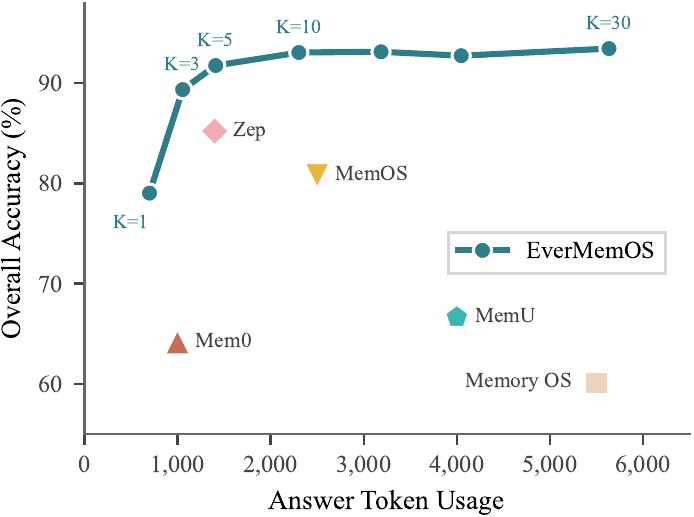
EverMemOS offers a favorable accuracy-efficiency trade-off. As shown in Figure 4, EverMemOS attains high accuracy with moderate retrieval budgets. This efficiency confirms the utility of the Reconstructive Recollection phase, where the agentic sufficiency check ensures the context is composed of necessary and sufficient evidence, avoiding the noise accumulation common in fixed-budget retrieval.
EverMemOS 提供了有利的准确率-效率权衡。 如图4所示,EverMemOS 以适中的检索预算取得了很高准确率。 这种效率证实了 Reconstructive Recollection 阶段的作用:其中的智能体式充分性检查确保上下文由必要且充分的证据组成,避免了固定预算检索中常见的噪声累积。
4.3 Ablation Study
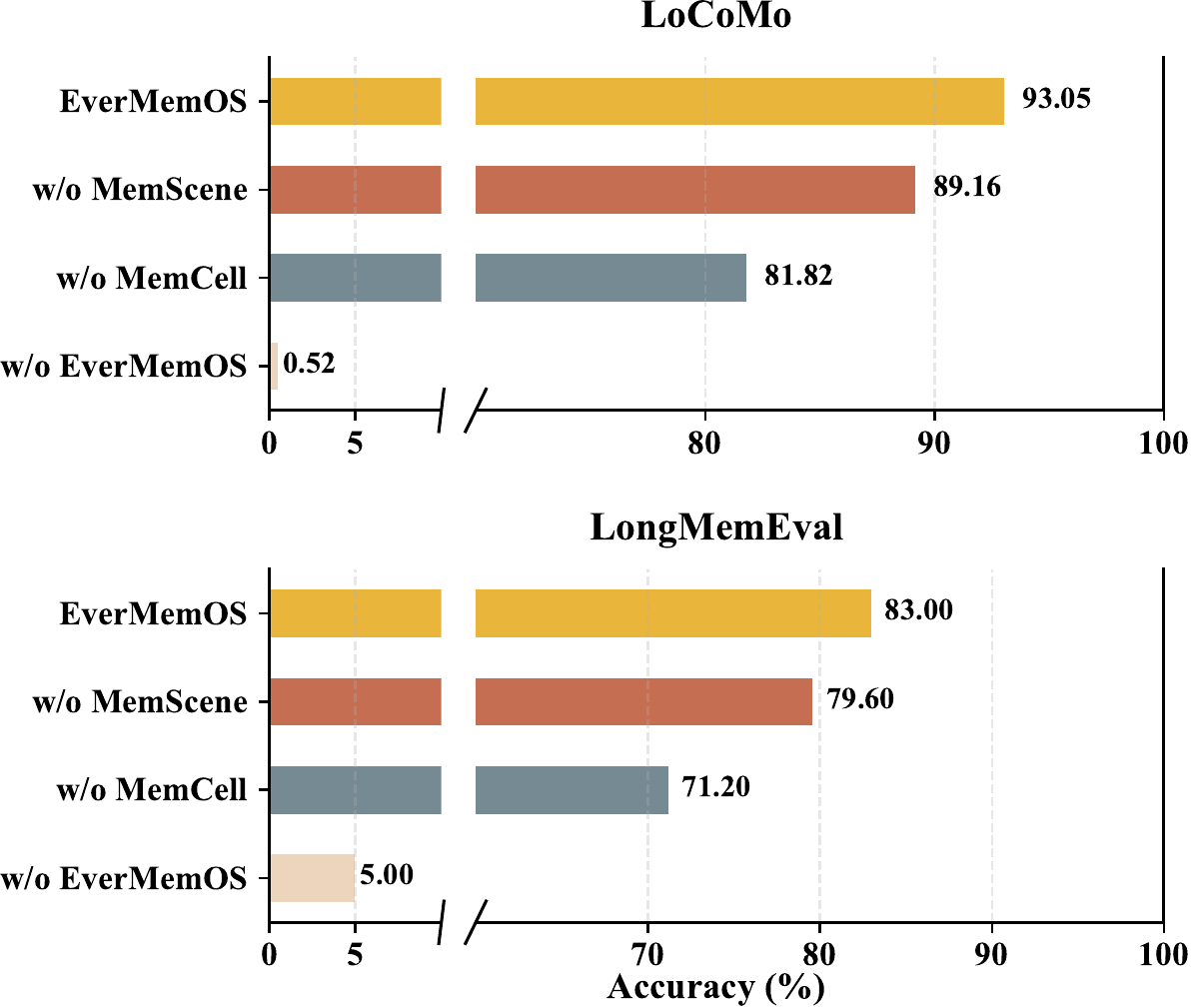
We conduct ablations on LoCoMo to isolate the contributions of MemScenes, MemCells, and episode segmentation. Impact of Memory Architecture. To isolate the contribution of memory structure, we compare EverMemOS with three degraded variants: w/o EverMemOS (no external memory), w/o MemScene (flat retrieval over MemCells), and w/o MemCell (retrieval over raw dialogue). The backbone model and prompts are fixed, and only the memory representation and retrieval pipeline are varied.
我们在 LoCoMo 上进行消融,以隔离 MemScenes、MemCells 和 episode 分段的贡献。 记忆架构的影响。 为了隔离记忆结构的贡献,我们将 EverMemOS 与三个退化变体进行比较:w/o EverMemOS(无外部记忆)、w/o MemScene(在 MemCells 上做扁平检索)和 w/o MemCell(在原始对话上检索)。 backbone 模型和提示固定不变,仅改变记忆表示和检索流水线。
As shown in Figure 5, performance degrades stepwise as structure is removed, revealing three corresponding capability losses. Removing MemScenes eliminates scene-level organization, weakening cross-turn aggregation over related episodes. Removing MemCells further drops the stable semantic units (episodes/facts), forcing retrieval to rely on raw dialogue matching. Finally, removing external memory collapses long-horizon performance, indicating that many queries cannot be handled reliably within the context window alone.
如图5所示,随着结构被移除,性能会逐步下降,揭示出三种对应的能力损失。 移除 MemScenes 会消除场景级组织,削弱对相关 episodes 的跨轮次聚合。 移除 MemCells 会进一步去掉稳定的语义单元(episodes/facts),迫使检索依赖原始对话匹配。 最后,移除外部记忆会导致长程性能崩塌,说明许多查询无法仅在上下文窗口内被可靠处理。
| Segmentation Method | Answer Model | |
|---|---|---|
| GPT-4.1-mini | Qwen3-4B | |
| Heuristic Baselines | ||
| Fixed-Message-10 | 88.05 | 80.95 |
| Fixed-Token-512 | 87.55 | 80.67 |
| Fixed-Token-1024 | 84.52 | 75.19 |
| Semantic Segmentation | ||
| Session (Oracle) | 87.66 | 80.63 |
| Default (EverMemOS) | ||
| w/ GPT-4.1-mini | 89.16 | 83.07 |
| w/ Qwen3-4B | 89.78 | 82.73 |
Effectiveness of Episode Segmentation. We evaluate semantic episode segmentation against fixed heuristics and ground-truth boundaries under w/o MemScene to isolate boundary quality. We compare three strategies: (1) Fixed Heuristics (fixed message count
Episode 分段的有效性。 我们在 w/o MemScene 下将语义 episode 分段与固定启发式和真实边界进行比较,以隔离边界质量。 我们比较三种策略:(1) Fixed Heuristics(固定消息数
4.4 Hyperparameter Analysis
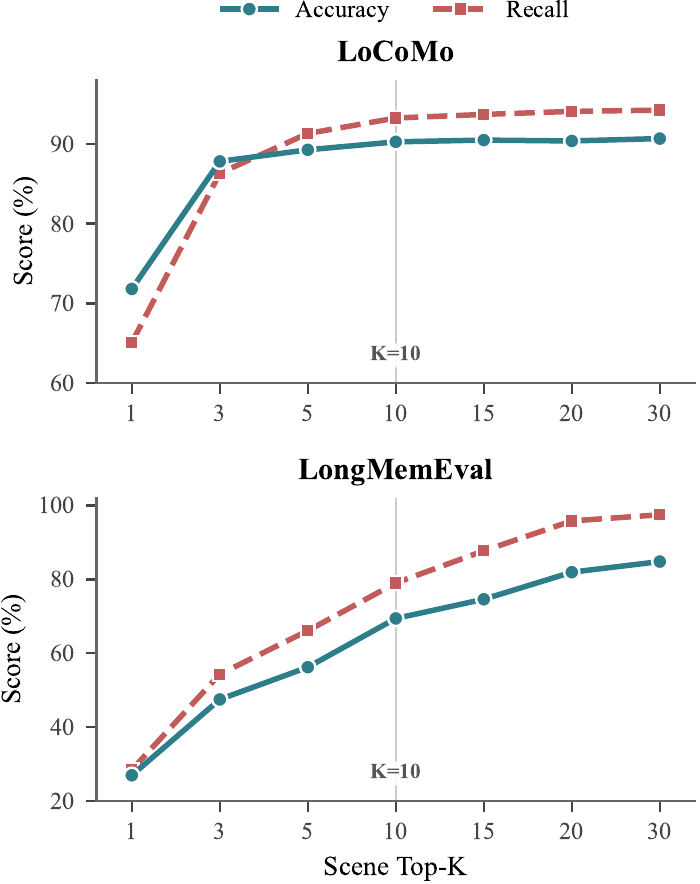
We investigate the impact of retrieval scope via two hyperparameters: the number of retrieved MemScenes (
我们通过两个超参数研究检索范围的影响:检索到的 MemScenes 数量(
4.5 Profile Study
| Scenario | Ep.+Prof. | Prof.-only | Ep.-only |
|---|---|---|---|
| Consultation | 51.03 | 47.33 | 44.44 |
| Email (Personal) | 53.85 | 46.15 | 46.15 |
| Translation | 50.00 | 46.15 | 38.08 |
| Email (Professional) | 53.79 | 41.38 | 45.17 |
| Writing (Creative) | 55.10 | 48.57 | 42.04 |
| Writing (Professional) | 45.56 | 44.79 | 40.15 |
| Knowledge Query | 63.68 | 62.94 | 54.73 |
| Social Media | 47.90 | 44.96 | 36.13 |
| Chat | 52.09 | 44.87 | 41.83 |
| Overall | 53.25 | 48.30 | 43.93 |
We evaluate the effect of the consolidated user profile on PersonaMem-v2 (32k); results are not directly comparable across dataset versions due to differences in task setup and annotations. Table 4 shows that adding the User Profile to episodic evidence improves overall accuracy by 9.32 points over episodes-only (53.25 vs. 43.93), indicating that semantic consolidation provides complementary signal beyond episodic retrieval. We defer the full comparison against other memory systems on PersonaMem-v2 to the appendix.
我们在 PersonaMem-v2(32k)上评估巩固后的用户画像的影响;由于任务设置和标注存在差异,不同数据集版本之间的结果不能直接比较。 表4显示,把 User Profile 加入情景证据后,overall accuracy 相比 episodes-only 提升 9.32 points(53.25 vs. 43.93),说明语义巩固提供了超越情景检索的互补信号。 我们把 PersonaMem-v2 上与其他记忆系统的完整比较留到附录。
4.6 Case Study
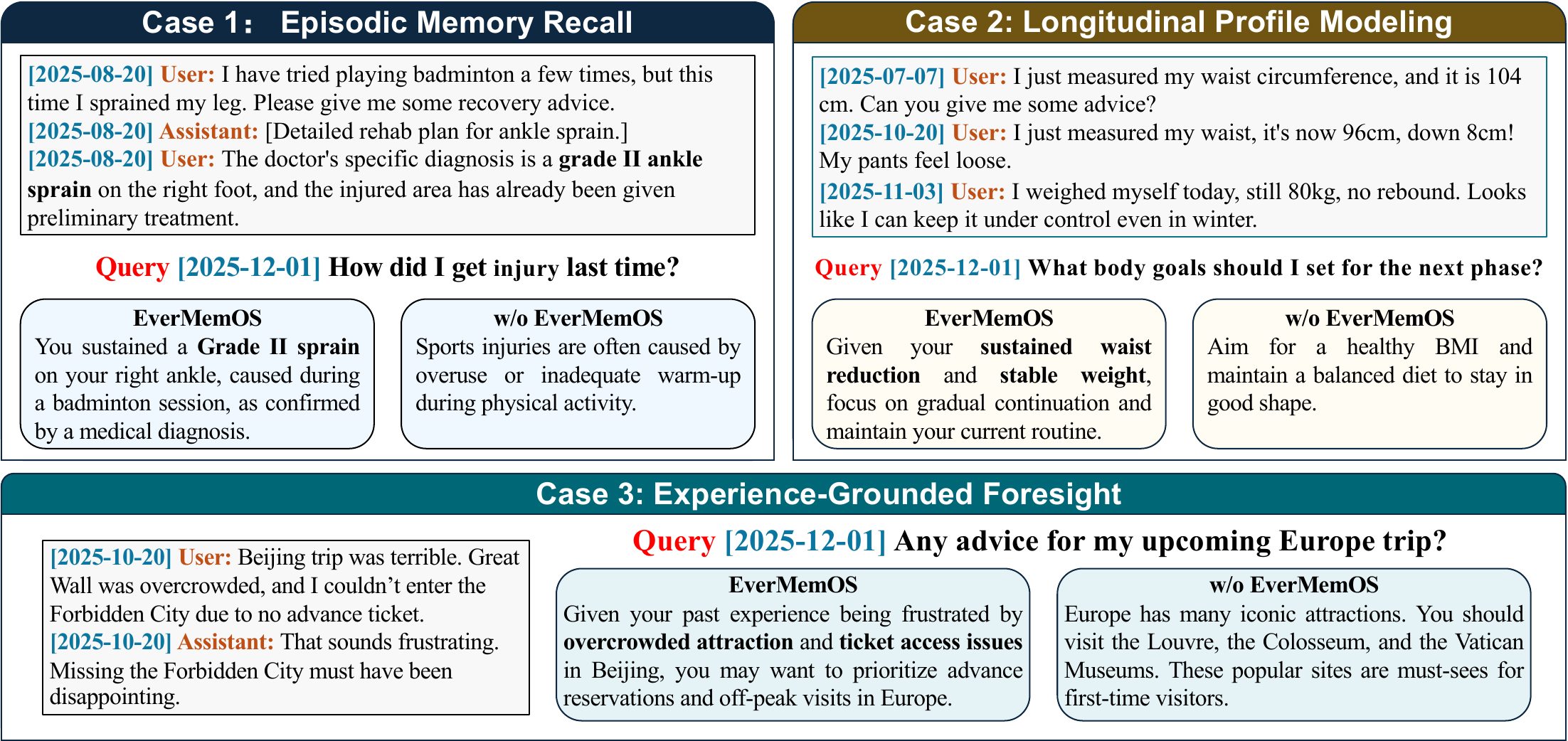
Existing benchmarks primarily evaluate answer-level accuracy/recall and do not capture several capabilities required for long-term conversational agents, such as conflict detection, profile stability, and experience-grounded foresight. To complement quantitative results, Figure 7 shows three representative cases: (Episode) reconstructing a concrete past injury episode (a Grade-II ankle sprain during badminton) rather than producing a generic explanation; (Profile) maintaining longitudinal stability and using sustained improvements (waist 104
现有基准主要评估答案级准确率和召回率,无法捕获长期对话智能体所需的若干能力,例如冲突检测、画像稳定性和基于经验的前瞻。 为了补充定量结果,图7展示了三个代表性案例:(Episode) 重构具体的过去受伤情景(一次羽毛球中的二级踝关节扭伤),而不是给出泛泛解释;(Profile) 维持纵向稳定性,并利用持续改善(腰围从 104
5. Conclusion
In this paper, we introduced EverMemOS, a unified memory operating system for long-horizon LLM agents. By modeling an explicit memory lifecycle composed of episodic trace formation, semantic consolidation, and reconstructive recollection, EverMemOS achieves state-of-the-art performance on memory-augmented reasoning benchmarks, with particularly strong gains on multi-hop and temporal questions. We hope EverMemOS provides an extensible foundation for building more consistent and context-aware interactive agents.
在本文中,我们介绍了 EverMemOS,这是一个面向长程 LLM 智能体的统一记忆操作系统。 通过建模一个由情景痕迹形成、语义巩固和重构性回忆组成的显式记忆生命周期,EverMemOS 在记忆增强推理基准上达到最先进性能,并在 multi-hop 和 temporal 问题上取得尤其显著的提升。 我们希望 EverMemOS 能为构建更一致、更具上下文感知能力的交互式智能体提供可扩展基础。
Limitations
We evaluate EverMemOS on text-only conversational benchmarks. Although the MemCell and MemScene abstraction is modality-agnostic, extending EverMemOS to multimodal or embodied settings is beyond the scope of this work. EverMemOS introduces LLM-mediated operations for memory construction and retrieval, increasing latency and computational cost relative to single-pass baselines. While many components can be cached, batched, or run asynchronously, improving end-to-end efficiency remains future work. Finally, current benchmarks lack protocols for stress-testing ultra-long timelines, so our evaluation does not fully isolate performance in such regimes. This motivates future benchmarks for long-term memory organization and consolidation.
我们在纯文本对话基准上评估 EverMemOS。 虽然 MemCell 和 MemScene 抽象与模态无关,但将 EverMemOS 扩展到多模态或具身设置超出了本文范围。 EverMemOS 为记忆构建和检索引入了由 LLM 介导的操作,相比单次前向基线增加了延迟和计算成本。 尽管许多组件可以缓存、批处理或异步运行,但提升端到端效率仍是未来工作。 最后,当前基准缺乏用于压力测试超长时间线的协议,因此我们的评估没有完全隔离这类设置下的性能。 这促使未来构建面向长期记忆组织和巩固的基准。