
SimpleMem: Efficient Lifelong Memory for LLM Agents
MemoryAgentSemantic Compression3500+ICLR 2026 Workshop Oral北卡罗来纳大学教堂山分校加利福尼亚大学伯克利分校加州大学圣克鲁兹分校SimpleMem:面向 LLM 智能体的高效终身记忆
Abstract
To support long-term interaction in complex environments, LLM agents require memory systems that manage historical experiences. Existing approaches either retain full interaction histories via passive context extension, leading to substantial redundancy, or rely on iterative reasoning to filter noise, incurring high token costs. To address this challenge, we introduce SimpleMem, an efficient memory framework based on semantic lossless compression. We propose a three-stage pipeline designed to maximize information density and token utilization: (1) Semantic Structured Compression, which distills unstructured interactions into compact, multi-view indexed memory units; (2) Online Semantic Synthesis, an intra-session process that instantly integrates related context into unified abstract representations to eliminate redundancy; and (3) Intent-Aware Retrieval Planning, which infers search intent to dynamically determine retrieval scope and construct precise context efficiently. Experiments on benchmark datasets show that our method consistently outperforms baseline approaches in accuracy, retrieval efficiency, and inference cost, achieving an average F1 improvement of 26.4% in LoCoMo while reducing inference-time token consumption by up to 30×, demonstrating a superior balance between performance and efficiency. Code is available at https://github.com/aiming-lab/SimpleMem.
为了支持复杂环境中的长期交互,LLM 智能体需要能够管理历史经验的记忆系统。 现有方法要么通过被动扩展上下文来保留完整交互历史,从而导致大量冗余;要么依赖迭代推理来过滤噪声,带来很高的 token 成本。 为解决这一挑战,我们提出 SimpleMem,这是一个基于语义无损压缩的高效记忆框架。 我们提出一个三阶段流水线,旨在最大化信息密度和 token 利用率:(1) Semantic Structured Compression,将非结构化交互提炼成紧凑的、多视图索引的记忆单元;(2) Online Semantic Synthesis,这是一个会话内过程,会即时把相关上下文整合为统一的抽象表示以消除冗余;(3) Intent-Aware Retrieval Planning,推断搜索意图以动态确定检索范围,并高效构造精确上下文。 在基准数据集上的实验表明,我们的方法在准确率、检索效率和推理成本上持续优于基线方法,在 LoCoMo 上平均 F1 提升 26.4%,同时将推理时 token 消耗最多降低 30×,展示出更优的性能与效率平衡。 代码位于 https://github.com/aiming-lab/SimpleMem。
1. Introduction
Large Language Model (LLM) agents have recently demonstrated remarkable capabilities across a wide range of tasks. However, constrained by fixed context windows, existing agents exhibit significant limitations when engaging in long-context and multi-turn interaction scenarios. To facilitate reliable long-term interaction, LLM agents require robust memory systems to efficiently manage and utilize historical experience.
大语言模型(LLM)智能体最近已经在广泛任务中展现出显著能力。 然而,受固定上下文窗口限制,现有智能体在参与长上下文和多轮交互场景时表现出明显局限。 为了促进可靠的长期交互,LLM 智能体需要稳健的记忆系统来高效管理和利用历史经验。
While recent research has extensively explored the design of memory modules for LLM agents, current systems still suffer from suboptimal retrieval efficiency and low token utilization. On one hand, many existing systems maintain complete interaction histories through full-context extension. However, this approach introduce substantial redundant information. Specifically, during long-horizon interactions, user inputs and model responses accumulate substantial low-entropy noise (e.g., repetitive logs, non-task-oriented dialogue), which degrades the effective information density of the memory buffer. This redundancy adversely affects memory retrieval and downstream reasoning, often leading to middle-context degradation phenomena, while also incurring significant computational overhead during retrieval and secondary inference. On the other hand, some agentic frameworks mitigate noise through online filtering based on iterative reasoning procedures. Although such approaches improve retrieval relevance, they rely on repeated inference cycles, resulting in substantial computational cost, including increased latency and token usage. As a result, neither paradigm achieves efficient allocation of memory and computation resources.
尽管近期研究广泛探索了 LLM 智能体记忆模块的设计,当前系统仍存在检索效率次优和 token 利用率低的问题。 一方面,许多现有系统通过完整上下文扩展来维护完整交互历史。 然而,这种方法会引入大量冗余信息。 具体而言,在长程交互期间,用户输入和模型响应会积累大量低熵噪声(例如重复日志、非任务导向对话),这会降低记忆缓冲区的有效信息密度。 这种冗余会对记忆检索和下游推理产生不利影响,常常导致中间上下文退化现象,同时也会在检索和二次推理期间带来显著计算开销。 另一方面,一些智能体框架通过基于迭代推理过程的在线过滤来缓解噪声。 尽管这类方法提高了检索相关性,但它们依赖重复推理循环,导致大量计算成本,包括更高延迟和 token 使用量。 因此,两种范式都没有实现记忆与计算资源的高效分配。
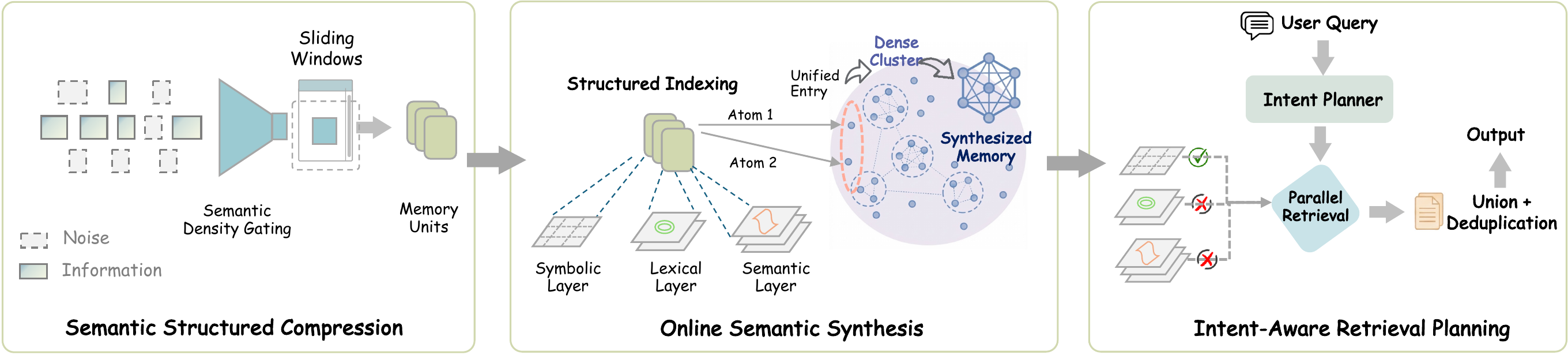
To address these limitations, we introduce SimpleMem, an efficient memory framework inspired by the Complementary Learning Systems (CLS) theory and built around structured semantic compression. The objective of SimpleMem is to improve information efficiency under fixed context and token budgets. We develop a three-stage pipeline that supports dynamic memory compression, organization, and adaptive retrieval: (1) Semantic Structured Compression: we apply a semantic density gating mechanism via LLM-based qualitative assessment. The system uses the foundation model as a semantic judge to estimate information gain relative to history, preserving only content with high downstream utility. Retained information is reformulated into compact memory units and indexed jointly using dense semantic embeddings, sparse lexical features, and symbolic metadata. (2) Online Semantic Synthesis: inspired by biological consolidation and optimized for real-time interaction, we introduce an intra-session process that reorganizes memory on-the-fly. Related memory units are synthesized into higher-level abstract representations during the write phase, allowing repetitive or structurally similar experiences to be denoised and compressed immediately. (3) Intent-Aware Retrieval Planning: we employ a planning-based retrieval strategy that infers latent search intent to determine retrieval scope dynamically. The system constructs a precise context by querying multiple indexes (symbolic, semantic, lexical) and unifying results through ID-based deduplication, balancing structural constraints and semantic relevance without complex linear weighting.
为解决这些限制,我们提出 SimpleMem,这是一个受互补学习系统(CLS)理论启发、围绕结构化语义压缩构建的高效记忆框架。 SimpleMem 的目标是在固定上下文和 token 预算下提高信息效率。 我们开发了一个支持动态记忆压缩、组织和自适应检索的三阶段流水线:(1) Semantic Structured Compression:我们通过基于 LLM 的定性评估应用语义密度门控机制。 系统把基础模型作为语义裁判,估计相对于历史的信息增益,只保留下游效用高的内容。 保留的信息被重构为紧凑记忆单元,并使用密集语义嵌入、稀疏词汇特征和符号元数据联合索引。 (2) Online Semantic Synthesis:受生物巩固启发并针对实时交互优化,我们引入一个会话内过程,在运行中重组记忆。 相关记忆单元会在写入阶段被合成为更高层次的抽象表示,使重复或结构相似的经验能够立即去噪和压缩。 (3) Intent-Aware Retrieval Planning:我们采用基于规划的检索策略,推断潜在搜索意图以动态确定检索范围。 系统通过查询多个索引(符号、语义、词汇)并通过基于 ID 的去重合并结果来构造精确上下文,在没有复杂线性加权的情况下平衡结构约束和语义相关性。
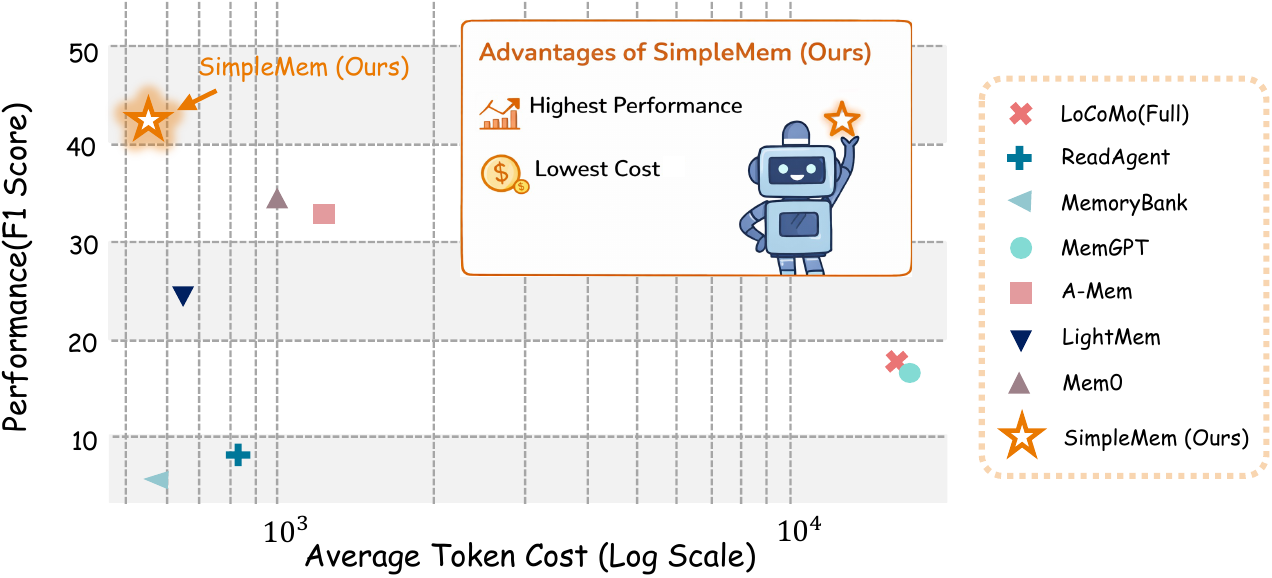
Our primary contribution is SimpleMem, an efficient memory framework grounded in structured semantic compression, which improves information efficiency through principled memory organization, online synthesis, and intent-aware planning. As shown in Figure 1, our empirical experiments demonstrate that SimpleMem establishes a new state-of-the-art with an F1 score, outperforming strong baselines like Mem0 by 26.4%, while reducing inference token consumption by
我们的主要贡献是 SimpleMem,这是一个基于结构化语义压缩的高效记忆框架,通过有原则的记忆组织、在线合成和意图感知规划提高信息效率。 如图1所示,我们的实证实验表明,SimpleMem 以 F1 分数建立了新的最先进结果,比 Mem0 等强基线高 26.4%,同时相比完整上下文模型将推理 token 消耗降低
2. The SimpleMem Architecture
In this section, we present SimpleMem, which operates through a three-stage pipeline (see Figure 2 for the detailed architecture). Specifically, we first describe the Semantic Structured Compression, which utilizes implicit semantic gating to filter redundant interaction content and reformulate raw dialogue streams into compact memory units. Next, we describe Online Semantic Synthesis, an on-the-fly mechanism that instantly synthesizes related memory units into higher-level abstract representations, ensuring a compact and noise-free memory topology. Finally, we present Intent-Aware Retrieval Planning, which infers latent search intent to dynamically adjust retrieval scope, constructing precise and token-efficient contexts for downstream reasoning.
在本节中,我们介绍 SimpleMem,它通过三阶段流水线运行(详细架构见图2)。 具体而言,我们首先描述 Semantic Structured Compression,它利用隐式语义门控来过滤冗余交互内容,并把原始对话流重构为紧凑记忆单元。 接着,我们描述 Online Semantic Synthesis,这是一种即时机制,会立即把相关记忆单元合成为更高层次的抽象表示,确保记忆拓扑紧凑且无噪声。 最后,我们介绍 Intent-Aware Retrieval Planning,它推断潜在搜索意图以动态调整检索范围,为下游推理构造精确且 token 高效的上下文。
2.1 Semantic Structured Compression
A primary bottleneck in long-term interaction is context inflation, the accumulation of raw, low-entropy dialogue. For example, a large portion of interaction segments in the real-world consists of phatic chit-chat or redundant confirmations, which contribute little to downstream reasoning but consume substantial context capacity. To address this, we introduce a mechanism to actively filter and restructure information at the source. Specifically, first, incoming dialogue is segmented into overlapping sliding windows
长期交互中的一个主要瓶颈是上下文膨胀,也就是原始、低熵对话的累积。 例如,真实世界中的很大一部分交互片段由寒暄或冗余确认组成,它们对下游推理贡献很少,却消耗大量上下文容量。 为解决这一问题,我们引入一种机制,在源头主动过滤和重构信息。 具体而言,首先,传入对话被切分为固定长度的重叠滑动窗口
Unlike traditional approaches that rely on rigid heuristic filters or separate classification models, we employ an implicit semantic density gating mechanism integrated directly into the generation process. We model the information assessment as an instruction-following task performed by the foundation model itself. The system leverages the attention mechanism of the LLM
不同于依赖僵硬启发式过滤器或独立分类模型的传统方法,我们采用一种直接整合进生成过程的隐式语义密度门控机制。 我们把信息评估建模为由基础模型自身执行的指令跟随任务。 系统利用 LLM
Here, the generation of an empty set (
这里,生成空集(
For windows containing valid semantic content, the system performs a unified De-linearization Transformation
对于包含有效语义内容的窗口,系统执行统一的 De-linearization Transformation
In this unified pass, the model follows strict instructional constraints to: (1) resolve ambiguous pronouns to specific entity names (
在这一次统一处理中,模型遵循严格的指令约束:(1) 将含糊代词解析为具体实体名称(
Following compression, the system organizes the memory units to support storage and retrieval. This stage consists of two synergistic processes: (i) structured multi-view indexing for precise access, and (ii) online semantic synthesis for minimizing redundancy at the point of creation. To support flexible and high-fidelity retrieval, each memory unit is indexed through three complementary representations. First, at the Semantic Layer, we map the entry to a dense vector space
压缩之后,系统会组织记忆单元以支持存储和检索。 这一阶段包含两个协同过程:(i) 用于精确访问的结构化多视图索引,以及 (ii) 在创建时最小化冗余的在线语义合成。 为了支持灵活且高保真的检索,每个记忆单元都通过三种互补表示进行索引。 首先,在语义层,我们使用嵌入模型把条目映射到密集向量空间
This architecture allows the system to flexibly query information based on conceptual similarity, exact keyword matches, or structured metadata constraints.
这一架构使系统能够基于概念相似性、精确关键词匹配或结构化元数据约束灵活查询信息。
2.2 Online Semantic Synthesis
While this multi-view indexing strategy facilitates access, naively accumulating raw extractions leads to fragmentation, causing the memory structure to grow in a purely additive and unregulated manner that fails to adapt in real time to the evolving semantic context of an ongoing interaction. To address this, we introduce Online Semantic Synthesis, an intra-session consolidation mechanism. Unlike traditional systems that rely on asynchronous background maintenance, SimpleMem performs synthesis on-the-fly during the write phase. The model analyzes the stream of extracted facts within the current session scope and synthesizes related fragments into unified, high-density entries before they are committed to the database.
虽然这种多视图索引策略方便访问,但朴素累积原始抽取会导致碎片化,使记忆结构以纯加法且不受调节的方式增长,无法实时适应当前交互中不断演化的语义上下文。 为解决这一问题,我们引入 Online Semantic Synthesis,这是一种会话内巩固机制。 不同于依赖异步后台维护的传统系统,SimpleMem 在写入阶段即时执行合成。 模型会分析当前会话范围内的抽取事实流,并在相关片段提交到数据库前把它们合成为统一的高密度条目。
Formally, we define this synthesis as a transformation function "User wants coffee", "User prefers oat milk", and "User likes it hot", the synthesis layer consolidates them into a single, comprehensive entry: "User prefers hot coffee with oat milk". This proactive synthesis ensures that the memory topology remains compact and free of redundant fragmentation, significantly reducing the burden on the retrieval system during future interactions.
形式上,我们把这种合成定义为一个变换函数 "User wants coffee"、"User prefers oat milk" 和 "User likes it hot" 这三个片段,而是由合成层将它们巩固为一个完整条目:"User prefers hot coffee with oat milk"。 这种主动合成确保记忆拓扑保持紧凑且没有冗余碎片,显著降低未来交互中检索系统的负担。
2.3 Intent-Aware Retrieval Planning
After memory entries are organized, the final challenge is to retrieve relevant information under constrained context budgets. Standard retrieval approaches typically fetch a fixed number of entries, which often results in recall failure for complex queries or token wastage for simple ones. To address this, we introduce Intent-Aware Retrieval Planning, a mechanism that dynamically determines the retrieval scope and depth by inferring the user's latent search intent. Unlike systems that rely on scalar complexity classifiers, SimpleMem leverages the reasoning capabilities of the LLM to generate a comprehensive retrieval plan. Given a query
记忆条目被组织好之后,最后的挑战是在受限上下文预算下检索相关信息。 标准检索方法通常获取固定数量的条目,这常常会让复杂查询召回失败,或让简单查询浪费 token。 为解决这一问题,我们引入 Intent-Aware Retrieval Planning,这是一种通过推断用户潜在搜索意图来动态确定检索范围和深度的机制。 不同于依赖标量复杂度分类器的系统,SimpleMem 利用 LLM 的推理能力生成完整检索计划。 给定查询
where
其中
Here, each view captures distinct relevance signals:
这里,每个视图捕捉不同相关性信号:
This hybrid approach ensures that strong signals from any view are preserved, allowing the system to adaptively scale its retrieval volume
这种混合方法确保任一视图中的强信号都被保留,使系统能够基于推断深度
3. Experiments
In this section, we evaluate SimpleMem on the benchmark to answer the following research questions: (1) Does SimpleMem outperform other memory systems in complex long-term reasoning understanding tasks? (2) Can SimpleMem achieve a superior trade-off between retrieval accuracy and token consumption? (3) How effective are the proposed components? (4) What factors account for the observed performance and efficiency gains?
在本节中,我们在基准上评估 SimpleMem,以回答以下研究问题:(1) SimpleMem 是否在复杂长期推理理解任务中优于其他记忆系统? (2) SimpleMem 能否在检索准确率和 token 消耗之间取得更优权衡? (3) 所提出组件的效果如何? (4) 哪些因素解释了观察到的性能与效率提升?
| Model | Method | MultiHop | Temporal | OpenDomain | SingleHop | Average | Token | |||||
|---|---|---|---|---|---|---|---|---|---|---|---|---|
| F1 | BLEU | F1 | BLEU | F1 | BLEU | F1 | BLEU | F1 | BLEU | Cost | ||
| GPT-4.1-mini | LoCoMo | 25.02 | 21.62 | 12.04 | 10.63 | 19.05 | 17.07 | 18.68 | 15.87 | 18.70 | 16.30 | 16,910 |
| ReadAgent | 6.48 | 5.6 | 5.31 | 4.23 | 7.66 | 6.62 | 9.18 | 7.91 | 7.16 | 6.09 | 643 | |
| MemoryBank | 5.00 | 4.68 | 5.94 | 4.78 | 5.16 | 4.52 | 5.72 | 4.86 | 5.46 | 4.71 | 432 | |
| MemGPT | 17.72 | 16.02 | 19.44 | 16.54 | 11.29 | 10.18 | 25.59 | 24.25 | 18.51 | 16.75 | 16,977 | |
| A-Mem | 25.06 | 17.32 | 51.01 | 44.75 | 13.22 | 14.75 | 41.02 | 36.99 | 32.58 | 28.45 | 2,520 | |
| LightMem | 24.96 | 21.66 | 20.55 | 18.39 | 19.21 | 17.68 | 33.79 | 29.66 | 24.63 | 21.85 | 612 | |
| Mem0 | 30.14 | 27.62 | 48.91 | 44.82 | 16.43 | 14.94 | 41.3 | 36.17 | 34.20 | 30.89 | 973 | |
| SimpleMem | 43.46 | 38.82 | 58.62 | 50.10 | 19.76 | 18.04 | 51.12 | 43.53 | 43.24 | 37.62 | 531 | |
| GPT-4o | LoCoMo | 28.00 | 18.47 | 9.09 | 5.78 | 16.47 | 14.80 | 61.56 | 54.19 | 28.78 | 23.31 | 16,910 |
| ReadAgent | 14.61 | 9.95 | 4.16 | 3.19 | 8.84 | 8.37 | 12.46 | 10.29 | 10.02 | 7.95 | 805 | |
| MemoryBank | 6.49 | 4.69 | 2.47 | 2.43 | 6.43 | 5.30 | 8.28 | 7.10 | 5.92 | 4.88 | 569 | |
| MemGPT | 30.36 | 22.83 | 17.29 | 13.18 | 12.24 | 11.87 | 40.16 | 36.35 | 25.01 | 21.06 | 16,987 | |
| A-Mem | 32.86 | 23.76 | 39.41 | 31.23 | 17.10 | 15.84 | 44.43 | 38.97 | 33.45 | 27.45 | 1,216 | |
| LightMem | 28.15 | 21.83 | 36.53 | 29.12 | 13.38 | 11.54 | 33.76 | 28.02 | 27.96 | 22.63 | 645 | |
| Mem0 | 35.13 | 27.56 | 52.38 | 44.15 | 17.73 | 15.92 | 39.12 | 35.43 | 36.09 | 30.77 | 985 | |
| SimpleMem | 35.89 | 32.83 | 56.71 | 20.57 | 18.23 | 16.34 | 45.41 | 39.25 | 39.06 | 27.25 | 550 | |
| Qwen3-Plus | LoCoMo | 24.15 | 18.94 | 16.57 | 13.28 | 11.81 | 10.58 | 38.58 | 28.16 | 22.78 | 17.74 | 16,910 |
| ReadAgent | 9.52 | 6.83 | 11.22 | 8.15 | 5.41 | 5.23 | 9.85 | 7.96 | 9.00 | 7.04 | 742 | |
| MemoryBank | 5.25 | 4.94 | 1.77 | 6.26 | 5.88 | 6.00 | 6.90 | 5.57 | 4.95 | 5.69 | 302 | |
| MemGPT | 25.80 | 17.50 | 24.10 | 18.50 | 9.50 | 7.80 | 40.20 | 42.10 | 24.90 | 21.48 | 16,958 | |
| A-Mem | 26.50 | 19.80 | 46.10 | 35.10 | 11.90 | 11.50 | 43.80 | 36.50 | 32.08 | 25.73 | 1,427 | |
| LightMem | 28.95 | 24.13 | 42.58 | 38.52 | 16.54 | 13.23 | 40.78 | 36.52 | 32.21 | 28.10 | 606 | |
| Mem0 | 32.42 | 21.24 | 47.53 | 39.82 | 17.18 | 14.53 | 46.25 | 37.52 | 35.85 | 28.28 | 1,020 | |
| SimpleMem | 33.74 | 29.04 | 50.87 | 43.31 | 18.41 | 16.24 | 46.94 | 38.16 | 37.49 | 31.69 | 583 | |
gpt-4.1-mini as the judge. SimpleMem achieves the best overall performance while maintaining balanced capabilities across different sub-tasks.| Method | Temporal | Multi-Session | Knowledge-Update | Single-Session-User | Single-Session-Assistant | Single-Session-Preference | Average |
|---|---|---|---|---|---|---|---|
| GPT-4.1-mini | |||||||
| Full-context | 27.06% | 30.08% | 41.03% | 47.14% | 32.14% | 60.00% | 39.57% |
| Mem0 | 40.60% | 50.37% | 69.23% | 87.14% | 48.21% | 63.33% | 59.81% |
| LightMem | 85.71% | 47.37% | 92.30% | 88.57% | 21.43% | 76.67% | 68.67% |
| SimpleMem | 83.46% | 60.92% | 79.48% | 85.71% | 75.00% | 76.67% | 76.87% |
| GPT-4.1 | |||||||
| Full-context | 51.88% | 39.10% | 70.51% | 65.71% | 96.43% | 16.67% | 56.72% |
| Mem0 | 43.61% | 54.89% | 75.64% | 54.29% | 39.29% | 83.33% | 58.51% |
| LightMem | 84.96% | 57.89% | 89.74% | 87.14% | 71.43% | 70.00% | 76.86% |
| SimpleMem | 86.47% | 81.20% | 80.76% | 98.57% | 76.79% | 80.00% | 83.97% |
| Model | Method | MultiHop | Temporal | OpenDomain | SingleHop | Average | Token | |||||
|---|---|---|---|---|---|---|---|---|---|---|---|---|
| F1 | BLEU | F1 | BLEU | F1 | BLEU | F1 | BLEU | F1 | BLEU | Cost | ||
| Qwen2.5-1.5b | LoCoMo | 9.05 | 6.55 | 4.25 | 4.04 | 9.91 | 8.50 | 11.15 | 8.67 | 8.59 | 6.94 | 16,910 |
| ReadAgent | 6.61 | 4.93 | 2.55 | 2.51 | 5.31 | 12.24 | 10.13 | 7.54 | 6.15 | 6.81 | 752 | |
| MemoryBank | 11.14 | 8.25 | 4.46 | 2.87 | 8.05 | 6.21 | 13.42 | 11.01 | 9.27 | 7.09 | 284 | |
| MemGPT | 10.44 | 7.61 | 4.21 | 3.89 | 13.42 | 11.64 | 9.56 | 7.34 | 9.41 | 7.62 | 16,953 | |
| A-Mem | 18.23 | 11.94 | 24.32 | 19.74 | 16.48 | 14.31 | 23.63 | 19.23 | 20.67 | 16.31 | 1,300 | |
| LightMem | 16.43 | 11.39 | 22.92 | 18.56 | 15.06 | 11.23 | 23.28 | 19.24 | 19.42 | 15.11 | 605 | |
| Mem0 | 20.18 | 14.53 | 27.42 | 22.14 | 19.83 | 15.68 | 27.63 | 23.42 | 23.77 | 18.94 | 942 | |
| SimpleMem | 21.85 | 16.10 | 29.12 | 23.50 | 21.05 | 16.80 | 28.90 | 24.50 | 25.23 | 20.23 | 678 | |
| Qwen2.5-3b | LoCoMo | 4.61 | 4.29 | 3.11 | 2.71 | 4.55 | 5.97 | 7.03 | 5.69 | 4.83 | 4.67 | 16,910 |
| ReadAgent | 2.47 | 1.78 | 3.01 | 3.01 | 5.57 | 5.22 | 3.25 | 2.51 | 3.58 | 3.13 | 776 | |
| MemoryBank | 3.60 | 3.39 | 1.72 | 1.97 | 6.63 | 6.58 | 4.11 | 3.32 | 4.02 | 3.82 | 298 | |
| MemGPT | 5.07 | 4.31 | 2.94 | 2.95 | 7.04 | 7.10 | 7.26 | 5.52 | 5.58 | 4.97 | 16,961 | |
| A-Mem | 12.57 | 9.01 | 27.59 | 25.07 | 7.12 | 7.28 | 17.23 | 13.12 | 16.13 | 13.62 | 1,137 | |
| LightMem | 16.43 | 11.39 | 6.92 | 4.56 | 8.06 | 7.23 | 18.28 | 15.24 | 12.42 | 9.61 | 605 | |
| Mem0 | 16.89 | 11.54 | 8.52 | 6.23 | 10.24 | 8.82 | 16.47 | 12.43 | 13.03 | 9.76 | 965 | |
| SimpleMem | 17.03 | 11.87 | 21.47 | 19.50 | 12.52 | 10.19 | 20.90 | 18.01 | 17.98 | 14.89 | 572 | |
| Qwen3-1.7b | LoCoMo | 10.28 | 8.82 | 6.45 | 5.78 | 10.42 | 9.02 | 11.16 | 10.35 | 9.58 | 8.49 | 16,910 |
| ReadAgent | 7.50 | 5.60 | 3.15 | 2.95 | 6.10 | 12.45 | 10.80 | 8.15 | 6.89 | 7.29 | 784 | |
| MemoryBank | 11.50 | 8.65 | 4.95 | 3.20 | 8.55 | 6.80 | 13.90 | 11.50 | 9.73 | 7.54 | 290 | |
| MemGPT | 11.50 | 8.20 | 4.65 | 4.10 | 13.85 | 11.90 | 10.25 | 7.85 | 10.06 | 8.01 | 16,954 | |
| A-Mem | 18.45 | 11.80 | 25.82 | 18.45 | 10.90 | 9.95 | 21.58 | 16.72 | 19.19 | 14.23 | 1,258 | |
| LightMem | 14.84 | 11.56 | 9.35 | 7.85 | 13.76 | 10.59 | 28.14 | 22.89 | 16.52 | 13.22 | 679 | |
| Mem0 | 18.23 | 13.44 | 18.54 | 14.22 | 16.82 | 13.54 | 31.15 | 26.42 | 21.19 | 16.91 | 988 | |
| SimpleMem | 20.85 | 15.42 | 26.75 | 18.63 | 17.92 | 14.15 | 32.85 | 26.46 | 24.59 | 18.67 | 730 | |
| Qwen3-8b | LoCoMo | 13.50 | 9.20 | 6.80 | 5.50 | 10.10 | 8.80 | 14.50 | 11.20 | 11.23 | 8.68 | 16,910 |
| ReadAgent | 7.20 | 5.10 | 3.50 | 3.10 | 5.50 | 5.40 | 8.10 | 6.20 | 6.08 | 4.95 | 721 | |
| MemoryBank | 9.50 | 7.10 | 3.80 | 2.50 | 7.50 | 6.50 | 9.20 | 7.50 | 7.50 | 5.90 | 287 | |
| MemGPT | 14.20 | 9.80 | 5.50 | 4.20 | 12.50 | 10.80 | 11.50 | 9.10 | 10.93 | 8.48 | 16,943 | |
| A-Mem | 20.50 | 13.80 | 22.50 | 18.20 | 13.20 | 10.50 | 26.80 | 21.50 | 20.75 | 16.00 | 1,087 | |
| LightMem | 18.53 | 14.23 | 26.78 | 21.52 | 14.12 | 11.24 | 29.48 | 23.83 | 22.23 | 17.71 | 744 | |
| Mem0 | 22.42 | 16.83 | 32.48 | 26.13 | 15.23 | 12.54 | 33.05 | 27.24 | 25.80 | 20.69 | 1,015 | |
| SimpleMem | 28.97 | 24.93 | 42.85 | 36.49 | 15.35 | 13.90 | 46.62 | 40.69 | 33.45 | 29.00 | 621 | |
3.1 Experimental Setup
Benchmark Dataset. We evaluate performance on the LoCoMo and LongMemEval-S benchmarks. Brief descriptions are provided below, with additional details in the appendix. LoCoMo is specifically designed to test the limits of LLMs in processing long-term conversational dependencies. The dataset comprises conversation samples ranging from 200 to 400 turns, containing complex temporal shifts and interleaved topics. The evaluation set consists of 1,986 questions categorized into four distinct reasoning types: (1) multi-hop reasoning; (2) temporal reasoning; (3) open Domain; (4) single hop.
基准数据集。 我们在 LoCoMo 和 LongMemEval-S 基准上评估性能。 下面提供简要描述,更多细节见附录。 LoCoMo 专门用于测试 LLM 处理长期对话依赖的极限。 该数据集包含 200 到 400 轮不等的对话样本,包含复杂时间转移和交错主题。 评估集包含 1,986 个问题,被分为四种不同推理类型:(1) 多跳推理;(2) 时间推理;(3) 开放域;(4) 单跳。
LongMemEval-S features extreme context lengths that pose severe challenges for memory systems. Unlike standard benchmarks, it requires precise answer localization across multiple sub-categories (e.g., temporal events, user preferences) within exceptionally long interaction histories. We use gpt-4.1-mini to evaluate answer correctness against ground-truth references, labeling responses as Correct or Wrong based on semantic and temporal alignment. The full evaluation prompt is provided in the appendix.
LongMemEval-S 具有极端上下文长度,对记忆系统构成严峻挑战。 不同于标准基准,它要求在特别长的交互历史中跨多个子类别(例如时间事件、用户偏好)精确定位答案。 我们使用 gpt-4.1-mini 根据真实参考答案评估回答正确性,并基于语义和时间对齐将响应标记为 Correct 或 Wrong。 完整评估提示见附录。
Baselines. We compare SimpleMem with representative memory-augmented systems: LoCoMo, ReadAgent, MemoryBank, MemGPT, A-Mem, LightMem, and Mem0. Backbone Models. To test robustness across capability scales, we instantiate each baseline and SimpleMem on multiple LLM backends: GPT-4o, GPT-4.1-mini, Qwen-Plus, Qwen2.5 (1.5B/3B), and Qwen3 (1.7B/8B). Implementation Details. For semantic structured compression, we use a sliding window of size Qwen3-embedding-0.6b (1024 dimensions) for dense semantic embeddings, BM25 for sparse lexical indexing, and SQL-based metadata storage for symbolic attributes. During retrieval, we employ adaptive query-aware retrieval, where the retrieval depth is dynamically adjusted based on estimated query complexity, ranging from
基线。 我们将 SimpleMem 与代表性记忆增强系统比较:LoCoMo、ReadAgent、MemoryBank、MemGPT、A-Mem、LightMem 和 Mem0。 Backbone 模型。 为了测试跨能力尺度的鲁棒性,我们在多个 LLM 后端上实例化每个基线和 SimpleMem:GPT-4o、GPT-4.1-mini、Qwen-Plus、Qwen2.5(1.5B/3B)和 Qwen3(1.7B/8B)。 实现细节。 对于语义结构化压缩,我们使用大小为 Qwen3-embedding-0.6b(1024 维)用于密集语义嵌入,BM25 用于稀疏词汇索引,基于 SQL 的元数据存储用于符号属性。 检索期间,我们采用自适应查询感知检索,其中检索深度会基于估计查询复杂度动态调整,范围从简单查找的
3.2 Results and Analysis
Tables 1 and 3 present detailed performance comparisons on the LoCoMo benchmark across different model scales, while Table 2 reports results on LongMemEval-S. Performance on High-Capability Models. Across LoCoMo and LongMemEval-S, SimpleMem consistently outperforms existing memory systems across model scales, achieving strong and robust gains in accuracy. On LoCoMo (Table 1), SimpleMem leads all baselines. Using GPT-4.1-mini, it achieves an Average F1 of 43.24, substantially exceeding Mem0 (34.20) and the full-context baseline (18.70). The largest gains are observed in Temporal Reasoning, where SimpleMem reaches 58.62 F1 compared to 48.91 for Mem0, underscoring the effectiveness of semantic structured compression in resolving complex temporal dependencies. These improvements persist at larger scales: on GPT-4o, SimpleMem attains the highest Average F1 (39.06), outperforming Mem0 (36.09) and A-Mem (33.45).
表 1 和表 3 展示了 LoCoMo 基准上跨不同模型尺度的详细性能比较,而表2报告了 LongMemEval-S 上的结果。 高能力模型上的性能。 在 LoCoMo 和 LongMemEval-S 上,SimpleMem 在不同模型尺度中持续优于现有记忆系统,并在准确率上取得强劲且稳健的提升。 在 LoCoMo 上(表1),SimpleMem 领先所有基线。 使用 GPT-4.1-mini 时,它取得 43.24 的平均 F1,显著超过 Mem0(34.20)和完整上下文基线(18.70)。 最大增益出现在时间推理中,SimpleMem 达到 58.62 F1,而 Mem0 为 48.91,凸显语义结构化压缩在解决复杂时间依赖方面的有效性。 这些提升在更大模型尺度上仍然保持:在 GPT-4o 上,SimpleMem 取得最高平均 F1(39.06),优于 Mem0(36.09)和 A-Mem(33.45)。
A task-level breakdown on LoCoMo further highlights the balanced capabilities of SimpleMem. In SingleHop QA, SimpleMem consistently achieves the best performance (e.g., 51.12 F1 on GPT-4.1-mini), demonstrating precise factual retrieval. In more challenging MultiHop settings, SimpleMem significantly outperforms Mem0 and LightMem on GPT-4.1-mini, indicating its ability to bridge disconnected facts and support deep reasoning without relying on expensive iterative retrieval loops.
LoCoMo 上的任务级分解进一步凸显 SimpleMem 的均衡能力。 在 SingleHop QA 中,SimpleMem 持续取得最佳性能(例如在 GPT-4.1-mini 上 F1 为 51.12),展示出精确事实检索能力。 在更具挑战性的 MultiHop 设置中,SimpleMem 在 GPT-4.1-mini 上显著优于 Mem0 和 LightMem,表明它能够连接分散事实并支持深层推理,而无需依赖昂贵的迭代检索循环。
Results on LongMemEval-S (Table 2) further demonstrate the robustness of SimpleMem under extreme context lengths. Using the gpt-4.1-mini backbone, SimpleMem achieves the highest average accuracy of 76.87%, outperforming LightMem (68.67%) and substantially exceeding Mem0 (59.81%) and the full-context baseline (39.57%). Gains are most pronounced in the challenging Multi-Session category, where SimpleMem attains 60.92% accuracy, compared to 47.37% for LightMem and 30.08% for full-context, highlighting its effectiveness in cross-session information integration under severe context constraints. When scaled to the more capable gpt-4.1 backbone, SimpleMem maintains its state-of-the-art performance with an average accuracy of 83.97%. It is particularly strong in the Single-Session User task (98.57%), demonstrating near-perfect recall of immediate user-provided details. While LightMem exhibits strong performance on temporally specific queries, SimpleMem offers a more balanced profile: it avoids catastrophic failures in assistant-focused recall (where LightMem drop significantly on the mini model) while maintaining high accuracy in complex multi-session retrieval. This balance suggests that SimpleMem’s structured indexing strategy effectively disentangles episodic noise from salient facts, providing a reliable memory substrate for long-term interaction.
LongMemEval-S 上的结果(表2)进一步展示了 SimpleMem 在极端上下文长度下的鲁棒性。 使用 gpt-4.1-mini backbone 时,SimpleMem 取得最高平均准确率 76.87%,优于 LightMem(68.67%),并显著超过 Mem0(59.81%)和完整上下文基线(39.57%)。 增益在具有挑战性的 Multi-Session 类别中最为明显,SimpleMem 达到 60.92% 准确率,而 LightMem 为 47.37%、完整上下文为 30.08%,突出了它在严苛上下文约束下跨会话信息整合的有效性。 当扩展到能力更强的 gpt-4.1 backbone 时,SimpleMem 仍以 83.97% 的平均准确率保持最先进性能。 它在 Single-Session User 任务中特别强(98.57%),展示出对即时用户提供细节近乎完美的回忆能力。 虽然 LightMem 在时间特定查询上表现很强,但 SimpleMem 提供了更均衡的能力画像:它避免了面向 assistant 的回忆中的灾难性失败(LightMem 在 mini 模型上在该项显著下降),同时在复杂多会话检索中保持高准确率。 这种平衡表明,SimpleMem 的结构化索引策略有效地将情景噪声与关键事实解耦,为长期交互提供可靠的记忆基底。
Token Efficiency. A key strength of SimpleMem lies in its inference-time efficiency. As reported in the rightmost columns of Tables 1 and 3, full-context approaches such as LoCoMo and MemGPT consume approximately 16,900 tokens per query. In contrast, SimpleMem reduces token usage by roughly
Token 效率。 SimpleMem 的一个关键优势在于其推理时效率。 如表 1 和表 3 最右列所示,LoCoMo 和 MemGPT 等完整上下文方法每次查询大约消耗 16,900 个 token。 相比之下,SimpleMem 将 token 使用量降低约
Performance on Smaller Models. Table 3 highlights the ability of SimpleMem to empower smaller parameter models. On Qwen3-8b, SimpleMem achieves an impressive Average F1 of 33.45, significantly surpassing Mem0 (25.80) and LightMem (22.23). Crucially, a 3B-parameter model (Qwen2.5-3b) paired with SimpleMem achieves 17.98 F1, outperforming the same model with Mem0 (13.03) by nearly 5 points. Even on the extremely lightweight Qwen2.5-1.5b, SimpleMem maintains robust performance (25.23 F1), beating larger models using inferior memory strategies (e.g., Qwen3-1.7b with Mem0 scores 21.19).
小模型上的性能。 表3凸显了 SimpleMem 增强小参数模型的能力。 在 Qwen3-8b 上,SimpleMem 取得令人印象深刻的 33.45 平均 F1,显著超过 Mem0(25.80)和 LightMem(22.23)。 关键的是,搭配 SimpleMem 的 3B 参数模型(Qwen2.5-3b)达到 17.98 F1,比同一模型搭配 Mem0(13.03)高近 5 分。 即使在极轻量的 Qwen2.5-1.5b 上,SimpleMem 也保持稳健性能(25.23 F1),击败了使用较差记忆策略的更大模型(例如搭配 Mem0 的 Qwen3-1.7b 得分为 21.19)。
3.3 Efficiency Analysis
We conduct a comprehensive evaluation of computational efficiency, examining both end-to-end system latency and the scalability of memory indexing and retrieval. To assess practical deployment viability, we measured the full lifecycle costs on the LoCoMo-10 dataset using GPT-4.1-mini.
我们对计算效率进行了综合评估,同时考察端到端系统延迟以及记忆索引和检索的可扩展性。 为了评估实际部署可行性,我们使用 GPT-4.1-mini 在 LoCoMo-10 数据集上测量了完整生命周期成本。
| Model | Construction Time | Retrieval Time | Total Time | Average F1 |
|---|---|---|---|---|
| A-mem | 5140.5s | 796.7s | 5937.2s | 32.58 |
| Lightmem | 97.8s | 577.1s | 675.9s | 24.63 |
| Mem0 | 1350.9s | 583.4s | 1934.3s | 34.20 |
| SimpleMem | 92.6s | 388.3s | 480.9s | 43.24 |
As illustrated in Table 4, SimpleMem exhibits superior efficiency across all operational phases. In terms of memory construction, our system achieves the fastest processing speed at 92.6 seconds per sample. This represents a dramatic improvement over existing baselines, outperforming Mem0 by approximately
如表4所示,SimpleMem 在所有操作阶段都表现出更优效率。 在记忆构建方面,我们的系统达到最快处理速度,每个样本 92.6 秒。 这相较现有基线是显著提升,比 Mem0 快约
Beyond construction, SimpleMem also maintains the lowest retrieval latency at 388.3 seconds per sample, which is approximately 33% faster than LightMem and Mem0. This gain arises from the adaptive retrieval mechanism, which dynamically limits retrieval scope and prioritizes high-level abstract representations before accessing fine-grained details. By restricting retrieval to only the most relevant memory entries, the system avoids the expensive neighbor traversal and expansion operations that commonly dominate the latency of graph-based memory systems. When considering the total time-to-insight, SimpleMem achieves a
除构建之外,SimpleMem 还保持最低检索延迟,每个样本 388.3 秒,比 LightMem 和 Mem0 快约 33%。 这一增益来自自适应检索机制,它会动态限制检索范围,并在访问细粒度细节之前优先使用高层抽象表示。 通过把检索限制在最相关的记忆条目内,系统避免了昂贵的邻居遍历和扩展操作,而这些操作通常主导图式记忆系统的延迟。 考虑总洞察时间时,SimpleMem 相比 Mem0 实现
3.4 Ablation Study
In addition, we conduct an ablation study using the GPT-4.1-mini backend. We investigate the contribution of three key components. The results are summarized in Table 5.
此外,我们使用 GPT-4.1-mini 后端进行了消融研究。 我们考察三个关键组件的贡献。 结果汇总于表5。
| Configuration | Multi-hop | Temporal | Open Domain | Single Hop | Average | |||||
|---|---|---|---|---|---|---|---|---|---|---|
| F1 | Diff | F1 | Diff | F1 | Diff | F1 | Diff | F1 | Diff | |
| Full SimpleMem | 43.46 | - | 58.62 | - | 19.76 | - | 51.12 | - | 43.24 | - |
| w/o Semantic Compression | 34.20 | ↓21.3% | 25.40 | ↓56.7% | 17.50 | ↓11.4% | 48.05 | ↓6.0% | 31.29 | ↓27.6% |
| w/o Online Synthesis | 29.85 | ↓31.3% | 55.10 | ↓6.0% | 18.20 | ↓7.9% | 49.80 | ↓2.6% | 38.24 | ↓11.6% |
| w/o Intent-Aware Retrieval | 38.60 | ↓11.2% | 56.80 | ↓3.1% | 14.50 | ↓26.6% | 41.20 | ↓19.4% | 37.78 | ↓12.6% |
Impact of Semantic Structured Compression. Replacing the proposed compression pipeline with standard chunk-based storage leads to a substantial degradation in temporal reasoning performance. Specifically, removing semantic structured compression reduces the Temporal F1 by 56.7%, from 58.62 to 25.40. This drop indicates that without context normalization steps such as resolving coreferences and converting relative temporal expressions into absolute timestamps, the retriever struggles to disambiguate events along the timeline. As a result, performance regresses to levels comparable to conventional retrieval-augmented generation systems that rely on raw or weakly structured context.
Semantic Structured Compression 的影响。 用标准基于 chunk 的存储替换所提出的压缩流水线,会导致时间推理性能显著下降。 具体而言,移除语义结构化压缩会使 Temporal F1 从 58.62 降至 25.40,降低 56.7%。 这种下降表明,如果没有共指消解、将相对时间表达转换为绝对时间戳等上下文规范化步骤,检索器就难以沿时间线消歧事件。 因此,性能退化到与依赖原始或弱结构化上下文的传统检索增强生成系统相当的水平。
Impact of Online Semantic Synthesis. Disabling online semantic synthesis results in a 31.3% decrease in multi-hop reasoning performance. Without on-the-fly consolidation during the write phase, semantically related facts accumulate as fragmented entries, forcing the retriever to assemble dispersed evidence at query time. This fragmentation inflates contextual redundancy and rapidly exhausts the available context window in complex queries. The observed degradation demonstrates that proactive, intra-session synthesis is essential for maintaining a compact and semantically coherent memory topology, and for transforming local observations into reusable, high-density abstractions.
Online Semantic Synthesis 的影响。 禁用在线语义合成会导致多跳推理性能下降 31.3%。 如果写入阶段没有即时巩固,语义相关事实会累积为碎片化条目,迫使检索器在查询时组装分散证据。 这种碎片化会增加上下文冗余,并在复杂查询中迅速耗尽可用上下文窗口。 观察到的退化表明,主动的会话内合成对于维护紧凑且语义连贯的记忆拓扑,以及将局部观察转化为可复用、高密度抽象至关重要。
Intent-Aware Retrieval Planning. Removing intent-aware retrieval planning and reverting to a fixed-depth retrieval strategy primarily degrades performance on open-domain and single-hop tasks, with drops of 26.6% and 19.4%, respectively. In the absence of query-aware adjustment, the system either retrieves insufficient context for entity-specific queries or introduces excessive irrelevant information for simple queries. These results highlight the importance of dynamically modulating retrieval scope to balance relevance and efficiency during inference.
Intent-Aware Retrieval Planning。 移除意图感知检索规划并回退到固定深度检索策略,主要会降低开放域和单跳任务性能,降幅分别为 26.6% 和 19.4%。 缺少查询感知调整时,系统要么为实体特定查询检索到不足上下文,要么为简单查询引入过多无关信息。 这些结果凸显了在推理期间动态调节检索范围以平衡相关性和效率的重要性。
3.5 Case Study: Long-Term Temporal Grounding
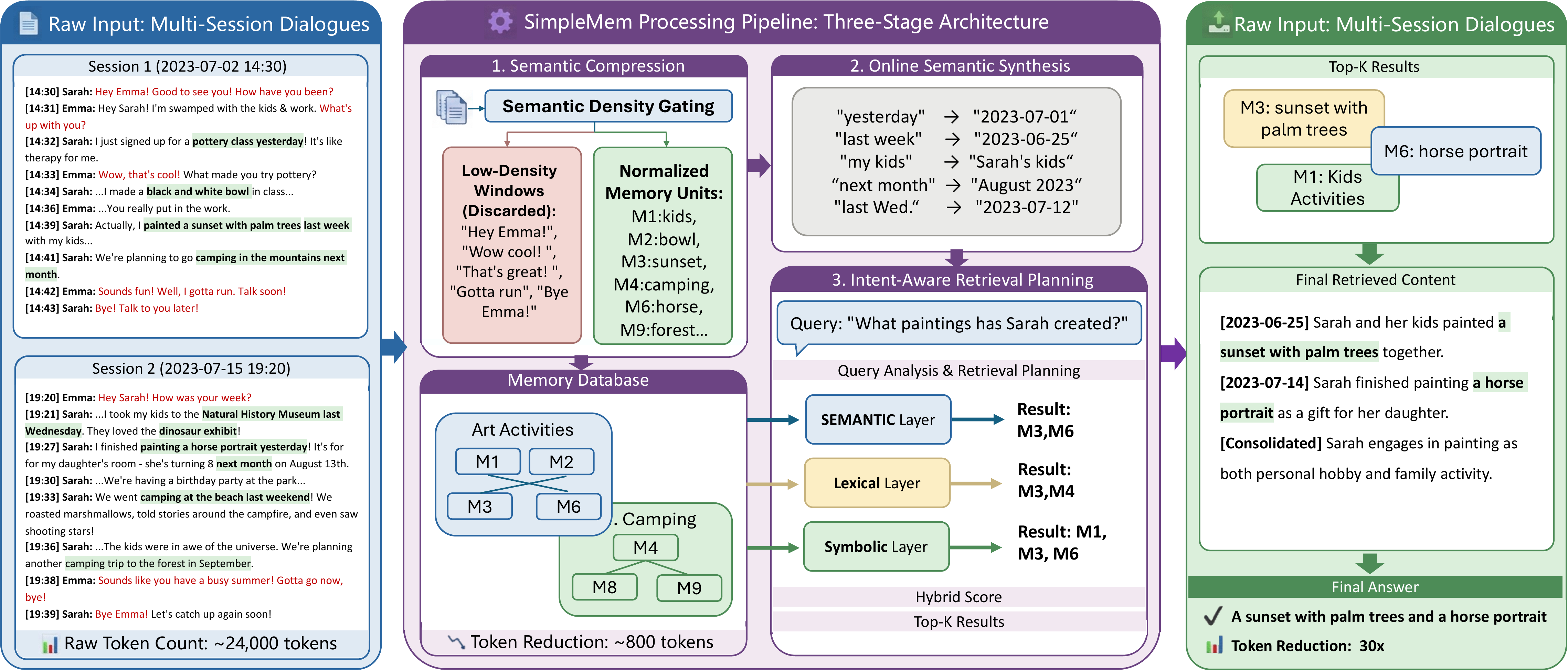
To illustrate how SimpleMem handles long-horizon conversational history, Figure 3 presents a representative multi-session example spanning two weeks and approximately 24,000 raw tokens. SimpleMem filters low-information dialogue during ingestion and retains only high-utility memory entries, reducing the stored memory to about 800 tokens without losing task-relevant content. Temporal Normalization. Relative temporal expressions such as last week'' and yesterday'' refer to different absolute times across sessions. SimpleMem resolves it into absolute timestamps at memory construction time, ensuring consistent temporal grounding over long interaction gaps. Precise Retrieval. When queried about Sarah’s past artworks, the intent-aware retrieval planner infers both the semantic focus (art-related activities) and the temporal constraints implied by the query. The system then performs parallel multi-view retrieval, combining semantic similarity with symbolic filtering to exclude unrelated activities and return only temporally valid entries. This example demonstrates how structured compression, temporal normalization, and adaptive retrieval jointly enable reliable long-term reasoning under extended interaction histories.
为了说明 SimpleMem 如何处理长程对话历史,图3展示了一个跨越两周、约 24,000 个原始 token 的代表性多会话示例。 SimpleMem 在摄取期间过滤低信息量对话,只保留高效用记忆条目,在不丢失任务相关内容的情况下把存储记忆减少到约 800 个 token。 时间规范化。 last week'' 和 yesterday'' 等相对时间表达在不同会话中指向不同绝对时间。 SimpleMem 在记忆构建时将其解析为绝对时间戳,确保跨长期交互间隔的一致时间 grounding。 精确检索。 当被问及 Sarah 过去的艺术作品时,意图感知检索规划器会推断语义焦点(艺术相关活动)以及查询隐含的时间约束。 随后系统执行并行多视图检索,把语义相似性与符号过滤结合起来,以排除无关活动并仅返回时间有效条目。 这个示例展示了结构化压缩、时间规范化和自适应检索如何在扩展交互历史下共同实现可靠长期推理。
4. Related Work
Memory Systems for LLM Agents. Recent approaches manage memory through virtual context or structured representations. Virtual context methods, including MemGPT, MemoryOS, and SCM, extend interaction length via paging or stream-based controllers but typically store raw conversation logs, leading to redundancy and increasing processing costs. In parallel, structured and graph-based systems, such as MemoryBank, Mem0, Zep, A-Mem, and O-Mem, impose structural priors to improve coherence but still rely on raw or minimally processed text, preserving referential and temporal ambiguities that degrade long-term retrieval. In contrast, SimpleMem adopts a semantic compression mechanism that converts dialogue into independent, self-contained facts, explicitly resolving referential and temporal ambiguities prior to storage.
LLM 智能体的记忆系统。 近期方法通过虚拟上下文或结构化表示来管理记忆。 MemGPT、MemoryOS 和 SCM 等虚拟上下文方法通过分页或基于流的控制器扩展交互长度,但通常存储原始对话日志,导致冗余并增加处理成本。 与此同时,MemoryBank、Mem0、Zep、A-Mem 和 O-Mem 等结构化和基于图的系统施加结构先验以提升连贯性,但仍依赖原始或最低限度处理的文本,保留了会降低长期检索效果的指代和时间歧义。 相比之下,SimpleMem 采用语义压缩机制,将对话转换为独立、自包含事实,并在存储前显式解决指代和时间歧义。
Context Management and Retrieval Efficiency. Beyond memory storage, efficient access to historical information remains a core challenge. Existing approaches primarily rely on either long-context models or retrieval-augmented generation (RAG). Although recent LLMs support extended context windows, and prompt compression methods aim to reduce costs, empirical studies reveal the “Lost-in-the-Middle” effect, where reasoning performance degrades as context length increases, alongside prohibitive computational overhead for lifelong agents. RAG-based methods, including structurally enhanced variants such as GraphRAG and LightRAG, decouple memory from inference but are largely optimized for static knowledge bases, limiting their effectiveness for dynamic, time-sensitive episodic memory. In contrast, SimpleMem improves retrieval efficiency through Intent-Aware Retrieval Planning, jointly leveraging semantic, lexical, and symbolic signals to construct query-specific retrieval plans and dynamically adapt the retrieval budget, achieving token-efficient reasoning under constrained context budgets.
上下文管理与检索效率。 除记忆存储外,对历史信息的高效访问仍是核心挑战。 现有方法主要依赖长上下文模型或检索增强生成(RAG)。 尽管近期 LLM 支持扩展上下文窗口,提示压缩方法也旨在降低成本,但实证研究揭示了“Lost-in-the-Middle”效应,即推理性能会随着上下文长度增加而退化,同时终身智能体还面临难以承受的计算开销。 基于 RAG 的方法,包括 GraphRAG 和 LightRAG 等结构增强变体,将记忆与推理解耦,但主要针对静态知识库优化,限制了它们对动态、时间敏感情景记忆的有效性。 相比之下,SimpleMem 通过 Intent-Aware Retrieval Planning 提高检索效率,联合利用语义、词汇和符号信号构造查询特定检索计划,并动态适配检索预算,从而在受限上下文预算下实现 token 高效推理。
5. Conclusion
We introduce SimpleMem, an efficient agent memory architecture grounded in the principle of semantic lossless compression. By treating memory as an active process rather than passive storage, SimpleMem integrates Semantic Structured Compression to filter noise at the source, Online Semantic Synthesis to consolidate fragmented observations during writing, and Intent-Aware Retrieval Planning to dynamically adapt retrieval scope. Empirical evaluation on the LoCoMo and LongMemEval-S benchmark demonstrates the effectiveness and efficiency of our method.
我们提出 SimpleMem,这是一个以语义无损压缩原则为基础的高效智能体记忆架构。 通过把记忆视为主动过程而不是被动存储,SimpleMem 整合 Semantic Structured Compression 在源头过滤噪声,整合 Online Semantic Synthesis 在写入期间巩固碎片化观察,并整合 Intent-Aware Retrieval Planning 动态适配检索范围。 在 LoCoMo 和 LongMemEval-S 基准上的实证评估证明了我们方法的有效性和效率。