
TiMem: Temporal-Hierarchical Memory Consolidation for Long-Horizon Conversational Agents
MemoryAgentTemporal Memory160+ACL Findings 2026中科院自动化所 / 国科大TiMem:面向长程对话智能体的时序层次记忆巩固
Abstract
Long-horizon conversational agents have to manage ever-growing interaction histories that quickly exceed the finite context windows of large language models (LLMs). Existing memory frameworks provide limited support for temporally structured information across hierarchical levels, often leading to fragmented memories and unstable long-horizon personalization. We present TiMem, a temporal--hierarchical memory framework that organizes conversations through a Temporal Memory Tree (TMT), enabling systematic memory consolidation from raw conversational observations to progressively abstracted persona representations.
长程对话智能体必须管理持续增长的交互历史,而这些历史会迅速超出大语言模型(LLM)有限的上下文窗口。 现有记忆框架对跨层级的时序结构化信息支持有限,常常导致记忆碎片化和长程个性化不稳定。 我们提出 TiMem,这是一种时序层次记忆框架,通过时序记忆树(Temporal Memory Tree,TMT)组织对话,使记忆能够从原始对话观察逐步巩固为更抽象的人格表示。
TiMem is characterized by three core properties: (1) temporal--hierarchical organization through TMT; (2) semantic-guided consolidation that enables memory integration across hierarchical levels without fine-tuning; and (3) complexity-aware memory recall that balances precision and efficiency across queries of varying complexity. Under a consistent evaluation setup, TiMem achieves state-of-the-art accuracy on both benchmarks, reaching 75.30% on LoCoMo and 76.88% on LongMemEval-S. It outperforms all evaluated baselines while reducing the recalled memory length by 52.20% on LoCoMo. Manifold analysis indicates clear persona separation on LoCoMo and reduced dispersion on LongMemEval-S.
TiMem 具有三个核心特性:(1) 通过 TMT 实现时序层次组织;(2) 语义引导的巩固,无需微调即可跨层级整合记忆;(3) 复杂度感知的记忆召回,可在复杂程度不同的查询之间平衡精度与效率。 在一致的评估设置下,TiMem 在两个基准上均取得了最先进的准确率,在 LoCoMo 上达到 75.30%,在 LongMemEval-S 上达到 76.88%。 它优于所有参与评估的基线,同时在 LoCoMo 上将召回记忆长度减少了 52.20%。 流形分析表明,LoCoMo 上的人格分离更加清晰,而 LongMemEval-S 上的离散程度有所降低。
Overall, TiMem treats temporal continuity as a first-class organizing principle for long-horizon memory in conversational agents.
总体而言,TiMem 将时间连续性视为对话智能体长程记忆的一等组织原则。
1. Introduction
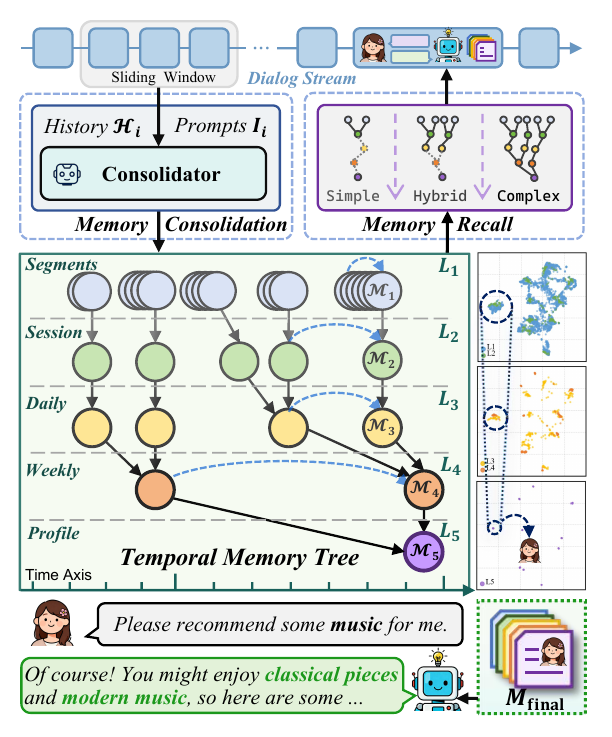
Large Language Models (LLMs) have enabled conversational agents to evolve from short-horizon task solvers to long-horizon personalized companions. Supporting such interactions requires two capabilities: maintaining temporal coherence as user states evolve, and forming stable representations by distilling consistent personas from dynamic experiences. However, interaction histories grow unbounded, while LLMs operate under finite context windows, making it harder to sustain temporally consistent personalization at scale. The key challenge is to transform long-horizon experience into compact representations that remain temporally grounded and useful for subsequent tasks.
大语言模型(LLM)使对话智能体得以从短程任务求解器演化为长程个性化伙伴。 支持此类交互需要两项能力:随着用户状态演化保持时间一致性,以及从动态经历中提炼一致的人格并形成稳定表示。 然而,交互历史会无限增长,而 LLM 只能在有限上下文窗口中运行,因此难以大规模维持时间一致的个性化。 关键挑战是将长程经历转化为紧凑表示,同时使其保持时间依据并能服务于后续任务。
Existing solutions under-emphasize temporal structure as a first-class constraint, and often lack explicit temporal containment guarantees across hierarchical levels. Parametric approaches expand context windows or optimize internal context capacity, but they remain bounded by model architecture and do not provide persistent cross-session storage. External memory systems enable persistence but often rely on semantic similarity-driven clustering or learned routing policies, treating temporal structure as auxiliary metadata. As a result, memories from different periods can be aggregated without clear temporal boundaries, and retrieval may surface temporally distant evidence without an explicit ordering. For evolving users, persona modeling benefits from a time-ordered evidence chain rather than only semantically similar fragments.
现有方案没有充分重视时序结构这一首要约束,而且往往缺乏跨层级的明确时间包含保证。 参数化方法扩展上下文窗口或优化内部上下文容量,但仍受模型架构限制,无法提供持久的跨会话存储。 外部记忆系统能够提供持久性,但通常依赖语义相似度驱动的聚类或学习式路由策略,将时序结构仅仅视为辅助元数据。 因此,不同时期的记忆可能在缺乏明确时间边界的情况下被聚合,而检索也可能在没有显式排序的情况下返回时间相隔很远的证据。 对于不断演化的用户,人格建模更需要按时间排序的证据链,而不只是语义相似的片段。
Cognitive neuroscience provides a principled perspective on this problem. Human memory relies on complementary learning systems, where memory consolidation progressively transforms rapid episodic encoding into more stable semantic structures. This adaptive process prioritizes goal-relevant information over indiscriminate retention. Translating this view to long-horizon agents suggests two design requirements: time should be encoded as an explicit structural constraint, and memory should be consolidated progressively across temporal granularities.
认知神经科学为这一问题提供了有原则的视角。 人类记忆依赖互补学习系统,其中 记忆巩固 会逐步将快速的情景编码转化为更稳定的语义结构。 这一自适应过程会优先处理与目标相关的信息,而不是不加区分地保留一切。 将这一观点用于长程智能体可以得到两项设计要求:应将时间编码为明确的结构约束,并应跨时间粒度逐步巩固记忆。
To this end, we introduce TiMem, a memory framework that uses temporal structure as the primary organizing principle and operationalizes consolidation in a computational form. TiMem consolidates fine-grained episodic interactions into higher-level semantic patterns and persona representations, rather than maintaining raw context buffers.
为此,我们提出 TiMem,这是一种以时序结构为主要组织原则、并以计算形式实现巩固过程的记忆框架。 TiMem 将细粒度情景交互巩固为更高层次的语义模式和人格表示,而不是维护原始上下文缓冲区。
As illustrated in Figure 1, TiMem implements a hierarchical consolidation mechanism with three components and requires no additional fine-tuning in our experiments. (1) The Temporal Memory Tree (TMT) organizes memories with explicit temporal containment and order through tree constraints. (2) The Memory Consolidator performs instruction-guided consolidation; level-specific prompts control the abstraction level, enabling plug-and-play use across different LLM backends. (3) Memory Recall performs complexity-aware hierarchical retrieval: a recall planner selects appropriate hierarchy levels based on query complexity, and a recall gating step filters candidates to balance factual detail with higher-level personalization.
如图1所示,TiMem 实现了由三个组件构成的层次化巩固机制,并且在我们的实验中不需要额外微调。 (1) 时序记忆树(TMT) 通过树约束,以明确的时间包含关系和顺序组织记忆。 (2) 记忆巩固器 执行指令引导的巩固;层级特定提示控制抽象程度,使其可以即插即用于不同的 LLM 后端。 (3) 记忆召回 执行复杂度感知的层次化检索:召回规划器依据查询复杂度选择适当的层级,召回门控步骤则过滤候选项,在事实细节与更高层次的个性化之间取得平衡。
Our contributions are threefold:
我们的贡献有三个方面:
- the TMT, a novel structure that enforces explicit temporal containment and granularity for memory organization;
- the TiMem framework, a temporal--hierarchical memory consolidation framework based on instruction-guided reasoning and complexity-adaptive recall, requiring no fine-tuning;
- a comprehensive evaluation demonstrating TiMem's state-of-the-art accuracy (75.30% on LoCoMo, 76.88% on LongMemEval-S) and efficiency (52.20% reduced recalled context on LoCoMo), with ablations and manifold analyses providing insights into its hierarchical representations.
- TMT,一种为记忆组织强制施加明确时间包含关系和粒度的新结构;
- TiMem 框架,一种基于指令引导推理和复杂度自适应召回、无需微调的时序层次记忆巩固框架;
- 全面的评估,展示了 TiMem 最先进的准确率(LoCoMo 上为 75.30%,LongMemEval-S 上为 76.88%)和效率(LoCoMo 上召回上下文减少 52.20%),并通过消融与流形分析揭示其层次表示的性质。
2. Related Work
Parametric Memory Approaches. Context window expansion methods such as Gemini, LongLoRA, and RoPE scaling alleviate sequence length limits but incur quadratic computational costs and attention dilution. Parametric optimization approaches, including MemLoRA, HMT, and TRIM-KV, compress memory through adapter distillation or learned token retention. However, they remain constrained by architectural context windows and do not support persistent cross-session memory.
参数化记忆方法。 Gemini、LongLoRA 和 RoPE scaling 等上下文窗口扩展方法缓解了序列长度限制,但会产生二次方计算成本和注意力稀释问题。 MemLoRA、HMT 和 TRIM-KV 等参数化优化方法通过适配器蒸馏或学习式 token 保留来压缩记忆。 然而,它们仍受架构上下文窗口限制,并且不支持持久的跨会话记忆。
External Memory Management. Semantic clustering approaches, including Mem0, RAPTOR, and MemTree, organize memory through embedding-based similarity aggregation. Graph-based approaches, including Zep, LiCoMemory, and Theanine, explicitly model entity relations and temporal knowledge. Cognitively motivated frameworks such as A-MEM, Nemori, ENGRAM, and RMM employ self-organizing or agentic mechanisms, while preference-aware systems like MemoryBank and PAMU support personalization through dynamic updates. OS-inspired memory systems such as MemGPT, MemoryOS, and MemOS manage long contexts via hierarchical tiers and virtual memory mechanisms. However, most existing approaches do not treat temporal structure as a first-class organizing principle, resulting in fragmented memory representations and unstable long-horizon behavior.
外部记忆管理。 Mem0、RAPTOR 和 MemTree 等语义聚类方法通过基于嵌入的相似性聚合来组织记忆。 Zep、LiCoMemory 和 Theanine 等图方法显式建模实体关系和时序知识。 A-MEM、Nemori、ENGRAM 和 RMM 等认知启发框架采用自组织或智能体机制,而 MemoryBank 和 PAMU 等偏好感知系统则通过动态更新支持个性化。 MemGPT、MemoryOS 和 MemOS 等操作系统启发的记忆系统通过层次化存储层和虚拟记忆机制管理长上下文。 然而,大多数现有方法并未将时序结构视为一等组织原则,因而会产生碎片化的记忆表示和不稳定的长程行为。
3. Methodology
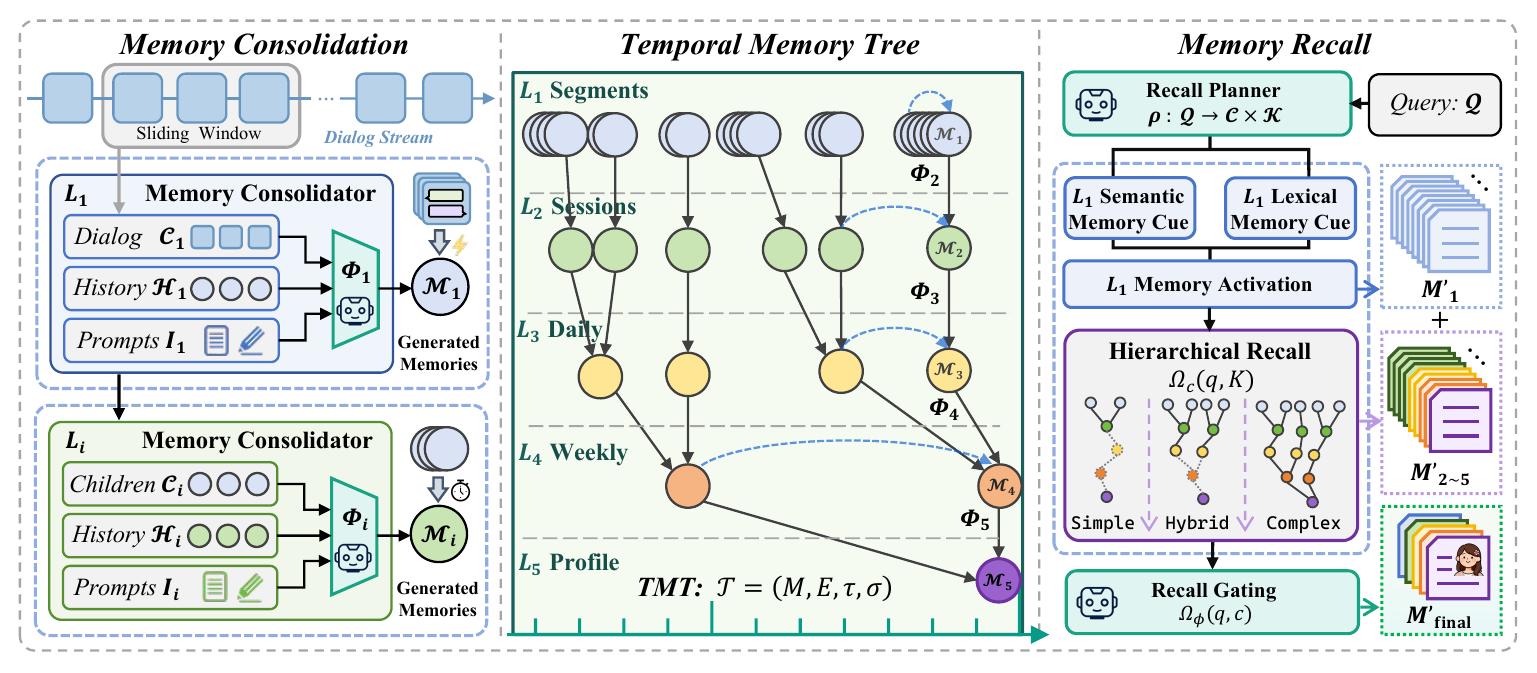
We present TiMem, a temporal--hierarchical memory framework for long-horizon conversational agents. TiMem consists of (i) a TMT that encodes temporal structure, (ii) a Memory Consolidator that performs level-specific consolidation via instruction prompting without fine-tuning, and (iii) a Recall pipeline that uses a planner to select relevant memory levels and a recall gating module to retain query-relevant memories, as illustrated in Figure 2.
我们提出 TiMem,这是一种面向长程对话智能体的时序层次记忆框架。 如图2所示,TiMem 包含:(i) 编码时序结构的 TMT;(ii) 无需微调、通过指令提示执行层级特定巩固的记忆巩固器;以及 (iii) 召回流程,其中规划器负责选择相关记忆层级,召回门控模块负责保留与查询相关的记忆。
3.1 Temporal Memory Tree
The TMT provides a stable backbone for long-horizon memory: it preserves temporal coherence, supports progressive consolidation, and reduces noise by transforming details into higher-level abstracts. Lower-level memories cover short intervals and keep concrete details, while higher-level ones span longer intervals and store more consolidated representations. Each node
TMT 为长程记忆提供了稳定骨架:它保持时间一致性、支持渐进式巩固,并通过将细节转化为更高层次的抽象来减少噪声。 低层记忆覆盖较短时间区间并保留具体细节,高层记忆则跨越更长区间并存储巩固程度更高的表示。 每个节点
Definition. TMT is a hierarchical memory structure
定义。 TMT 是一个层次化记忆结构
is the set of memory nodes partitioned across abstraction levels; defines parent--child relationships where , ; assigns each node a temporal interval which is continuous over periods; maps each node to a semantic memory stored as text and embeddings.
是划分到 个抽象层级的记忆节点集合; 定义父子关系,其中 , ; 为每个节点分配一个时间区间 ,该区间在各时间段上连续; 将每个节点映射到以文本和嵌入形式存储的语义记忆 。
Structural Properties. The structure is governed by three principles that make temporal order explicit and enable progressive abstraction:
结构性质。 该结构遵循三项原则,使时间顺序显式化并支持渐进式抽象:
- Temporal Containment:
, for each parent-child edge , the parent interval covers the child interval. - Progressive Consolidation:
ensures higher-level memories are fewer, reflecting consolidation from fine-grained facts to patterns and profiles. - Semantic Consolidation: Specified by level-specific instruction prompts
, enables hierarchy specialization through the consolidation process.
- 时间包含:
;对于每条父子边 ,父节点区间覆盖子节点区间。 - 渐进式巩固:
确保高层记忆数量更少,反映从细粒度事实到模式和画像的巩固过程。 - 语义巩固: 由层级特定指令提示
指定; 使各层能够通过巩固过程形成专门化表示。
Implementation. TMT supports arbitrary
实现。 TMT 支持任意的
- Factual Summarization: Segments
distill key dialog details; Sessions merge into non-redundant event summaries. - Evolving Patterns: Daily
captures routine contexts and recurrent interests; Weekly integrates evolving behavioral features and preference patterns. - Persona Representation: Profile
is an incrementally refined profile capturing stable personality, preferences, and values from long-term patterns, updated on monthly intervals.
- 事实摘要: 片段层
提炼关键对话细节;会话层 将其合并为无冗余的事件摘要。 - 演化模式: 天层
捕获日常情境和反复出现的兴趣;周层 整合不断演化的行为特征与偏好模式。 - 人格表示: 画像层
是一份增量细化的画像,从长期模式中捕获稳定性格、偏好和价值观,并按月更新。
The framework is designed to be model-independent and does not require fine-tuning; it can be applied across different LLM backbones.
该框架被设计为与模型无关且无需微调,可应用于不同的 LLM 骨干模型。
3.2 Memory Consolidation
TiMem constructs the hierarchy with a Memory Consolidator that converts dialog into structured memories and uses Stratified Scheduling to balance consolidation efficiency and computational cost.
TiMem 使用记忆巩固器构建层次结构:该巩固器将对话转化为结构化记忆,并通过分层调度平衡巩固效率与计算成本。
3.2.1 Memory Consolidator
At level
在第
In the formula,
在该公式中,
Child Memories. We group the conversation timeline into intervals
子记忆。 我们将对话时间线划分为区间
At the base level (
在基础层(
Historical Memories.
历史记忆。
where
其中,
3.2.2 Stratified Scheduling
Memory consolidation follows a two-tier scheduling strategy that balances freshness and efficiency:
记忆巩固采用双层调度策略,在新鲜度与效率之间取得平衡:
- Online consolidation (
): Factual segment memories are generated immediately as the dialog progresses. With dialog turn (one user--assistant exchange), the consolidator is invoked after each new turn to capture fine-grained evidence. - Scheduled consolidation (
- ): Higher-level memories are generated automatically when their temporal windows end. Upon closure of temporal group , the framework triggers to consolidate child memories into a higher-level, more abstract representation.
- 在线巩固(
): 随着对话进行,立即生成事实片段记忆 。当 个对话轮次(一次用户—助手交换)时,每完成一个新轮次便调用巩固器 ,以捕获细粒度证据。 - 定时巩固(
- ): 高层记忆 会在其时间窗口结束时自动生成。当时间分组 关闭时,框架触发 ,将子记忆巩固为层次更高、抽象程度更高的表示。
Thus, the stratified design ensures that factual details are captured in real time while consolidation is aligned with predefined temporal boundaries.
因此,这种分层设计既能实时捕获事实细节,又能使巩固过程与预定义时间边界对齐。
3.3 Memory Recall
Memory recall traverses the TMT to surface relevant memories, balancing precision, efficiency, and context length. It adapts scope to query complexity: simple questions target exact evidence, while complex ones recall more context across all levels. A final recall gating performs recall-time forgetting, filtering redundancy and conflicts, retaining only memories required for the current interaction.
记忆召回遍历 TMT 以找出相关记忆,并在精度、效率和上下文长度之间取得平衡。 它根据查询复杂度调整范围:简单问题以精确证据为目标,复杂问题则从所有层级召回更多上下文。 最后的召回门控执行召回时遗忘,过滤冗余和冲突,仅保留当前交互所需的记忆。
3.3.1 Recall Planner
The planner
规划器
Query complexity determines which TMT levels to search. We define three layer groups:
查询复杂度决定要搜索哪些 TMT 层级。 我们定义了三组层级:
- Factual Layers (
): - capturing fine-grained event details. - Pattern Layers (
): - behavioral trends and patterns. - Profile Layer (
): synthesizing long-term, stable characteristics.
- 事实层(
): - ,捕获细粒度事件细节。 - 模式层(
): - ,捕获行为趋势和模式。 - 画像层(
): ,综合长期稳定特征。
Although simple queries are short, they can still ask about stable preferences, so we include the profile layer
尽管 simple 查询很短,它们仍可能询问稳定偏好,因此我们默认纳入画像层
The recall strategy
召回策略
where
其中,
3.3.2 Hierarchical Recall
Hierarchical recall operates in two stages: leaf selection at the base level, followed by hierarchical recall propagation through memory subtrees.
层次化召回分两个阶段运行:首先在基础层选择叶节点,然后通过记忆子树进行层次化召回传播。
Stage 1: Base-Level Memory Activation. At
阶段 1:基础层记忆激活。 在
where
其中,
Stage 2: Hierarchical Recall Propagation. For each leaf
阶段 2:层次化召回传播。 对于每个叶节点
where
其中,
For brevity, we denote this candidate set as
为简洁起见,我们将该候选集记为
3.3.3 Recall Gating
Recall gating implements recall-time forgetting: after collecting candidate memories, we keep only the truly useful ones for answering the query.
召回门控实现 召回时遗忘:收集候选记忆后,我们只保留真正有助于回答查询的记忆。
The recall gating module
召回门控模块
where
其中,
The retained memories are ranked by hierarchy level and temporal proximity within each level:
保留的记忆按照层级以及各层内的时间接近程度排序:
where
其中,
3.3.4 Recall Pipeline
The complete recall integrates three stages:
完整召回流程整合三个阶段:
- Recall planner:
predicts complexity and extracts keywords to determine the hierarchical search scope. - Hierarchical Recall: Dual-channel scoring selects
leaves, then hierarchical recall propagation collects relevant ancestors at planner-specified levels, forming the candidate set . - Recall Gating: The refiner filters the candidates based on query relevance and temporal consistency, then orders them to produce the final memory set
.
- 召回规划器:
预测复杂度 并抽取关键词 ,以确定层次化搜索范围。 - 层次化召回: 双通道评分选择
叶节点,随后层次化召回传播在规划器指定的层级收集相关祖先节点,形成候选集 。 - 召回门控: 细化器依据查询相关性和时间一致性过滤候选项,然后对其排序,生成最终记忆集合
。
This pipeline enables complexity-adaptive recall that balances precision and temporal relevance across TMT's hierarchical structure.
该流程实现了复杂度自适应召回,可在 TMT 层次结构中平衡精度与时间相关性。
4. Experiments
4.1 Experimental Setup
Datasets. We evaluate on two long-term conversational memory benchmarks: LoCoMo, a dataset with 10 user groups across multi-session dialog, and LongMemEval-S, including 500 conversations designed for very-long memory processing evaluation.
数据集。 我们在两个长期对话记忆基准上进行评估:LoCoMo 是一个包含 10 个用户组和多会话对话的数据集;LongMemEval-S 包含 500 段对话,专门用于评估超长记忆处理能力。
Baselines. We compare TiMem with five representative memory baselines using their recommended configurations: MemoryBank, Mem0, A-MEM, MemoryOS, and MemOS.
基线。 我们使用各方法推荐的配置,将 TiMem 与五个有代表性的记忆基线进行比较:MemoryBank、Mem0、A-MEM、MemoryOS 和 MemOS。
Implementation Details. For fair comparison, all methods use the same LLM and embedding setup: gpt-4o-mini-2024-07-18 for generation and recall, Qwen3-Embedding-0.6B for embeddings, and recall budget
实现细节。 为进行公平比较,所有方法都使用相同的 LLM 和嵌入设置:使用 gpt-4o-mini-2024-07-18 进行生成和召回,使用 Qwen3-Embedding-0.6B 生成嵌入,并将召回预算设为
4.2 Main Results
4.2.1 Results on LoCoMo
Table 1 shows that TiMem achieves the best overall LLJ accuracy on LoCoMo at 75.30% ± 0.16%. It outperforms the strongest evaluated baseline, MemOS, at 69.24% ± 0.11%. TiMem also improves F1 and ROUGE-L (RL) to 54.40 and 54.68 in percentage, and achieves the best LLJ score in each question type. We compute LLJ using Mem0's evaluation prompt template, as shown in the appendix.
表1显示,TiMem 在 LoCoMo 上取得最佳总体 LLJ 准确率,达到 75.30% ± 0.16%。 它优于参与评估的最强基线 MemOS,后者为 69.24% ± 0.11%。 TiMem 还将 F1 和 ROUGE-L(RL)分别提升到 54.40 和 54.68,并在每种问题类型上都取得最佳 LLJ 分数。 我们使用 Mem0 的评估提示模板计算 LLJ,具体见附录。
| Method | Single-Hop | Temporal | Open-Domain | Multi-Hop | Overall | F1 | RL |
|---|---|---|---|---|---|---|---|
| ↑ LLJ (841Q) | ↑ LLJ (321Q) | ↑ LLJ (96Q) | ↑ LLJ (282Q) | ↑ LLJ (1540Q) | ↑ | ↑ | |
| MemoryBank | 46.18 ± 0.32 | 29.34 ± 0.45 | 36.67 ± 0.47 | 33.36 ± 0.54 | 39.77 ± 0.27 | 25.78 | 25.15 |
| A-MEM | 52.82 ± 0.28 | 60.87 ± 0.37 | 43.75 ± 0.00 | 38.37 ± 0.27 | 51.29 ± 0.06 | 30.37 | 36.85 |
| Mem0 | 62.09 ± 0.42 | 59.25 ± 0.41 | 37.70 ± 0.47 | 50.14 ± 0.32 | 57.79 ± 0.34 | 42.52 | 44.14 |
| MemoryOS | 68.37 ± 0.46 | 52.46 ± 0.49 | 46.67 ± 1.79 | 52.76 ± 0.49 | 60.79 ± 0.48 | 45.36 | 43.74 |
| MemOS | 76.07 ± 0.10 | 69.47 ± 0.25 | 45.14 ± 0.49 | 56.85 ± 0.69 | 69.24 ± 0.11 | 45.02 | 47.41 |
| TiMem (Ours) | 81.43 ± 0.05 | 77.63 ± 0.34 | 52.08 ± 0.74 | 62.20 ± 0.82 | 75.30 ± 0.16 | 54.40 | 54.68 |
4.2.2 Results on LongMemEval-S
Table 2 shows that TiMem achieves the best overall LLJ accuracy on LongMemEval-S at 76.88% ± 0.30% with gpt-4o-mini-2024-07-18 as the answer model, outperforming the evaluated baselines. With gpt-4o-2024-11-20 as the answer model, TiMem remains best overall at 78.96% ± 0.26%. The QA and LLJ protocol follow the official LongMemEval-S evaluation template, as shown in the appendix.
表2显示,以 gpt-4o-mini-2024-07-18 作为回答模型时,TiMem 在 LongMemEval-S 上取得最佳总体 LLJ 准确率 76.88% ± 0.30%,优于参与评估的基线。 以 gpt-4o-2024-11-20 作为回答模型时,TiMem 仍以 78.96% ± 0.26% 的总体成绩保持最佳。 QA 和 LLJ 协议遵循 LongMemEval-S 官方评估模板,具体见附录。
| Method | LongMemEval-S Task Categories | Overall | |||||
|---|---|---|---|---|---|---|---|
| KU | MS | SSA | SSP | SSU | TR | ||
| ↑ (78Q) | ↑ (133Q) | ↑ (56Q) | ↑ (30Q) | ↑ (70Q) | ↑ (133Q) | ↑ (500Q) | |
| Answer Model: GPT-4o-mini-2024-07-18 | |||||||
| MemoryBank | 21.79 ± 0.00 | 9.77 ± 0.00 | 50.00 ± 0.00 | 12.00 ± 1.83 | 29.71 ± 0.64 | 17.14 ± 0.34 | 21.04 ± 0.09 |
| A-MEM | 72.82 ± 0.51 | 40.30 ± 0.37 | 87.50 ± 0.00 | 39.33 ± 2.49 | 82.86 ± 0.00 | 36.09 ± 0.48 | 55.44 ± 0.15 |
| Mem0 | 78.72 ± 0.70 | 66.17 ± 0.92 | 51.79 ± 0.00 | 50.00 ± 2.36 | 94.29 ± 0.00 | 49.17 ± 0.67 | 64.96 ± 0.41 |
| MemoryOS | 56.15 ± 0.57 | 44.81 ± 0.41 | 78.18 ± 0.00 | 51.33 ± 1.83 | 81.14 ± 0.64 | 53.38 ± 0.00 | 58.04 ± 0.18 |
| MemOS | 76.67 ± 0.51 | 58.80 ± 0.30 | 67.86 ± 0.00 | 50.67 ± 1.33 | 93.71 ± 0.70 | 65.11 ± 0.37 | 68.68 ± 0.16 |
| TiMem (Ours) | 86.16 ± 1.07 | 70.83 ± 0.98 | 82.14 ± 0.00 | 63.33 ± 0.00 | 95.71 ± 0.00 | 68.42 ± 0.00 | 76.88 ± 0.30 |
| Answer Model: GPT-4o-2024-11-20 | |||||||
| MemoryBank | 22.56 ± 0.70 | 12.78 ± 0.00 | 61.43 ± 0.98 | 13.33 ± 0.00 | 33.43 ± 0.78 | 13.53 ± 0.00 | 22.88 ± 0.23 |
| A-MEM | 87.18 ± 0.00 | 45.26 ± 0.30 | 83.21 ± 0.87 | 56.67 ± 2.98 | 90.00 ± 0.00 | 46.77 ± 0.30 | 63.40 ± 0.33 |
| Mem0 | 84.87 ± 0.57 | 65.11 ± 0.41 | 55.00 ± 0.80 | 60.67 ± 1.49 | 95.71 ± 0.00 | 51.88 ± 0.00 | 67.56 ± 0.30 |
| MemoryOS | 60.00 ± 0.57 | 51.13 ± 0.53 | 80.00 ± 0.00 | 53.33 ± 0.00 | 82.86 ± 0.00 | 54.59 ± 0.67 | 61.20 ± 0.23 |
| MemOS | 76.07 ± 0.60 | 68.42 ± 0.00 | 63.69 ± 0.84 | 64.44 ± 1.57 | 92.86 ± 0.00 | 71.43 ± 0.61 | 73.07 ± 0.25 |
| TiMem (Ours) | 87.69 ± 0.70 | 72.78 ± 0.34 | 85.71 ± 0.00 | 55.33 ± 1.83 | 96.28 ± 0.78 | 73.38 ± 1.14 | 78.96 ± 0.26 |
4.3 Ablation Studies
We ablate TiMem to isolate the contribution of its main components. All ablations use gpt-4o-mini-2024-07-18 for LLM operations and Qwen3-Embedding-0.6B for embeddings.
我们对 TiMem 进行消融,以分离其主要组件的贡献。 所有消融实验都使用 gpt-4o-mini-2024-07-18 执行 LLM 操作,并使用 Qwen3-Embedding-0.6B 生成嵌入。
4.3.1 Planner and Recall Gating
Table 3 compares seven configurations of recall scope and gating. Fixed-scope recall under-recalls for Simple queries and introduces noise for Complex ones. Recall gating sharply reduces memory length—for example, from 3710.30 to 367.68 tokens on LoCoMo under Simple—but accuracy drops when the scope is overly narrow. Among fixed-scope settings, Hybrid + Recall Gating performs best, achieving 73.38% on LoCoMo and 75.00% on LongMemEval-S. The adaptive planner further improves the accuracy–cost trade-off, reaching 75.30% with 511.25 tokens on LoCoMo and 76.88% with 1270.62 tokens on LongMemEval-S.
表3比较了七种召回范围与门控配置。 固定范围召回会在 Simple 查询上召回不足,并在 Complex 查询上引入噪声。 召回门控会显著缩短记忆长度,例如在 LoCoMo 的 Simple 设置下从 3710.30 token 降至 367.68 token;但当范围过窄时,准确率也会下降。 在固定范围设置中,Hybrid + Recall Gating 表现最佳,在 LoCoMo 和 LongMemEval-S 上分别达到 73.38% 和 75.00%。 自适应规划器进一步改善了准确率与成本之间的权衡,在 LoCoMo 上以 511.25 token 达到 75.30%,在 LongMemEval-S 上以 1270.62 token 达到 76.88%。
| Configuration | LoCoMo | LongMemEval-S | ||
|---|---|---|---|---|
| LLJ ↑ | Mem Len ↓ | LLJ ↑ | Mem Len ↓ | |
| w/o Planner, w/o Gating | ||||
| Simple | 73.51 | 3710.30 | 73.20 | 3371.53 |
| Hybrid | 72.40 | 4376.40 | 74.00 | 4054.78 |
| Complex | 72.86 | 5658.26 | 74.40 | 5685.68 |
| w/o Planner, w Gating | ||||
| Simple | 71.88 | 367.68 | 69.00 | 397.04 |
| Hybrid | 73.38 | 691.59 | 75.00 | 1673.93 |
| Complex | 72.92 | 4479.06 | 74.20 | 3028.68 |
| w Planner, w/o Gating | ||||
| Planned | 72.99 | 4411.09 | 73.80 | 3941.98 |
| w P., w G. (Baseline) | 75.30 | 511.25 | 76.88 | 1270.62 |
4.3.2 Hierarchical Architecture
Table 4 examines hierarchy depth and recall strategy. With L1-only memories, hierarchical recall propagation raises LongMemEval-S LLJ from 57.40% to 72.40% compared to flat recall, indicating that hierarchical propagation recovers necessary temporal dependencies. However, L1-only remains below the full hierarchy on LoCoMo, as isolated factual fragments often lack the broader context required for complex queries. Using only high-level layers (L2--L5) further reduces accuracy, confirming that summaries alone cannot replace fine-grained evidence. Overall, the full hierarchy combines precise L1 grounding with contextual understanding from L2--L5, achieving the best performance on both datasets.
表4考察了层次深度与召回策略。 仅使用 L1 记忆时,与平面召回相比,层次化召回传播将 LongMemEval-S 的 LLJ 从 57.40% 提升至 72.40%,说明层次化传播能够恢复必要的时间依赖。 然而,仅使用 L1 在 LoCoMo 上仍不及完整层次结构,因为孤立的事实片段往往缺少复杂查询所需的更广泛上下文。 仅使用高层记忆(L2--L5)会进一步降低准确率,证实摘要本身无法取代细粒度证据。 总体而言,完整层次结构将精确的 L1 依据与 L2--L5 的上下文理解相结合,在两个数据集上均取得最佳性能。
These ablations support TiMem's core design: the temporal hierarchy provides both factual precision and contextual understanding through memory consolidation, while the adaptive planner dynamically balances recall scope.
这些消融结果支持 TiMem 的核心设计:时序层次结构通过记忆巩固同时提供事实精度和上下文理解,而自适应规划器则动态平衡召回范围。
| Memory Layers | LoCoMo | LongMemEval-S | ||
|---|---|---|---|---|
| LLJ ↑ | Mem Len ↓ | LLJ ↑ | Mem Len ↓ | |
| L1 only (base layer) | ||||
| w Flat Rec. | 70.06 | 995.15 | 57.40 | 1823.98 |
| w Hier. Rec. | 73.18 | 361.23 | 72.40 | 437.42 |
| L2–L5 only (high-level) | ||||
| w Flat Rec. | 51.23 | 2348.49 | 48.00 | 2657.68 |
| w Hier. Rec. | 57.08 | 3786.44 | 64.20 | 2344.92 |
| L1–L5 (full hierarchy) | ||||
| w Flat Rec. | 70.71 | 1715.65 | 55.40 | 4519.26 |
| w H. R. (Baseline) | 75.30 | 511.25 | 76.88 | 1270.62 |
4.4 Memory Manifold Analysis
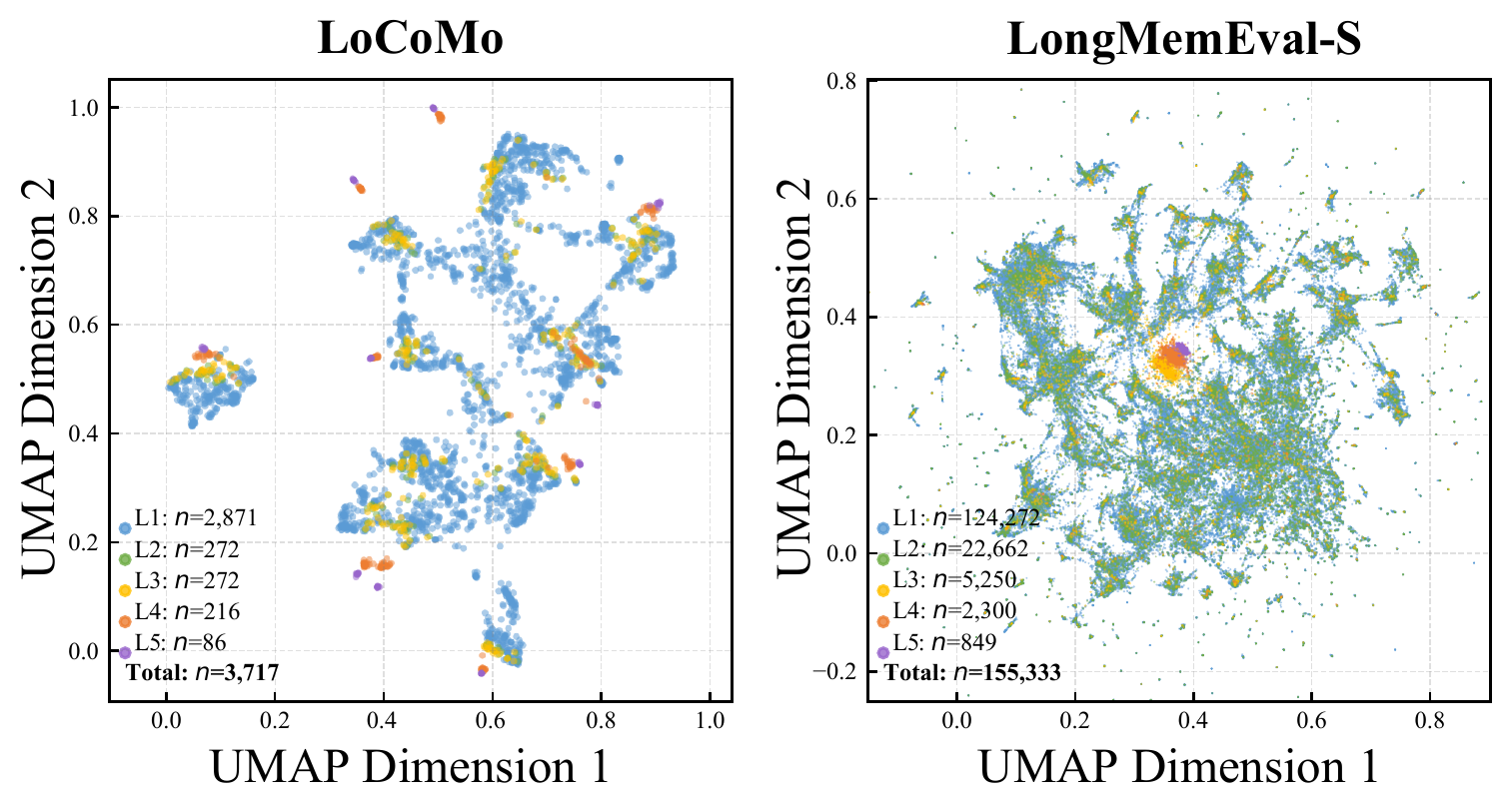
Figure 3 illustrates UMAP visualization of TiMem memory embeddings on LoCoMo and LongMemEval-S through different hierarchies. It shows that consolidation reshapes memory geometry differently across datasets. On LoCoMo, higher-level memories separate users more clearly, with clustering quality improving
图3展示了 TiMem 在 LoCoMo 和 LongMemEval-S 上经过不同层次结构处理后的记忆嵌入 UMAP 可视化。 结果表明,巩固会以不同方式重塑不同数据集上的记忆几何结构。 在 LoCoMo 上,高层记忆能够更清晰地区分用户,聚类质量提高
4.5 Efficiency Analysis
We evaluate TiMem's efficiency by analyzing both offline consolidation overhead and online recall performance. Table 5 compares the LLM calls required for consolidation, while Table 6 reports memory context length and latency.
我们通过分析离线巩固开销和在线召回性能来评估 TiMem 的效率。 表5比较了巩固所需的 LLM 调用次数,表6则报告记忆上下文长度和延迟。
| Dataset | L1-only | Full TMT | Extra Calls | Rate |
|---|---|---|---|---|
| LoCoMo | 2,871 | 3,717 | 846 | +29.5% |
| LME-S | 124,272 | 155,333 | 31,061 | +25.0% |
| Method | LoCoMo | LongMemEval-S | ||
|---|---|---|---|---|
| Memory | Latency | Memory | Latency | |
| ↓ (tokens) | ↓ (P50/P95) | ↓ (tokens) | ↓ (P50/P95) | |
| MemoryBank | 8063.77 | 9.46/13.07 | 13906.81 | 10.74/14.50 |
| A-MEM | 2431.4 | 1.74/7.23 | 3971.6 | 5.12/11.89 |
| Mem0 | 1070.10 | 2.44/4.29 | 1647.56 | 3.64/6.11 |
| MemoryOS | 4659.09 | 1.66/2.21 | 7574.30 | 1.63/3.95 |
| MemOS | 1371.42 | 1.69/3.44 | 1091.51 | 1.64/2.70 |
| TiMem (Ours) | 511.25 | 2.35/4.91 | 1270.62 | 1.76/4.48 |
As shown in Table 5, the full TMT hierarchy increases internal LLM calls by 25%--30% compared to a flat L1-only baseline. However, this consolidation cost is amortized over the interaction history and significantly lowers the token cost and latency for the external answering model during inference.
如表5所示,与平面 L1-only 基线相比,完整 TMT 层次结构使内部 LLM 调用增加 25%--30%。 然而,这一巩固成本会在交互历史中摊销,并显著降低推理期间外部回答模型的 token 成本和延迟。
Specifically, on LoCoMo, TiMem recalls only 511.25 tokens per query—a 52.20% reduction compared to Mem0's 1,070.10 tokens. The P50 recall latency is 2.35s on LoCoMo and 1.76s on LongMemEval-S. While latency is primarily dominated by internal LLM calls for planning and gating, the overall system remains efficient due to the shortened input context. We also observe that context length scales with query complexity, with the more diverse queries in LongMemEval-S requiring broader recall.
具体而言,在 LoCoMo 上,TiMem 每个查询仅召回 511.25 token,比 Mem0 的 1,070.10 token 减少 52.20%。 LoCoMo 上的 P50 召回延迟为 2.35 秒,LongMemEval-S 上为 1.76 秒。 尽管延迟主要由用于规划和门控的内部 LLM 调用决定,但缩短后的输入上下文使整体系统仍然高效。 我们还观察到,上下文长度会随查询复杂度扩大;LongMemEval-S 中更多样化的查询需要更广泛的召回。
4.6 Parameter Studies
We conduct a parameter study on LoCoMo.
我们在 LoCoMo 上进行了参数研究。
LLM Configuration. Under the same answering and judgement protocol, TiMem is portable across internal LLMs for memory operations. End-to-end performance is primarily driven by the answering LLM, with the best configuration reaching 80.45%, indicating that answer-time reasoning dominates once memory quality is adequate.
LLM 配置。 在相同的回答与判定协议下,TiMem 可以迁移到不同的内部 LLM 来执行记忆操作。 端到端性能主要由回答 LLM 决定,最佳配置达到 80.45%,这表明一旦记忆质量足够,回答阶段的推理便成为主导因素。
Segment Granularity. Increasing the L1 segment size consistently degrades accuracy, dropping from 75.30% at 1 turn to 65.26% at 8 turns, indicating that finer-grained segments better preserve atomic evidence for downstream QA.
片段粒度。 增大 L1 片段规模会持续降低准确率,从 1 轮时的 75.30% 降至 8 轮时的 65.26%,说明更细粒度的片段能够更好地为下游问答保留原子证据。
Semantic--Lexical Balance. We investigate the impact of
语义—词法平衡。 我们研究了混合检索中
Detailed experimental designs, results, and cross-configuration analysis are provided in the appendix.
详细实验设计、结果和跨配置分析见附录。
4.7 Case Study
Figure 4 contrasts TiMem's hierarchical consolidation against Mem0 fragmented memories.
图4对比了 TiMem 的层次化巩固与 Mem0 的碎片化记忆。
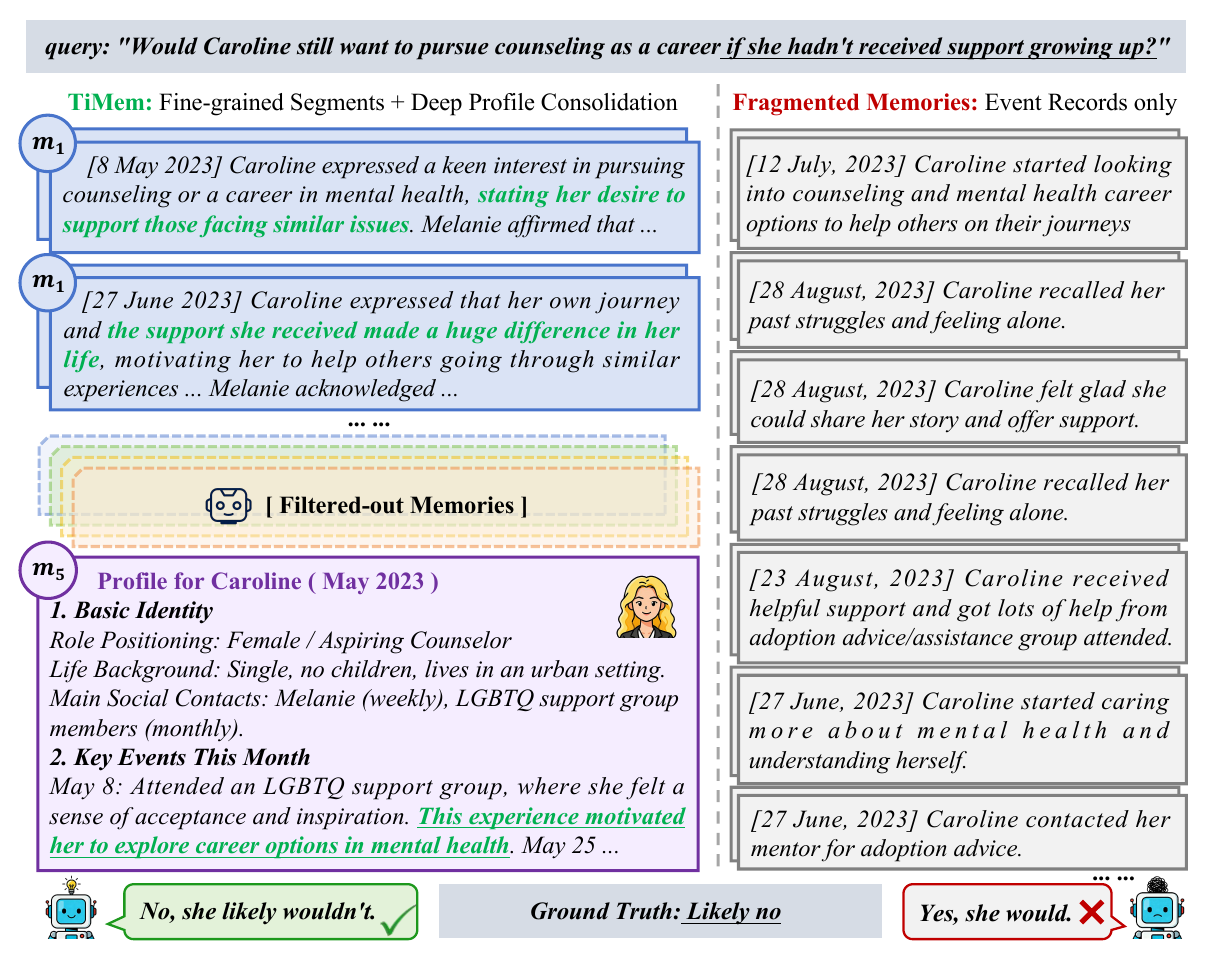
TiMem recalls segments establishing causal dependency, with the consolidated L5 profile connecting her career aspiration to formative experiences. The recall gating module excludes memories lacking true relevance. This structured causality yields the correct answer: No, she likely wouldn't.
TiMem 召回了建立因果依赖的片段,巩固后的 L5 画像将她的职业志向与成长经历联系起来。 召回门控模块排除了缺乏真正相关性的记忆。 这种结构化因果关系得出了正确答案:不,她很可能不会。
Mem0 as a representative baseline recalls fragmented factual memories. Without hierarchical consolidation, the framework fails to construct the support
作为代表性基线,Mem0 召回的是碎片化事实记忆。 由于缺少层次化巩固,该框架无法构建 支持
This comparison highlights how TMT's temporal containment and instruction-based consolidation organize episodic evidence into a coherent inferential structure for counterfactual reasoning.
这一对比凸显了 TMT 的时间包含关系和基于指令的巩固如何将情景证据组织成用于反事实推理的连贯推断结构。
4.8 Discussion
Our experiments suggest three key takeaways for long-horizon memory in conversational agents.
我们的实验为对话智能体中的长程记忆带来三项关键启示。
Temporal continuity is an effective organizing principle. By enforcing temporal containment, TMT provides stable temporal leaves for consolidation and recall, instead of treating semantic similarity as the primary structure. Ablation studies and manifold analysis indicate that this temporal hierarchy enables effective compression: it facilitates the construction of temporal evidence chains, amplifies user-specific distinctions, and suppresses noise in long dialogs.
时间连续性是一项有效的组织原则。 TMT 通过强制时间包含关系为巩固和召回提供稳定的时间叶节点,而不是将语义相似度视为主要结构。 消融研究和流形分析表明,这种时序层次结构能够实现有效压缩:它有助于构建时间证据链、放大用户特定差异,并抑制长对话中的噪声。
Semantic-guided consolidation makes abstraction explicit and portable. Level-specific prompts encourage distinct consolidation objectives across layers without architecture-specific tuning. Empirically, hierarchical consolidation outperforms the evaluated methods, indicating that progressive transformation over temporally grouped memories is beneficial beyond storing more text.
语义引导的巩固使抽象过程显式且可迁移。 层级特定提示在无需架构特定调优的情况下,使不同层级采用不同的巩固目标。 从实验结果看,层次化巩固优于参与评估的方法,说明对按时间分组的记忆进行渐进式转化所带来的收益不只是存储更多文本。
Recall reflects a practical trade-off between precision and efficiency. The complexity-aware recall planner consistently outperforms fixed recall scopes, while recall gating is most effective when the candidate set contains distractors. For highly complex queries, broader context may outweigh aggressive filtering, and planner errors can expand or shrink the recall scope; in practice, recall budgets can be tuned to different application needs.
召回体现了精度与效率之间的实际权衡。 复杂度感知召回规划器始终优于固定召回范围,而当候选集中含有干扰项时,召回门控最为有效。 对于高度复杂的查询,更广泛上下文的价值可能超过激进过滤;规划器错误也可能扩大或缩小召回范围,因此在实践中可针对不同应用需求调整召回预算。
Overall, TiMem suggests that combining temporal organization with hierarchical consolidation and adaptive recall yields compact yet grounded long-term memory for conversational agents.
总体而言,TiMem 表明,将时序组织与层次化巩固和自适应召回相结合,可以为对话智能体形成紧凑但有依据的长期记忆。
5. Conclusion
We introduced TiMem, a temporal--hierarchical memory framework for long-horizon conversational agents, which treats temporal continuity as a first-class organizing principle for long-term memory personalization. TiMem provides: (i) the TMT, a structure that enforces temporal containment and order; (ii) instruction-guided consolidation without fine-tuning that progressively transforms raw dialog into higher-level patterns and incrementally refined profiles updated monthly; and (iii) complexity-aware recall that plans the recall scope, propagates evidence hierarchically from activated leaves, and applies recall-time gating to retain only query-relevant memories.
我们提出了 TiMem,这是一种面向长程对话智能体的时序层次记忆框架,将时间连续性视为长期记忆个性化的一等组织原则。 TiMem 提供:(i) TMT,一种强制时间包含关系与顺序的结构;(ii) 无需微调的指令引导巩固,逐步将原始对话转化为高层模式以及按月更新、增量细化的画像;(iii) 复杂度感知召回,负责规划召回范围,从激活的叶节点层次化传播证据,并应用召回时门控,只保留与查询相关的记忆。
Under a consistent evaluation setup, TiMem achieves state-of-the-art accuracy of 75.30% on LoCoMo and 76.88% on LongMemEval-S, while reducing recalled context by 52.20% on LoCoMo via recall planning and gating. Manifold analysis indicates that temporal consolidation yields persona separation while reducing dispersion, supporting coherent long-horizon memory representations.
在一致的评估设置下,TiMem 在 LoCoMo 和 LongMemEval-S 上分别取得 75.30% 和 76.88% 的最先进准确率,同时通过召回规划和门控在 LoCoMo 上将 召回上下文减少 52.20%。 流形分析表明,时序巩固能够在降低离散程度的同时形成人格分离,从而支持连贯的长程记忆表示。
We view TiMem as a practical and interpretable foundation for long-term agent memory. Future directions include combining temporal hierarchies with richer structured memory representations and incorporating storage-time forgetting and adaptive temporal boundaries to further improve efficiency and robustness.
我们将 TiMem 视为长期智能体记忆的实用且可解释基础。 未来方向包括将时序层次结构与更丰富的结构化记忆表示相结合,并引入存储时遗忘和自适应时间边界,以进一步提高效率和稳健性。
6. Limitations
LLM Middleware Performance. Consolidation and recall modules rely on general-purpose LLMs through instruction prompts. Fine-tuning specialized smaller models for these operations may improve efficiency while maintaining module functionality.
LLM 中间件性能。 巩固和召回模块通过指令提示依赖通用 LLM。 针对这些操作微调专用小模型,可能在保持模块功能的同时提高效率。
Structured Representation. High-level memories lack explicit categorical structures or knowledge graphs. Hybrid architectures combining temporal hierarchies with typed entity representations may better capture multi-dimensional content.
结构化表示。 高层记忆缺少明确的类别结构或知识图谱。 将时序层次结构与类型化实体表示相结合的混合架构,或许能更好地捕获多维内容。
Forgetting Mechanism. The framework lacks storage-time forgetting mechanism. Future work should explore effective storage-level forgetting methods that selectively consolidate memories while maintaining critical facts and recurring patterns, balancing efficiency with factual integrity.
遗忘机制。 该框架缺少存储时遗忘机制。 未来工作应探索有效的存储层遗忘方法,在保留关键事实和反复出现模式的同时选择性巩固记忆,从而平衡效率与事实完整性。
Temporal Parameterization. TiMem uses realistic temporal boundaries for reproducibility. Adaptive temporal boundaries detection or interaction-density scheduling could enhance domain transferability.
时间参数化。 TiMem 使用符合实际的时间边界,以保证可复现性。 自适应时间边界检测或交互密度调度可以增强领域迁移能力。
7. Ethics Statement
This work does not involve human subjects or personally identifiable information. Experiments use publicly available benchmarks under appropriate licenses. TiMem enforces strict user-group isolation by design: each memory tree is scoped to a single user, with no cross-user memory sharing or aggregation, protecting individual privacy.
本工作不涉及人类受试者或个人身份信息。 实验使用依照适当许可证公开提供的基准。 TiMem 在设计上强制实施严格的用户组隔离:每棵记忆树仅属于单个用户,不进行跨用户记忆共享或聚合,从而保护个人隐私。
Deployed systems should implement secure storage, explicit user consent, and data deletion mechanisms. As with any LLM-based system, practitioners should monitor for potential biases in memory consolidation and ensure transparency about retention policies.
部署后的系统应实现安全存储、明确的用户同意和数据删除机制。 与任何基于 LLM 的系统一样,实践者应监测记忆巩固中潜在的偏差,并确保记忆保留政策透明。