
HiMem:面向 LLM 长程智能体的分层长期记忆
Abstract
Although long-term memory systems have made substantial progress in recent years, they still exhibit clear limitations in adaptability, scalability, and self-evolution under continuous interaction settings. Inspired by cognitive theories, we propose HiMem, a hierarchical long-term memory framework for long-horizon dialogues, designed to support memory construction, retrieval, and dynamic updating during sustained interactions. HiMem constructs cognitively consistent Episode Memory via a Topic-Aware Event--Surprise Dual-Channel Segmentation strategy, and builds Note Memory that captures stable knowledge through a multi-stage information extraction pipeline. These two memory types are semantically linked to form a hierarchical structure that bridges concrete interaction events and abstract knowledge, enabling efficient retrieval without sacrificing information fidelity. HiMem supports both hybrid and best-effort retrieval strategies to balance accuracy and efficiency, and incorporates conflict-aware Memory Reconsolidation to revise and supplement stored knowledge based on retrieval feedback. This design enables continual memory self-evolution over long-term use. Experimental results on long-horizon dialogue benchmarks demonstrate that HiMem consistently outperforms representative baselines in accuracy, consistency, and long-term reasoning, while maintaining favorable efficiency. Overall, HiMem provides a principled and scalable design paradigm for building adaptive and self-evolving LLM-based conversational agents.
尽管长期记忆系统近年来取得了实质性进展,但在持续交互环境下,它们在适应性、可扩展性和自演化方面仍存在明显局限。 受认知理论启发,我们提出 HiMem,一种面向长程对话的分层长期记忆框架,旨在支持持续交互期间的记忆构建、检索和动态更新。 HiMem 通过主题感知的事件—惊异双通道分段策略构建认知一致的情景记忆(Episode Memory),并通过多阶段信息抽取流水线构建捕获稳定知识的笔记记忆(Note Memory)。 这两类记忆在语义上相互连接,形成连接具体交互事件与抽象知识的分层结构,从而在不牺牲信息保真度的情况下实现高效检索。 HiMem 同时支持混合检索和尽力检索策略,以平衡准确性与效率,并结合冲突感知的记忆再巩固,根据检索反馈修订和补充已存储知识。 这一设计使记忆能够在长期使用中持续自演化。 长程对话基准上的实验结果表明,HiMem 在准确性、一致性和长期推理方面持续优于代表性基线,同时保持良好效率。 总体而言,HiMem 为构建具有适应性和自演化能力的 LLM 对话智能体提供了一种原则清晰且可扩展的设计范式。
1. Introduction
Large language models (LLMs) have demonstrated remarkable progress in language understanding and reasoning, enabling the development of LLM-based agents for complex, multi-turn tasks such as personalized assistance, planning, and long-term decision support. In realistic interactive settings, however, these agents are required to operate over extended time horizons, where relevant information is scattered across long dialogues and multiple sessions. Despite strong short-term reasoning ability, existing LLM agents still struggle to reliably preserve, organize, and utilize information over long time spans. This limitation has emerged as a fundamental bottleneck for building adaptive and consistent long-horizon conversational agents.
大语言模型(LLM)在语言理解和推理方面取得了显著进展,推动了 LLM 智能体处理个性化辅助、规划和长期决策支持等复杂多轮任务的发展。 然而,在真实交互环境中,这些智能体需要在较长时间跨度内运行,而相关信息分散在长对话和多个会话中。 尽管具有强大的短期推理能力,现有 LLM 智能体仍难以在很长的时间跨度内可靠地保存、组织和利用信息。 这一局限已经成为构建适应性强且行为一致的长程对话智能体的根本瓶颈。
Recent efforts to address this challenge can be broadly categorized into three directions. Retrieval-augmented generation (RAG) systems introduce external memory stores to fetch relevant information on demand, improving factual grounding. Long-context modeling approaches extend the context window to thousands or even millions of tokens, enabling direct reasoning over extended histories. More recently, structured long-term memory systems have been proposed to persistently store and retrieve dialogue information in compressed or structured forms. While these methods significantly improve efficiency and continuity, they still exhibit systematic limitations when applied to long-horizon interactions.
近期应对这一挑战的工作大致可分为三个方向。 检索增强生成(RAG)系统引入外部记忆存储,按需获取相关信息,从而增强事实依据。 长上下文建模方法将上下文窗口扩展到数千甚至数百万 token,使模型能够直接对较长历史进行推理。 最近,研究者提出了结构化长期记忆系统,以压缩或结构化形式持续存储和检索对话信息。 尽管这些方法显著提升了效率和连续性,但应用于长程交互时仍表现出系统性局限。
From both empirical observations and cognitive perspectives, we identify three recurring challenges that existing long-term memory systems struggle to address simultaneously. First, semantic misalignment arises when extracted memories are detached from their original dialogue context, leading to errors in resolving temporal references, coreference, and implicit semantics. Second, most systems rely on monolithic or insufficiently hierarchical memory structures, forcing a trade-off between information fidelity and retrieval efficiency. Fine-grained dialogue logs preserve rich context but incur high retrieval costs, whereas aggressively abstracted representations reduce cost at the expense of critical details needed for reasoning and personalization. Third, memory updates are typically static or similarity-driven, lacking principled mechanisms to revise or correct stored knowledge when new information partially overlaps with, extends, or contradicts existing memories. As a result, long-term consistency degrades over sustained interactions.
从经验观察和认知视角出发,我们发现现有长期记忆系统难以同时解决三个反复出现的挑战。 第一,当抽取出的记忆脱离原始对话上下文时,会出现语义错位,进而导致时间指代、共指和隐含语义解析错误。 第二,大多数系统依赖单体式或层次不足的记忆结构,被迫在信息保真度和检索效率之间进行权衡。 细粒度对话日志保留丰富上下文,却带来较高检索成本;过度抽象的表示虽然降低成本,却会丢失推理和个性化所需的关键细节。 第三,记忆更新通常是静态的或由相似度驱动,当新信息与现有记忆部分重叠、对其扩展或与之矛盾时,系统缺少以明确原则修订或纠正已存知识的机制。 因此,长期一致性会在持续交互中逐渐下降。
Inspired by cognitive theories of human memory, we argue that effective long-term memory for LLM agents must satisfy three properties: (i) a hierarchical structure that bridges concrete interaction events and abstracted knowledge, (ii) a unified semantic alignment mechanism that preserves interpretability across memory representations, and (iii) a conflict-aware update process that supports continual self-evolution rather than static accumulation. Based on these principles, we propose HiMem, a hierarchical long-term memory framework designed for long-horizon conversational agents.
受人类记忆认知理论启发,我们认为,面向 LLM 智能体的有效长期记忆必须满足三个性质:(i)连接具体交互事件与抽象知识的分层结构;(ii)在不同记忆表示之间保持可解释性的统一语义对齐机制;(iii)支持持续自演化而非静态累积的冲突感知更新过程。 基于这些原则,我们提出 HiMem,一种为长程对话智能体设计的分层长期记忆框架。
HiMem organizes memory into two semantically linked layers. Episode Memory preserves fine-grained, temporally grounded interaction segments constructed via a Topic-Aware Event--Surprise Dual-Channel Segmentation strategy, which aligns memory boundaries with both topical shifts and cognitively salient discontinuities. Note Memory abstracts stable knowledge such as facts, user preferences, and user profiles through a multi-stage information extraction pipeline. These two memory types form a hierarchical transition from concrete events to compact knowledge representations, enabling efficient retrieval without sacrificing information fidelity. During retrieval, HiMem supports both a hybrid retrieval strategy and a best-effort retrieval strategy that descends from abstract knowledge to concrete events only when necessary. Crucially, retrieval failures are treated as learning signals: HiMem performs conflict-aware Memory Reconsolidation to supplement missing knowledge and revise existing memories, enabling continuous self-evolution over long-term use.
HiMem 将记忆组织为两个在语义上相连的层级。 情景记忆保存细粒度、具有时间依据的交互片段;这些片段由主题感知的事件—惊异双通道分段策略构建,使记忆边界同时与主题变化和认知上显著的不连续点对齐。 笔记记忆通过多阶段信息抽取流水线,抽象出事实、用户偏好和用户画像等稳定知识。 这两类记忆形成从具体事件到紧凑知识表示的层次化转换,使系统能够在不牺牲信息保真度的情况下高效检索。 检索时,HiMem 同时支持混合检索策略,以及仅在必要时从抽象知识下探到具体事件的尽力检索策略。 关键在于,检索失败会被视为学习信号:HiMem 执行冲突感知的记忆再巩固,以补充缺失知识并修订现有记忆,从而在长期使用中持续自演化。
We evaluate HiMem on long-horizon dialogue benchmarks and demonstrate that it consistently outperforms representative baselines in accuracy, consistency, and efficiency. Extensive ablation studies further validate the necessity of hierarchical memory organization, semantic alignment, and conflict-aware updating for robust long-term reasoning.
我们在长程对话基准上评估 HiMem,并证明它在准确性、一致性和效率方面持续优于代表性基线。 大量消融研究进一步验证了分层记忆组织、语义对齐和冲突感知更新对于稳健长期推理的必要性。
In summary, this paper makes the following contributions:
总之,本文作出以下贡献:
- We propose HiMem, a hierarchical long-term memory framework that integrates episodic and knowledge-oriented memories to support scalable and adaptive long-horizon conversational agents.
- 我们提出 HiMem,一种整合情景记忆和知识导向记忆的分层长期记忆框架,以支持可扩展且具适应性的长程对话智能体。
- We introduce a Topic-Aware Event--Surprise Dual-Channel Segmentation mechanism and a multi-stage information extraction pipeline to construct cognitively consistent and efficient memory representations.
- 我们引入主题感知的事件—惊异双通道分段机制和多阶段信息抽取流水线,以构建认知一致且高效的记忆表示。
- We design a conflict-aware Memory Reconsolidation mechanism that enables long-term memory systems to self-correct and evolve during sustained interactions.
- 我们设计了冲突感知的记忆再巩固机制,使长期记忆系统能够在持续交互期间自我纠正并演化。
- We provide extensive experimental evidence showing that principled hierarchical design and dynamic updating substantially improve long-horizon reasoning performance.
- 我们提供了大量实验证据,表明原则明确的分层设计和动态更新能显著提升长程推理性能。
2. Methodology
HiMem is a modular long-term memory framework built upon a hierarchical architecture that integrates episodic interaction records with abstracted knowledge representations. It is designed to support efficient retrieval, semantic consistency, and continual memory evolution during long-horizon interactions.
HiMem 是一个模块化长期记忆框架,建立在整合情景交互记录与抽象知识表示的分层架构之上。 它旨在支持长程交互期间的高效检索、语义一致性和持续记忆演化。
2.1 Overall Framework
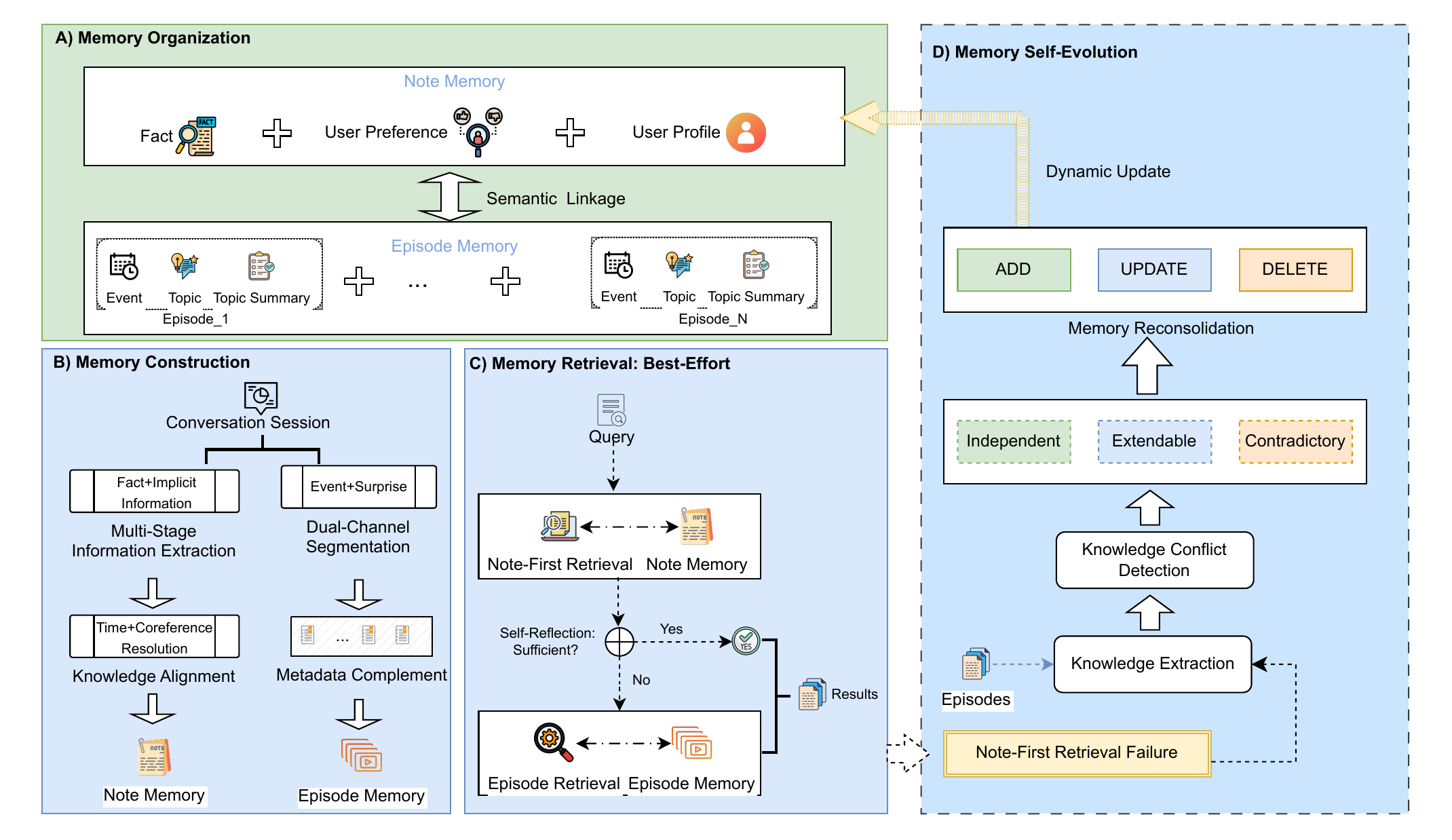
As shown in Figure 1, HiMem consists of three core modules: (i) a hierarchical memory construction module that builds Episode Memory and Note Memory from raw dialogues, (ii) a hierarchical memory retrieval module that supports both hybrid and best-effort retrieval strategies, and (iii) a conflict-aware memory updating module that enables continual self-evolution. Episode Memory preserves fine-grained interaction events, while Note Memory consolidates stable knowledge such as facts, user preferences, and user profiles. The two memory layers are semantically linked to form a hierarchy that bridges concrete experiences and abstract knowledge.
如图1所示,HiMem 由三个核心模块组成:(i)从原始对话构建情景记忆和笔记记忆的分层记忆构建模块;(ii)同时支持混合检索和尽力检索策略的分层记忆检索模块;(iii)支持持续自演化的冲突感知记忆更新模块。 情景记忆保存细粒度交互事件,而笔记记忆则巩固事实、用户偏好和用户画像等稳定知识。 两个记忆层在语义上相互连接,形成连接具体经验与抽象知识的层级。
2.2 Memory Construction
Memory construction in HiMem follows a multi-stage pipeline that progressively transforms raw dialogue logs into structured long-term memory representations. This pipeline unifies event-level segmentation, knowledge extraction, and semantic alignment to ensure both fidelity and efficiency.
HiMem 中的记忆构建遵循一条多阶段流水线,逐步将原始对话日志转换为结构化长期记忆表示。 该流水线统一了事件级分段、知识抽取和语义对齐,以同时保证保真度与效率。
2.2.1 Episode Memory
Episode Memory records fine-grained interaction events aligned with topical and cognitive boundaries. Given a dialogue sequence, HiMem segments it into a sequence of non-overlapping episodes. Each episode is represented by a structured record containing an ID, timestamp, topic, topic summary, metadata, and the corresponding dialogue segment.
情景记忆记录与主题边界和认知边界对齐的细粒度交互事件。 给定一个对话序列,HiMem 将其分割为一系列互不重叠的情景。 每个情景都表示为一条结构化记录,其中包含 ID、时间戳、主题、主题摘要、元数据及相应的对话片段。
Dual-Channel Segmentation. To obtain cognitively coherent episodes, HiMem adopts a Topic-Aware Event--Surprise Dual-Channel Segmentation strategy. A segmentation boundary is introduced when either (i) a topical shift occurs in discourse goals or subtopics, or (ii) a salient discontinuity is detected, such as an abrupt change in intent or emotional state. These two criteria are fused using an OR rule, producing event units that align with both semantic continuity and cognitive salience.
双通道分段。 为获得认知上连贯的情景,HiMem 采用主题感知的事件—惊异双通道分段策略。 当(i)话语目标或子主题发生主题变化,或(ii)检测到意图或情绪状态突然变化等显著不连续现象时,系统会引入分段边界。 这两个标准通过 OR 规则融合,生成同时符合语义连续性和认知显著性的事件单元。
Segmentation is performed in a single pass, where an LLM jointly evaluates topical and surprise signals and directly outputs the final segmentation. This design yields compact and self-contained episodes that reduce cross-segment interference while preserving critical contextual evidence for downstream reasoning.
分段通过单次处理完成,其中 LLM 联合评估主题信号和惊异信号,并直接输出最终分段结果。 这一设计生成紧凑且自包含的情景,在保留下游推理所需关键上下文证据的同时,减少跨片段干扰。
2.2.2 Note Memory
Note Memory focuses on long-term storage of knowledge-oriented information that remains stable or reusable across interactions. From each dialogue, HiMem extracts three categories of knowledge:
笔记记忆专注于长期存储在多次交互间保持稳定或可重复使用的知识导向信息。 HiMem 从每段对话中抽取三类知识:
where
其中,
Multi-Stage Knowledge Extraction. Knowledge extraction is decomposed into three stages to avoid semantic collapse. Stage 1 extracts independently interpretable factual and situational units. Stage 2 identifies high-confidence implicit information related to user preferences and profiles without introducing new facts. Stage 3 performs non-destructive normalization, including deduplication, coreference resolution, and temporal normalization, producing aligned knowledge representations suitable for long-term storage. Each aligned knowledge entry is stored as a note, represented as a structured record containing an identifier, the extracted content, a semantic category, and associated metadata.
多阶段知识抽取。 为避免语义坍缩,知识抽取被分解为三个阶段。 阶段 1 抽取可独立解释的事实单元和情境单元。 阶段 2 在不引入新事实的前提下,识别与用户偏好和用户画像相关的高置信度隐含信息。 阶段 3 执行非破坏性规范化,包括去重、共指消解和时间规范化,生成适合长期存储的对齐知识表示。 每条对齐后的知识都作为一条笔记存储,并表示为包含标识符、抽取内容、语义类别和相关元数据的结构化记录。
2.2.3 Knowledge Alignment
To maintain semantic consistency across memory layers, HiMem applies a unified alignment process during memory construction. This process includes temporal alignment of relative time expressions, coreference resolution for entity mentions, and extraction of implicit semantic relations. Alignment is selectively applied: Episode Memory prioritizes preserving original dialogue context, while Note Memory emphasizes abstraction and normalization.
为保持不同记忆层之间的语义一致性,HiMem 在记忆构建期间应用统一的对齐过程。 该过程包括相对时间表达的时间对齐、实体提及的共指消解,以及隐含语义关系抽取。 系统会选择性应用对齐:情景记忆优先保留原始对话上下文,而笔记记忆强调抽象与规范化。
2.3 Memory Retrieval
HiMem supports two complementary retrieval strategies. In hybrid retrieval, the system retrieves information from both Episode Memory and Note Memory to maximize recall. In contrast, best-effort retrieval proceeds hierarchically by querying Note Memory first and falling back to Episode Memory only when evidence is deemed insufficient. Retrieved evidence is evaluated by an LLM to assess answerability, and unsupported queries are explicitly marked as unanswerable.
HiMem 支持两种互补的检索策略。 在混合检索中,系统同时从情景记忆和笔记记忆中检索信息,以最大化召回率。 相比之下,尽力检索按层次进行:首先查询笔记记忆,只有在证据被判定为不足时才回退到情景记忆。 检索到的证据由 LLM 评估其可回答性,不受支持的查询会被明确标记为无法回答。
2.4 Memory Updating and Self-Evolution
During best-effort retrieval, HiMem employs a fixed LLM-based self-evaluation prompt to assess whether the retrieved evidence is sufficient to answer the query. This evaluation produces a binary judgment (sufficient or insufficient) under deterministic decoding (temperature = 0) and serves solely as a control signal, without introducing or revising memory content. While related to iterative self-refinement approaches, HiMem confines the LLM to deterministic routing and decision control.
在尽力检索期间,HiMem 使用固定的基于 LLM 的自评估提示,判断检索到的证据是否足以回答查询。 该评估在确定性解码(temperature = 0)下产生二元判断(充分或不充分),且仅作为控制信号,不会引入或修订记忆内容。 尽管这与迭代式自我改进方法有关,HiMem 将 LLM 的作用限制在确定性路由和决策控制上。
Memory reconsolidation is triggered only when two conditions are jointly satisfied: (i) retrieval from Note Memory alone is insufficient, and (ii) the subsequently retrieved Episode Memory provides adequate supporting evidence. This conjunctive trigger grounds updates in episodic context and prevents premature revisions. Although conceptually related to reflective agent frameworks, HiMem performs structured, evidence-grounded memory operations rather than free-form verbal reflection.
只有同时满足两个条件时才会触发记忆再巩固:(i)仅从笔记记忆检索到的信息不足;(ii)随后检索到的情景记忆提供了充分的支持证据。 这种合取式触发使更新建立在情景上下文之上,并防止过早修订。 尽管在概念上与反思型智能体框架相关,HiMem 执行的是结构化、以证据为依据的记忆操作,而不是自由形式的文字反思。
When reconsolidation is triggered, HiMem conducts query-conditioned knowledge extraction over the supporting episodes and compares the extracted information with existing notes. Their relationship is classified as independent, extendable, or contradictory, based on which the system applies ADD, UPDATE, or DELETE operations to revise Note Memory. This typed design avoids indiscriminate overwriting and echoes classic belief revision perspectives, promoting long-term stability and semantic consistency.
触发再巩固后,HiMem 会对提供支持的情景执行以查询为条件的知识抽取,并将抽取信息与现有笔记进行比较。 二者关系被分类为独立、可扩展或矛盾,系统据此应用 ADD、UPDATE 或 DELETE 操作来修订笔记记忆。 这种类型化设计避免不加区分地覆盖内容,并呼应经典信念修订观点,从而促进长期稳定性和语义一致性。
In contrast, episodic memory is treated as immutable: newly constructed episodes are appended chronologically without modification, preserving the temporal integrity of interaction histories.
相比之下,情景记忆被视为不可变:新构建的情景按时间顺序追加且不作修改,从而保持交互历史的时间完整性。
2.5 Adaptive Forgetting
To regulate memory growth under sustained interactions, HiMem optionally employs an adaptive forgetting mechanism based on usage frequency. In this work, forgetting primarily serves as a scalability-oriented mechanism to control memory size and maintain retrieval efficiency, and does not contribute directly to the performance gains reported in our experiments.
为调节持续交互中的记忆增长,HiMem 可选用基于使用频率的自适应遗忘机制。 在本文中,遗忘主要是一种面向可扩展性的机制,用于控制记忆规模并保持检索效率,并不直接促成我们实验中报告的性能提升。
3. Experiments
3.1 Datasets
We evaluate HiMem on LoCoMo, a benchmark designed to assess long-horizon conversational reasoning under sustained interactions. LoCoMo consists of multi-session dialogues with an average length of approximately 600 turns (around 16K tokens) and spans up to 32 interaction stages, posing significant challenges for long-range dependency modeling and memory management.
我们在 LoCoMo 上评估 HiMem,该基准旨在评估持续交互中的长程对话推理能力。 LoCoMo 由多会话对话组成,平均长度约为 600 轮(约 16K token),最多跨越 32 个交互阶段,对长距离依赖建模和记忆管理提出了显著挑战。
The benchmark covers diverse reasoning scenarios, including Single-Hop questions answerable within a single session, Multi-Hop questions requiring aggregation across distant dialogue turns, Temporal Reasoning questions involving implicit or explicit time relations, and Open-Domain questions that combine dialogue content with external or commonsense knowledge. Following prior work, we exclude the Adversarial category from quantitative evaluation, as it focuses on unanswerability detection rather than answer correctness.
该基准涵盖多种推理场景,包括可在单个会话内回答的单跳问题、需要聚合相距较远对话轮次信息的多跳问题、涉及隐式或显式时间关系的时间推理问题,以及结合对话内容与外部知识或常识的开放域问题。 遵循先前工作,我们从定量评估中排除对抗类别,因为它关注的是不可回答性检测,而非答案正确性。
3.2 Evaluation Metrics
Since different long-term memory systems may apply varying degrees of compression or abstraction over dialogue histories, we adopt a multi-dimensional evaluation protocol to assess answer quality comprehensively. Specifically, following prior work that systematically studies LLM-as-a-Judge and its biases, we use GPT-4o-mini as the LLM judge to compute evaluation score (denoted as GPT-Score) as the primary metric to approximate semantic correctness and consistency, together with F1 to measure lexical overlap.
由于不同长期记忆系统可能对对话历史采用不同程度的压缩或抽象,我们采用多维评估协议全面评估答案质量。 具体而言,遵循系统研究 LLM-as-a-Judge 及其偏差的先前工作,我们使用 GPT-4o-mini 作为 LLM 评审器计算评估分数(记为 GPT-Score),将其作为近似衡量语义正确性和一致性的主要指标,同时使用 F1 衡量词汇重叠。
In addition, for efficiency evaluation, we report latency (Lat.) and token consumption (Tok.). Latency is measured as the time required for memory retrieval only, excluding LLM inference and response generation, in order to isolate the efficiency of the memory system.
此外,在效率评估中,我们报告延迟(Lat.)和 token 消耗(Tok.)。 延迟仅测量记忆检索所需时间,不包括 LLM 推理和响应生成,以单独衡量记忆系统的效率。
3.3 Baselines
We compare HiMem with representative long-term memory frameworks that cover different design paradigms. Mem0 represents structured memory systems based on atomic factual extraction and graph-based organization. SeCom adopts event-level semantic segmentation and compression to improve contextual completeness. A-MEM augments event-level memory with entities, relations, and temporal features to support time-aware retrieval and reasoning. These baselines enable a systematic comparison across retrieval-based, compressed-context, and structured memory approaches.
我们将 HiMem 与覆盖不同设计范式的代表性长期记忆框架进行比较。 Mem0 代表基于原子事实抽取和图结构组织的结构化记忆系统。 SeCom 采用事件级语义分段和压缩来提升上下文完整性。 A-MEM 使用实体、关系和时间特征增强事件级记忆,以支持时间感知检索和推理。 这些基线使我们能够系统比较基于检索、压缩上下文和结构化记忆的方法。
These baselines are selected based on their compatibility with long-horizon conversational memory, availability of reproducible implementations, and suitability for evaluation under a unified agent interface with comparable inference budgets; methods that primarily target system-level context management or non-dialogue memory access are therefore not included.
这些基线依据其与长程对话记忆的兼容性、可复现实现的可用性,以及在统一智能体接口和可比推理预算下进行评估的适用性进行选择;因此,我们未纳入主要面向系统级上下文管理或非对话记忆访问的方法。
3.4 Settings
To ensure fair comparison, all methods are evaluated using the same base language model and identical decoding configurations. We use GPT-4o-mini as the backbone LLM and a shared embedding model for vector representations. For each evaluation setting, we conduct three independent trials with fixed prompts.
为确保公平比较,所有方法都使用相同的基础语言模型和完全一致的解码配置进行评估。 我们使用 GPT-4o-mini 作为骨干 LLM,并使用共享嵌入模型生成向量表示。 对于每种评估设置,我们使用固定提示进行三次独立试验。
For baseline-comparative main results, we report mean±std over multiple runs to reflect run-to-run variability. For auxiliary analyses and ablations (e.g., Table 3 and Table 4), we report mean values only for compact presentation, as these results are primarily intended to validate relative trends rather than to serve as headline comparisons.
对于基线比较的主要结果,我们报告多次运行的均值±标准差,以反映运行间差异。 对于辅助分析和消融实验(例如表3和表4),我们仅报告均值以便紧凑呈现,因为这些结果主要用于验证相对趋势,而不是作为核心结果比较。
Additional implementation details, including model configurations and hardware specifications, are provided in the Appendix.
模型配置和硬件规格等其他实现细节见附录。
4. Results and Analyses
4.1 Main Results
We evaluate HiMem on the LoCoMo benchmark to assess its ability to preserve, retrieve, and utilize information over long-horizon dialogues. Table 1 reports the performance of HiMem and representative baseline methods across diverse reasoning categories, including Single-Hop, Multi-Hop, Temporal Reasoning, and Open-Domain questions.
我们在 LoCoMo 基准上评估 HiMem,以考察其在长程对话中保存、检索和利用信息的能力。 表1报告了 HiMem 和代表性基线方法在单跳、多跳、时间推理和开放域问题等多种推理类别上的性能。
| Task | A-MEM | SeCom | Mem0 | HiMem | ||||
|---|---|---|---|---|---|---|---|---|
| GPT-Score | F1 | GPT-Score | F1 | GPT-Score | F1 | GPT-Score | F1 | |
| Single Hop | 59.33 (0.51) | 34.45 (0.46) | 87.02 (0.35) | 23.70 (0.06) | 75.90 (0.74) | 53.05 (0.65) | 89.22 (0.06) | 43.93 (0.24) |
| Multi Hop | 40.78 (0.77) | 20.98 (0.05) | 59.10 (1.17) | 13.21 (0.01) | 56.62 (2.86) | 32.90 (1.11) | 70.92 (0.77) | 28.32 (0.05) |
| Temporal | 50.26 (1.55) | 35.84 (0.26) | 33.54 (0.39) | 4.28 (0.06) | 68.54 (0.51) | 56.37 (0.74) | 74.77 (0.25) | 22.05 (0.22) |
| Open Domain | 24.65 (2.14) | 9.30 (0.50) | 60.07 (0.49) | 8.57 (0.10) | 42.36 (0.49) | 22.70 (0.20) | 54.86 (1.30) | 18.92 (0.45) |
| Overall | 51.88 (0.52) | 30.71 (0.29) | 69.03 (0.24) | 16.77 (0.02) | 68.74 (0.98) | 48.16 (0.73) | 80.71 (0.21) | 34.95 (0.11) |
Overall, HiMem consistently outperforms all baselines across almost all categories. In particular, HiMem achieves substantial improvements on Multi-Hop and Temporal Reasoning tasks, which require aggregating scattered evidence across long interaction histories. These results indicate that hierarchical memory organization enables more effective modeling of long-range dependencies and semantic consistency than flat or monolithic memory structures. Moreover, the strong performance on Open-Domain questions suggests that HiMem can reliably integrate dialogue-derived knowledge with external or implicit information over extended time spans.
总体而言,HiMem 在几乎所有类别上都持续优于全部基线。 特别是,HiMem 在需要聚合长交互历史中分散证据的多跳和时间推理任务上取得了显著提升。 这些结果表明,与扁平或单体式记忆结构相比,分层记忆组织能够更有效地建模长距离依赖和语义一致性。 此外,在开放域问题上的强劲表现说明,HiMem 能够在较长时间跨度内可靠地整合对话衍生知识与外部或隐含信息。
4.2 Ablation Study: Memory Components
To examine the contribution of different memory components, we conduct an ablation study by selectively removing Episode Memory or Note Memory from HiMem. The results are shown in Table 2.
为考察不同记忆组件的贡献,我们通过从 HiMem 中选择性移除情景记忆或笔记记忆进行消融研究。 结果如表2所示。
| Task | HiMem | - w/o Episode | - w/o Note | |||
|---|---|---|---|---|---|---|
| GPT-Score | F1 | GPT-Score | F1 | GPT-Score | F1 | |
| Single Hop | 89.22 (0.06) | 43.93 (0.24) | 76.50 (0.24) | 41.09 (0.09) | 89.02 (0.20) | 45.14 (0.03) |
| Multi Hop | 70.92 (0.77) | 28.32 (0.05) | 56.26 (0.33) | 26.29 (0.12) | 70.33 (0.44) | 26.13 (0.25) |
| Temporal | 74.77 (0.25) | 22.05 (0.22) | 68.12 (0.59) | 23.65 (0.31) | 72.48 (0.39) | 29.35 (0.16) |
| Open Domain | 54.86 (1.30) | 18.92 (0.45) | 48.26 (0.49) | 22.58 (0.55) | 48.61 (0.98) | 16.81 (0.15) |
| Overall | 80.71 (0.21) | 34.95 (0.11) | 69.29 (0.05) | 33.59 (0.06) | 79.63 (0.22) | 36.60 (0.02) |
Removing Episode Memory leads to a pronounced performance degradation across most categories, particularly on Multi-Hop and Temporal Reasoning tasks. This observation highlights the importance of preserving fine-grained contextual evidence aligned with the original interaction process. Without Episode Memory, the system struggles to recover detailed event-level information necessary for tracing complex reasoning chains over long dialogues.
移除情景记忆会导致大多数类别的性能明显下降,尤其是在多跳和时间推理任务上。 这一观察凸显了保存与原始交互过程对齐的细粒度上下文证据的重要性。 没有情景记忆,系统便难以恢复追踪长对话中复杂推理链所需的详细事件级信息。
In contrast, removing Note Memory results in a smaller but still consistent performance drop. This suggests that structured knowledge representations primarily serve to accelerate information localization and stabilize semantic anchors, while detailed contextual evidence remains indispensable for coverage and reasoning. Together, these findings demonstrate that Episode Memory and Note Memory play asymmetric yet complementary roles: effective long-term memory systems must balance information fidelity and abstraction rather than relying solely on either raw dialogue context or aggressively compressed representations.
相比之下,移除笔记记忆带来的性能下降较小,但仍保持一致。 这表明,结构化知识表示主要用于加速信息定位并稳定语义锚点,而详细上下文证据对于覆盖和推理仍不可或缺。 综合来看,这些发现表明情景记忆和笔记记忆发挥着不对称但互补的作用:有效的长期记忆系统必须平衡信息保真度与抽象,而不能只依赖原始对话上下文或高度压缩的表示。
4.3 Ablation Study: Knowledge Alignment
We further examine the role of the Knowledge Alignment module by comparing different memory types with and without a unified semantic alignment space. As shown in Table 3, disabling Knowledge Alignment causes a pronounced performance drop for Note Memory, indicating that a unified semantic space is crucial for extraction-based memories that do not retain raw dialogue context. Such alignment substantially improves intent understanding and memory localization. In contrast, removing Knowledge Alignment for Episode Memory slightly improves performance, suggesting that when segmentation is well-structured, additional semantic fusion may dilute information inherent in raw dialogue. Overall, although extracted knowledge representations are more compact and explicit, they are more sensitive to implicit semantics and coreference resolution, and therefore benefit more from unified semantic alignment.
我们进一步通过比较具有和不具有统一语义对齐空间的不同记忆类型,考察知识对齐模块的作用。 如表3所示,禁用知识对齐会使笔记记忆的性能明显下降,说明统一语义空间对于不保留原始对话上下文的抽取式记忆至关重要。 这种对齐显著提升了意图理解和记忆定位能力。 相比之下,移除情景记忆的知识对齐会略微提升性能,这表明当分段结构良好时,额外语义融合可能稀释原始对话中固有的信息。 总体而言,尽管抽取出的知识表示更加紧凑和明确,但它们对隐含语义和共指消解更为敏感,因此从统一语义对齐中获益更多。
| Method | Single Hop | Multi Hop | Temporal | Open Domain | Average | |||||
|---|---|---|---|---|---|---|---|---|---|---|
| GPT | F1 | GPT | F1 | GPT | F1 | GPT | F1 | GPT | F1 | |
| HiMem | 89.22 | 43.93 | 70.92 | 28.32 | 74.77 | 22.05 | 54.86 | 18.92 | 80.71 | 34.95 |
| - w/o KA | 87.51 | 43.75 | 69.86 | 28.53 | 75.18 | 28.14 | 52.08 | 15.96 | 79.50 | 35.98 |
| Note Memory | 66.51 | 35.88 | 54.26 | 24.92 | 67.39 | 19.89 | 50.35 | 23.88 | 63.44 | 29.79 |
| - w/o KA | 61.79 | 34.16 | 46.81 | 23.57 | 60.12 | 19.77 | 42.71 | 18.52 | 57.51 | 28.25 |
| Episode Memory | 88.31 | 45.53 | 65.25 | 24.76 | 71.55 | 29.08 | 48.61 | 18.09 | 78.12 | 36.59 |
| - w/o KA | 89.02 | 45.14 | 70.33 | 26.13 | 72.48 | 29.35 | 48.61 | 16.81 | 79.63 | 36.60 |
4.4 Memory Self-Evolution
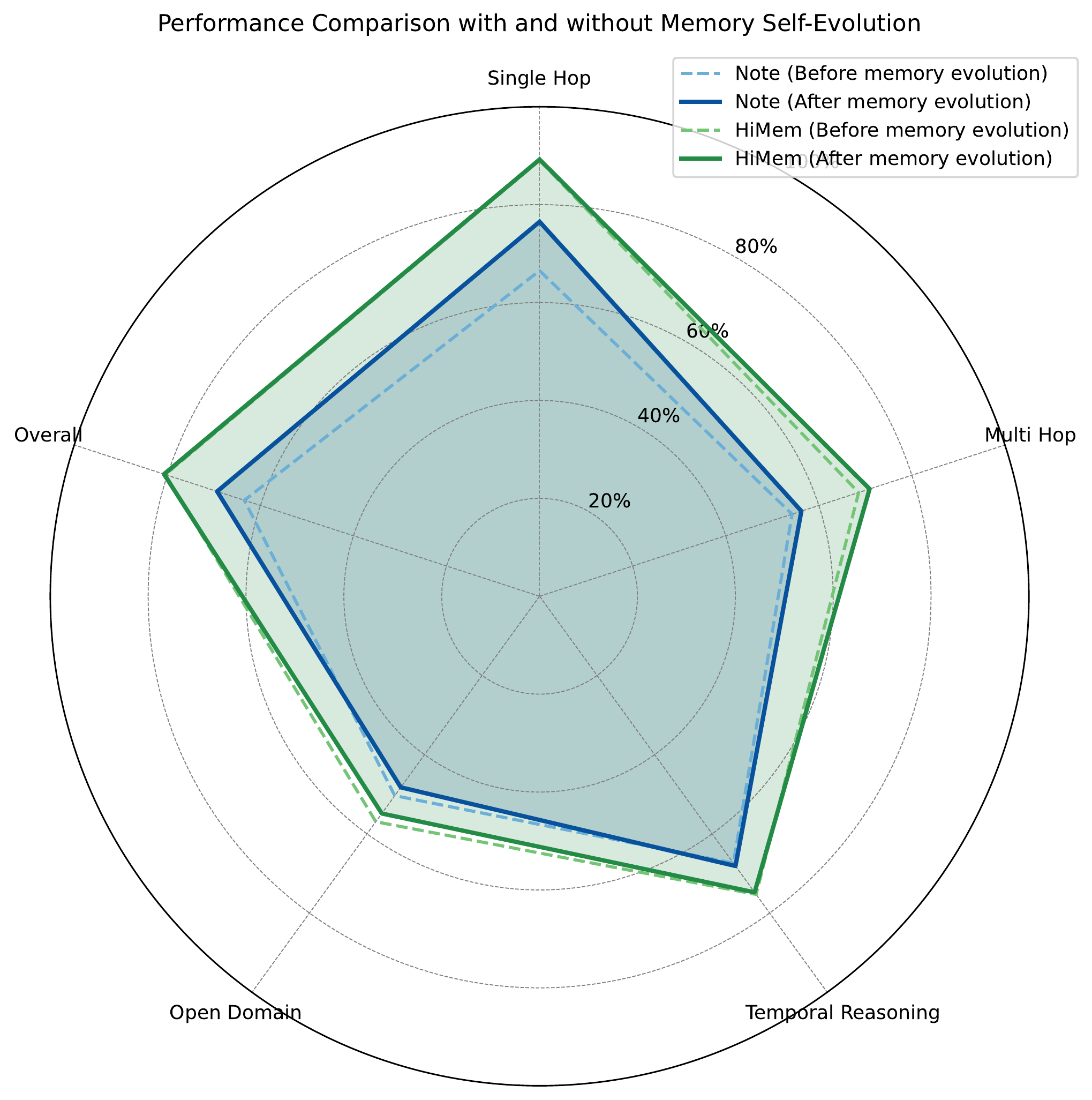
During best-effort retrieval, when Note Memory fails to return self-validated results while Episode Memory provides sufficient evidence, HiMem triggers the Memory Reconsolidation mechanism. Specifically, the system performs query-conditioned information extraction over retrieved Episode Memory results and supplements missing knowledge in Note Memory through conflict detection and dynamic updating. As shown in Figure 2 and Table 4, enabling Memory Self-Evolution improves Note Memory performance by approximately 5.85%, which further leads to a slight overall performance gain of about 0.28%. These results demonstrate that Memory Reconsolidation is an effective mechanism for enabling long-term memory self-evolution.
在尽力检索期间,当笔记记忆未能返回通过自我验证的结果,而情景记忆提供了充分证据时,HiMem 会触发记忆再巩固机制。 具体而言,系统对检索到的情景记忆结果执行以查询为条件的信息抽取,并通过冲突检测和动态更新补充笔记记忆中缺失的知识。 如图2和表4所示,启用记忆自演化使笔记记忆性能提升约 5.85%,并进一步带来约 0.28% 的整体性能小幅提升。 这些结果表明,记忆再巩固是实现长期记忆自演化的有效机制。
| Method | Single Hop | Multi Hop | Temporal | Open Domain | Average | |||||
|---|---|---|---|---|---|---|---|---|---|---|
| GPT | F1 | GPT | F1 | GPT | F1 | GPT | F1 | GPT | F1 | |
| Note Memory | ||||||||||
| w/o KA | 61.79 | 34.16 | 46.81 | 23.57 | 60.12 | 19.77 | 42.71 | 18.52 | 57.51 | 28.25 |
| +KA | 66.51 | 35.88 | 54.26 | 24.92 | 67.39 | 19.89 | 50.35 | 23.88 | 63.44 | 29.79 |
| +KA & +ME | 76.50 | 41.09 | 56.26 | 26.29 | 68.12 | 23.65 | 48.26 | 22.58 | 69.29 | 33.59 |
4.5 Discussion of Extended Analyses
Additional analyses, including the retrieval strategies, hyperparameter sensitivity, and efficiency trade-offs, are provided in the Appendix.
检索策略、超参数敏感性和效率权衡等其他分析见附录。
5. Discussion
Long-horizon conversational agents require more than extended context windows or incremental memory accumulation; they critically depend on how information is structured, abstracted, and revised over time. The empirical results consistently demonstrate that hierarchical memory organization is a necessary condition for robust long-term reasoning rather than an optional architectural refinement. Episode Memory and Note Memory play asymmetric yet complementary roles: the former preserves fine-grained contextual evidence aligned with the original interaction process, while the latter consolidates stable, high-frequency knowledge into compact representations that substantially reduce retrieval cost. The performance degradation observed when either component is removed confirms that effective long-term memory systems must balance fidelity and abstraction, instead of relying solely on raw dialogue context or aggressive compression.
长程对话智能体需要的不只是扩展上下文窗口或增量式记忆累积;其能力关键取决于信息如何随时间被组织、抽象和修订。 实验结果持续表明,分层记忆组织是稳健长期推理的必要条件,而非可有可无的架构改进。 情景记忆和笔记记忆发挥着不对称但互补的作用:前者保存与原始交互过程对齐的细粒度上下文证据,后者则将稳定、高频知识巩固为能够显著降低检索成本的紧凑表示。 移除任一组件后观察到的性能下降证实,有效的长期记忆系统必须平衡保真度与抽象,而不能只依赖原始对话上下文或激进压缩。
Beyond static organization, our findings highlight that memory updating cannot be treated as a purely similarity-driven or append-only process. In long-term interactions, newly observed information often partially overlaps with, extends, or contradicts existing knowledge. HiMem’s conflict-aware Memory Reconsolidation explicitly distinguishes these cases and applies differentiated update strategies, which proves essential for maintaining semantic consistency over time. Importantly, the gains brought by memory self-evolution do not arise from heuristic rewriting, but from a conservative feedback loop between retrieval failure, episodic evidence inspection, and targeted knowledge supplementation.
除静态组织外,我们的发现还强调,记忆更新不能被视为完全由相似度驱动或仅执行追加的过程。 在长期交互中,新观察到的信息经常与现有知识部分重叠、对其扩展或与之矛盾。 HiMem 的冲突感知记忆再巩固明确区分这些情况,并应用差异化更新策略;事实证明,这对于随时间保持语义一致性至关重要。 重要的是,记忆自演化带来的收益并非源于启发式重写,而是来自检索失败、情景证据检查和定向知识补充之间的保守反馈闭环。
Finally, the comparison between hybrid and best-effort retrieval strategies indicates that hierarchical memory is not only a representational choice but also an efficiency mechanism. Retrieving abstract knowledge first and descending to concrete events only when necessary achieves a favorable trade-off between accuracy and computational cost, while simultaneously exposing latent information that can drive further memory evolution. Together, these observations suggest that long-horizon LLM agents should treat memory as a dynamic, multi-level system tightly coupled with retrieval and usage, rather than as a static external store.
最后,混合检索与尽力检索策略的比较表明,分层记忆不仅是一种表示选择,也是一种效率机制。 首先检索抽象知识,并仅在必要时下探到具体事件,可以在准确性与计算成本之间取得良好权衡,同时暴露能够推动记忆进一步演化的潜在信息。 综合这些观察,长程 LLM 智能体应当将记忆视为与检索和使用紧密耦合的动态多层系统,而不是静态外部存储。
6. Conclusion
This paper proposes HiMem, a hierarchical long-term memory framework for long-horizon dialogues, aimed at addressing several fundamental challenges faced by existing LLM agents in sustained interactions, including memory fragmentation, semantic drift, and the lack of self-evolution capability. Grounded in cognitive theories of human long-term memory, HiMem organically integrates event-level experiences with knowledge-level abstractions, and realizes efficient storage, retrieval, and dynamic updating of long-term information through a structured system design.
本文提出 HiMem,一种面向长程对话的分层长期记忆框架,旨在解决现有 LLM 智能体在持续交互中面临的若干根本挑战,包括记忆碎片化、语义漂移和缺乏自演化能力。 HiMem 以人类长期记忆的认知理论为基础,有机整合事件级经验与知识级抽象,并通过结构化系统设计实现长期信息的高效存储、检索和动态更新。
Methodologically, HiMem constructs cognitively consistent Episode Memory via Topic-Aware Event--Surprise Dual-Channel Segmentation, providing fine-grained and semantically stable contextual support for complex reasoning tasks. Meanwhile, through a multi-stage information extraction pipeline and selective Knowledge Alignment, high-frequency and stable facts as well as user-specific attributes are consolidated into dense Note Memory representations, significantly reducing retrieval costs while preserving semantic fidelity. Furthermore, HiMem introduces a conflict-aware Memory Reconsolidation mechanism that closes the loop between retrieval and memory updating, enabling continuous correction and evolution of knowledge through usage.
在方法上,HiMem 通过主题感知的事件—惊异双通道分段构建认知一致的情景记忆,为复杂推理任务提供细粒度且语义稳定的上下文支持。 同时,通过多阶段信息抽取流水线和选择性知识对齐,高频稳定事实以及用户特定属性被巩固为稠密笔记记忆表示,在保持语义保真度的同时显著降低检索成本。 此外,HiMem 引入冲突感知的记忆再巩固机制,形成检索与记忆更新之间的闭环,使知识能够在使用过程中持续纠正和演化。
Extensive experiments across multiple long-horizon conversational scenarios systematically validate the effectiveness of these design choices. HiMem consistently outperforms existing methods in terms of accuracy, temporal reasoning, and open-domain understanding. Ablation and analysis studies further reveal that these gains arise from the synergistic interaction among hierarchical memory structures, cognitively aligned event segmentation, memory-type-aware semantic alignment, and self-evolution mechanisms, rather than from isolated component-level improvements. In addition, analyses of retrieval modes and hyperparameters demonstrate that HiMem achieves a robust balance between knowledge coverage and system efficiency.
多个长程对话场景中的大量实验系统验证了这些设计选择的有效性。 HiMem 在准确性、时间推理和开放域理解方面持续优于现有方法。 消融与分析研究进一步揭示,这些收益来自分层记忆结构、认知对齐的事件分段、感知记忆类型的语义对齐,以及自演化机制之间的协同作用,而非孤立的组件级改进。 此外,对检索模式和超参数的分析表明,HiMem 在知识覆盖与系统效率之间实现了稳健平衡。
Overall, HiMem’s contributions extend beyond empirical performance improvements. More importantly, it offers a practical paradigm for systematically integrating cognitive theories into the design of long-term memory for LLM agents. By emphasizing memory-type distinctions, structured organization, and usage-driven feedback, this paradigm provides a methodological foundation for building scalable, interpretable, and self-evolving LLM agents. We hope that this work will inspire future research on long-term memory in more complex settings, including multi-agent, multimodal, and richly interactive environments.
总体而言,HiMem 的贡献超越了经验性能提升本身。 更重要的是,它为将认知理论系统融入 LLM 智能体的长期记忆设计提供了一种实用范式。 通过强调记忆类型区分、结构化组织和使用驱动的反馈,该范式为构建可扩展、可解释且能够自演化的 LLM 智能体提供了方法论基础。 我们希望这项工作能够启发更复杂环境中的长期记忆研究,包括多智能体、多模态和具有丰富交互的环境。
Limitations
Although HiMem demonstrates stable and significant performance advantages on long-horizon conversational tasks, several limitations remain that warrant further investigation. These limitations do not stem from flaws in the design itself, but rather reflect broader challenges commonly faced by long-term memory systems in realistic interactive settings.
尽管 HiMem 在长程对话任务上展现出稳定且显著的性能优势,但仍存在若干值得进一步研究的局限。 这些局限并非源自设计本身的缺陷,而是反映了长期记忆系统在真实交互环境中普遍面临的更广泛挑战。
Dependence on LLM Judgment Capabilities. First, HiMem relies extensively on the semantic and pragmatic judgment capabilities of the underlying LLM during memory construction and updating, including event segmentation, information extraction, conflict detection, and evidence sufficiency evaluation. While experimental results indicate that such one-shot, rule-constrained judgments are stable and effective in practice, their quality inevitably depends on the capability of the base model. In scenarios involving noisy inputs, metaphorical language, or cross-cultural pragmatic variations, the accuracy of segmentation and knowledge extraction may be affected. Future work could explore incorporating lightweight auxiliary classifiers or uncertainty estimation mechanisms at critical decision points to further enhance robustness under complex linguistic conditions.
对 LLM 判断能力的依赖。 第一,HiMem 在记忆构建和更新期间高度依赖底层 LLM 的语义与语用判断能力,包括事件分段、信息抽取、冲突检测和证据充分性评估。 尽管实验结果表明,这类受规则约束的单次判断在实践中稳定有效,但其质量不可避免地依赖基础模型的能力。 在涉及噪声输入、隐喻语言或跨文化语用差异的场景中,分段和知识抽取的准确性可能受到影响。 未来工作可以探索在关键决策点引入轻量级辅助分类器或不确定性估计机制,以进一步增强复杂语言条件下的稳健性。
Expressive Limits of One-Shot Segmentation. Second, HiMem currently adopts a one-shot segmentation strategy, which offers clear advantages in efficiency and controllability, but also imposes an upper bound on expressive capacity. This strategy assumes that the event structure of a conversation can be sufficiently identified through a single global pass. However, in extremely long or highly interleaved dialogues, event boundaries may exhibit hierarchical or recursive structures. Future extensions could investigate multi-granularity or iterative event restructuring strategies, while preserving the simplicity of the current design, to better accommodate non-linear conversational dynamics in Episode Memory.
单次分段的表达能力上限。 第二,HiMem 当前采用单次分段策略,该策略在效率和可控性方面具有明显优势,但也为表达能力设置了上限。 这一策略假设,通过单次全局处理即可充分识别对话的事件结构。 然而,在极长或高度交错的对话中,事件边界可能呈现分层或递归结构。 未来扩展可以在保持当前设计简洁性的同时,研究多粒度或迭代式事件重构策略,以使情景记忆更好地适应非线性对话动态。
Conservative Triggers for Knowledge Evolution. Regarding memory self-evolution, HiMem primarily relies on retrieval failure or insufficient evidence as triggers for Memory Reconsolidation. While this conservative design promotes stability and avoids unnecessary updates, it may allow certain latent inconsistencies or outdated knowledge to persist if they are not explicitly surfaced during retrieval. Designing more proactive yet noise-resistant evolution triggers remains an open challenge. For example, future work could incorporate user feedback, cross-task consistency checks, or long-term statistical signals to detect and resolve implicit conflicts more effectively.
知识演化的保守触发条件。 在记忆自演化方面,HiMem 主要依赖检索失败或证据不足来触发记忆再巩固。 尽管这种保守设计有助于稳定并避免不必要的更新,但如果某些潜在不一致或过时知识未在检索期间明确暴露,它们可能会继续存在。 设计更主动但又能够抵抗噪声的演化触发条件仍是一项开放挑战。 例如,未来工作可以结合用户反馈、跨任务一致性检查或长期统计信号,更有效地检测并解决隐式冲突。
Limited Evaluation Scope. Finally, although HiMem is evaluated on representative long-horizon dialogue benchmarks, the experiments are mainly confined to single-user, text-based interaction scenarios. Real-world long-term interactions often involve multiple users, multimodal inputs, and richer social contexts, which impose additional demands on memory organization and updating. Extending HiMem to multi-agent or multimodal settings, and studying how memories interact, conflict, and propagate across different agents, constitutes an important direction for future research.
有限的评估范围。 最后,尽管 HiMem 在代表性长程对话基准上进行了评估,但实验主要局限于单用户、基于文本的交互场景。 真实世界的长期交互通常涉及多个用户、多模态输入和更丰富的社会情境,这对记忆组织与更新提出了额外要求。 将 HiMem 扩展到多智能体或多模态环境,并研究记忆如何在不同智能体之间交互、冲突和传播,是未来研究的重要方向。
Overall, these limitations highlight key research frontiers in advancing long-term memory systems from usable to truly general-purpose. HiMem provides a viable pathway for systematically integrating cognitive theories into the design of long-term memory for LLM agents. How to further enhance adaptability and generalization while maintaining structural clarity and interpretability remains a central focus for future work.
总体而言,这些局限凸显了推动长期记忆系统从可用走向真正通用的关键研究前沿。 HiMem 为将认知理论系统融入 LLM 智能体的长期记忆设计提供了一条可行路径。 如何在保持结构清晰和可解释性的同时进一步增强适应性与泛化能力,仍是未来工作的核心重点。
Ethical Considerations
We acknowledge that the development of hierarchical long-term memory systems for LLM agents carries significant ethical responsibilities, particularly concerning data privacy, knowledge integrity, and potential societal impacts.
我们认识到,为 LLM 智能体开发分层长期记忆系统伴随着重大的伦理责任,尤其涉及数据隐私、知识完整性和潜在社会影响。
Data Privacy and User Profiling. HiMem is designed to extract and store structured information, including user preferences and profiles, to maintain long-term interaction coherence. In real-world applications, this involves the persistent storage of potentially sensitive personal information. We emphasize that any practical implementation of HiMem should adhere to privacy-by-design principles, such as the General Data Protection Regulation (GDPR). This includes implementing robust data encryption, ensuring transparency regarding what information is being "memorized," and providing users with the "right to be forgotten" by allowing them to inspect and delete specific entries in both Episode and Note Memory. In addition, the datasets used in this study are all publicly available and used in accordance with their respective licenses.
数据隐私与用户画像。 HiMem 旨在抽取并存储包括用户偏好和用户画像在内的结构化信息,以保持长期交互的一致性。 在真实应用中,这会涉及对潜在敏感个人信息的持续存储。 我们强调,HiMem 的任何实际实现都应遵循隐私设计原则,例如《通用数据保护条例》(GDPR)。 这包括实施稳健的数据加密、确保用户清楚了解哪些信息正在被“记住”,并允许用户检查和删除情景记忆与笔记记忆中的特定条目,从而赋予其“被遗忘权”。 此外,本研究使用的数据集均为公开可用,并依据各自许可使用。
Knowledge Integrity and Hallucinations. The "Memory Reconsolidation" mechanism introduces a dynamic self-evolution process where the system updates its internal knowledge based on new interactions. While this improves adaptability, it also poses a risk of "consolidating" hallucinations or incorrect information if the backbone LLM makes erroneous judgments during the conflict-aware update phase. We have mitigated this through a conservative update strategy, but we caution that such systems should not be deployed in high-stakes domains (e.g., medical or legal advice) without human-in-the-loop verification.
知识完整性与幻觉。 “记忆再巩固”机制引入了动态自演化过程,系统会根据新的交互更新内部知识。 尽管这提升了适应性,但如果骨干 LLM 在冲突感知更新阶段作出错误判断,也会带来“巩固”幻觉或错误信息的风险。 我们通过保守更新策略缓解了这一问题,但仍要提醒:在没有人在回路验证的情况下,不应将这类系统部署到医疗或法律建议等高风险领域。
Bias Amplification. As HiMem relies on the semantic understanding and summarization capabilities of pre-trained LLMs, it may inadvertently inherit or amplify biases present in the foundation models during the memory abstraction process (Stage 1-3). We encourage future research to integrate bias-detection filters within the memory extraction pipeline to ensure that the "Notes" stored do not perpetuate harmful stereotypes or unfair social biases.
偏差放大。 由于 HiMem 依赖预训练 LLM 的语义理解和总结能力,它可能在记忆抽象过程(阶段 1–3)中无意继承或放大基础模型中的偏差。 我们鼓励未来研究在记忆抽取流水线中集成偏差检测过滤器,以确保所存储的“笔记”不会延续有害刻板印象或不公平的社会偏差。
Intended Use and Transparency. HiMem aims to foster more meaningful and efficient human-AI collaboration. However, the ability of an agent to form a "long-term bond" through persistent memory could potentially be misused for manipulative purposes. We advocate for full disclosure: users should be explicitly informed when they are interacting with an agent equipped with long-term memory capabilities to manage expectations and ensure informed consent.
预期用途与透明度。 HiMem 旨在促进更有意义且更高效的人机协作。 然而,智能体通过持久记忆形成“长期纽带”的能力可能被滥用于操纵目的。 我们主张充分披露:当用户与具备长期记忆能力的智能体交互时,应明确告知用户,以管理预期并确保知情同意。