
Genie: Generative Interactive Environments
World ModelGenerative AIVideo ModelLatent ActionGoogle DeepMindUBCGenie:生成式交互环境
Abstract
We introduce Genie, the first generative interactive environment trained in an unsupervised manner from unlabelled Internet videos. The model can be prompted to generate an endless variety of action-controllable virtual worlds described through text, synthetic images, photographs, and even sketches. At 11B parameters, Genie can be considered a foundation world model. It is comprised of a spatiotemporal video tokenizer, an autoregressive dynamics model, and a simple and scalable latent action model. Genie enables users to act in the generated environments on a frame-by-frame basis despite training without any ground-truth action labels or other domain-specific requirements typically found in the world model literature. Further the resulting learned latent action space facilitates training agents to imitate behaviors from unseen videos, opening the path for training generalist agents of the future.
我们提出 Genie,这是首个以无监督方式从无标签互联网视频中训练得到的 生成式交互环境。 用户可以通过文本、合成图像、照片甚至草图提示该模型,生成种类无穷、可由动作控制的虚拟世界。 Genie 拥有 110 亿参数,可以被视为一个 基础世界模型。 它由时空视频分词器、自回归动力学模型,以及简单且可扩展的潜在动作模型组成。 尽管训练时没有任何真实动作标签,也没有世界模型研究中常见的其他领域特定要求,Genie 仍使用户能够逐帧操控生成的环境。 此外,由此学习到的潜在动作空间有助于训练智能体模仿未见视频中的行为,为训练未来的通用智能体开辟了道路。
1. Introduction
The last few years have seen an emergence of generative AI, with models capable of generating novel and creative content. Driven by breakthroughs in architectures such as transformers, advances in hardware, and a recent focus on scaling models and datasets, we can now generate coherent, conversational language, as well as crisp and aesthetically pleasing images from a text prompt. Early signs indicate video generation will be yet another frontier, with recent results suggesting that such models may also benefit from scale. Still, there remains a gulf between the level of interactions and engagement of video generative models and language tools such as ChatGPT, let alone more immersive experiences.
过去几年见证了 生成式人工智能 的兴起,相关模型已经能够生成新颖而富有创造性的内容。 在 Transformer 等架构突破、硬件进步以及近期对模型与数据集规模扩展的共同推动下,我们现在不仅能生成连贯且具有对话性的语言,也能根据文本提示生成清晰且美观的图像。 早期迹象表明,视频生成将成为另一个前沿方向,近期结果说明此类模型同样可能从规模扩展中受益。 尽管如此,视频生成模型与 ChatGPT 等语言工具在交互程度和参与感上仍存在巨大差距,更不用说更具沉浸感的体验了。
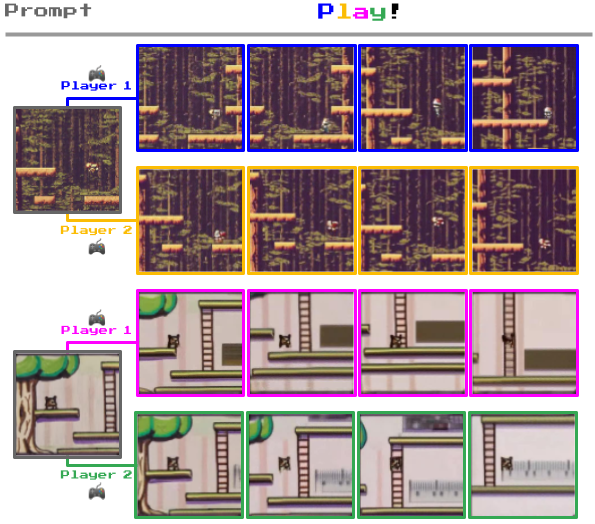
What if, given a large corpus of videos from the Internet, we could not only train models capable of generating novel images or videos, but entire interactive experiences? We propose generative interactive environments, a new paradigm for generative AI whereby interactive environments can be generated from a single text or image prompt. Our approach, Genie, is trained from a large dataset of over 200,000 hours of publicly available Internet gaming videos and, despite training without action or text annotations, is controllable on a frame-by-frame basis via a learned latent action space (see Table 1 for a comparison to other approaches). At 11B parameters, Genie exhibits properties typically seen in foundation models---it can take an unseen image as a prompt making it possible to create and play entirely imagined virtual worlds (e.g. Figure 1).
如果给定一个大规模互联网视频语料库,我们不仅能训练生成新图像或视频的模型,还能生成完整的交互体验,会怎样? 我们提出 生成式交互环境,这是一种生成式人工智能新范式,能够根据单个文本或图像提示生成交互环境。 我们的方法 Genie 使用超过 20 万小时的公开互联网游戏视频组成的大型数据集进行训练;尽管训练时 没有动作或文本标注,它仍能通过学习到的潜在动作空间实现逐帧控制(与其他方法的比较见 表1)。 Genie 拥有 110 亿参数,展现出基础模型通常具有的性质:它可以把未见图像作为提示,从而创建并游玩完全由想象生成的虚拟世界(例如 图1)。
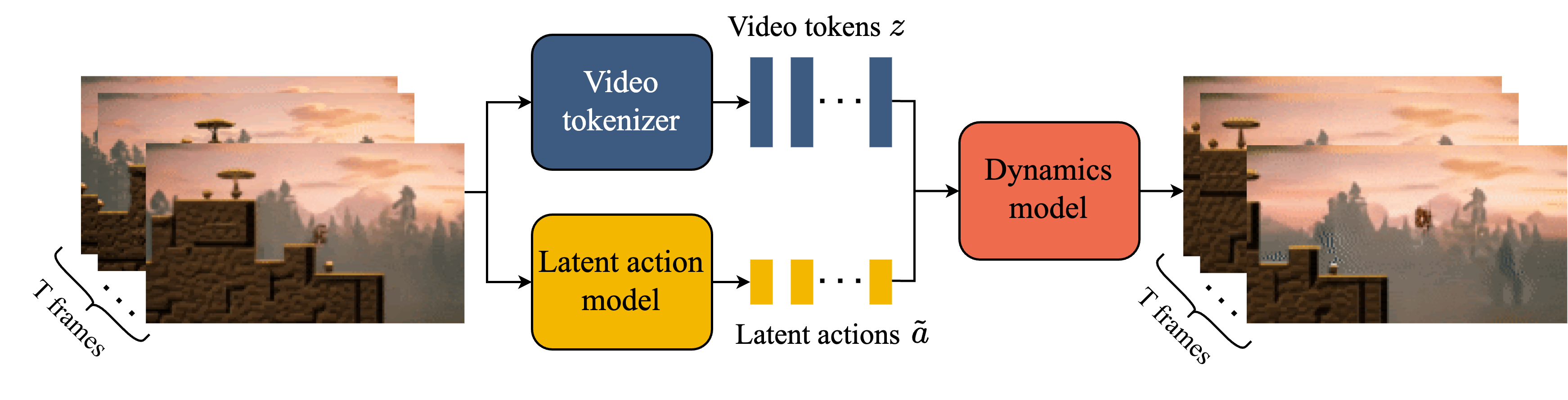
Genie builds on ideas from state-of-the-art video generation models, with a core design choice being spatiotemporal (ST) transformers which are used in all of our model components. Genie utilizes a novel video tokenizer, and extracts latent actions via a causal action model. Both the video tokens and latent actions are passed to a dynamics model, which autoregressively predicts the next frame using MaskGIT. We provide a rigorous scaling analysis of our architecture with respect to both batch and model size, which we vary from 40M to 2.7B parameters. The results show that our architecture scales gracefully with additional computational resources, leading to a final 11B parameter model. We train Genie on a filtered set of 30,000 hours of Internet gameplay videos from hundreds of 2D platformer games, producing a foundation world model for this setting.
Genie 建立在先进视频生成模型的思想之上,其核心设计选择是在所有模型组件中使用时空(ST)Transformer。 Genie 使用一种新的视频分词器,并通过因果动作模型提取潜在动作。 视频词元和潜在动作都会传入动力学模型,该模型使用 MaskGIT 自回归地预测下一帧。 我们从批大小和模型规模两方面对架构进行了严格的扩展分析,其中模型参数量从 4000 万变化到 27 亿。 结果表明,随着计算资源增加,我们的架构能够平稳扩展,最终得到一个 110 亿参数的模型。 我们使用从数百款二维平台游戏中筛选出的 3 万小时互联网游戏视频训练 Genie,从而为这一场景构建了基础世界模型。
To demonstrate the generality of our approach, we also train a separate model on action-free robot videos from the RT1 dataset, learning a generative environment with consistent latent actions. Finally, we show that latent actions learned from Internet videos can be used for inferring policies from unseen action-free videos of simulated reinforcement learning (RL) environments, indicating that Genie may hold the key to unlocking unlimited data for training the next generation of generalist agents.
为了证明我们方法的通用性,我们还在 RT1 数据集的无动作标签机器人视频上训练了一个独立模型,学习具有一致潜在动作的生成环境。 最后,我们表明,从互联网视频中学习到的潜在动作可用于根据模拟强化学习(RL)环境中未见过的无动作标签视频推断策略,这说明 Genie 可能是释放无限数据、训练下一代通用智能体的关键。
| Model Class | Training Data | Controllability |
|---|---|---|
| World Models | Video + Actions | Frame-level |
| Video Models | Video + Text | Video-level |
| Genie | Video | Frame-level |
2. Methodology
Genie is a generative interactive environment trained from video-only data. In this section we begin with preliminaries before explaining the main components of our model.
Genie 是一种仅用视频数据训练的生成式交互环境。 本节先介绍预备知识,然后说明模型的主要组件。
Several components in the Genie architecture are based on the Vision Transformer (ViT). Notably, the quadratic memory cost of transformers poses challenges for videos, which can contain up to
Genie 架构中的多个组件都基于视觉 Transformer(ViT)。 值得注意的是,Transformer 的内存成本呈二次增长,这给最多可包含
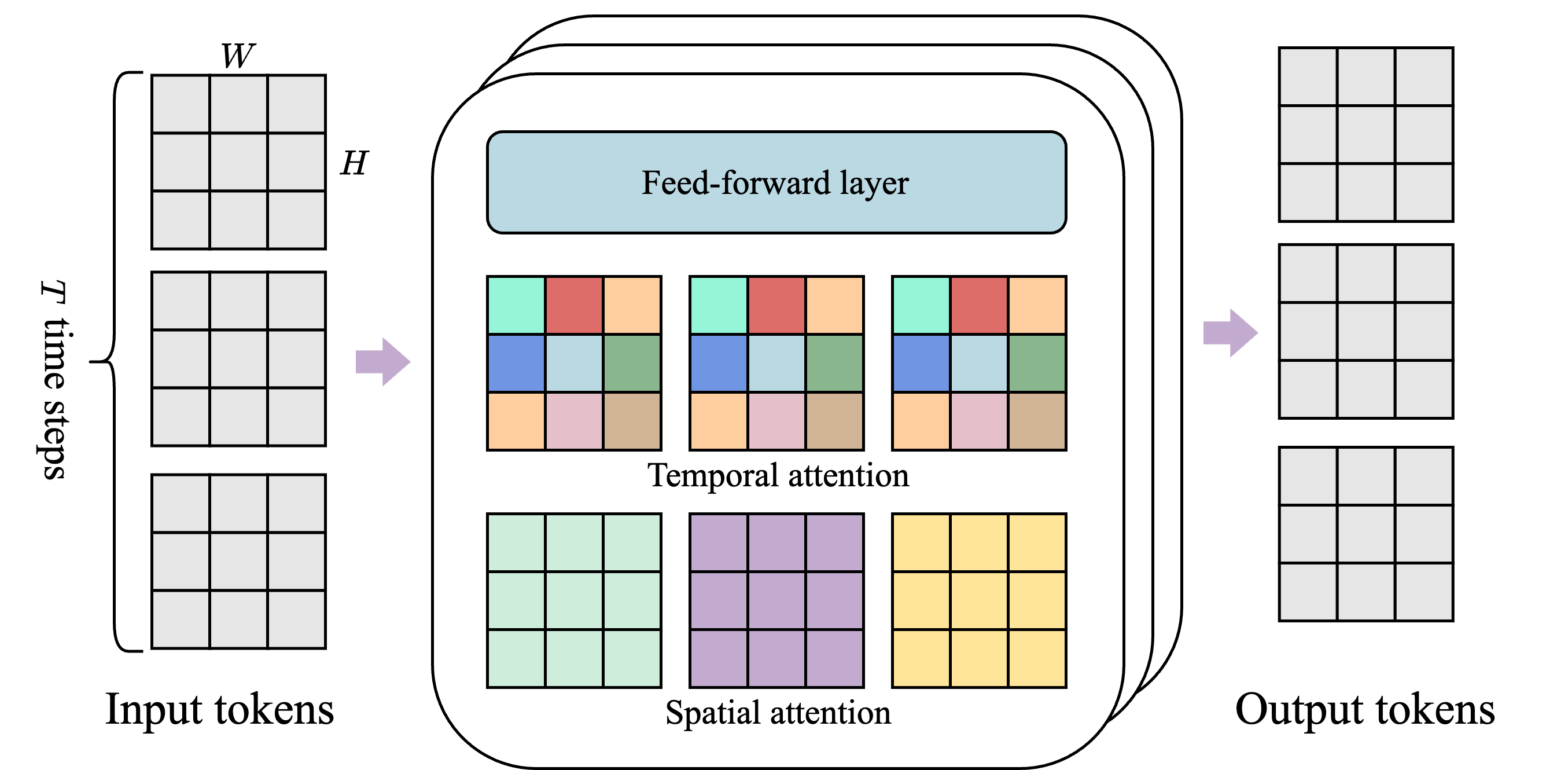
Unlike a traditional transformer where every token attends to all others, an ST-transformer contains
传统 Transformer 中每个词元都会关注所有其他词元;与之不同,ST-Transformer 包含
2.1 Model Components
As shown in Figure 2, our model contains three key components: 1) a latent action model that infers the latent action
如 图2 所示,我们的模型包含三个关键组件:1)推断每对相邻帧之间潜在动作
Latent Action Model (LAM). To achieve controllable video generation, we condition each future frame prediction on the action taken at the previous frame. However, such action labels are rarely available in videos from the Internet and action annotation can be costly to obtain. Instead, we learn latent actions in a fully unsupervised manner (see Figure 4).
潜在动作模型(LAM)。 为了实现可控视频生成,我们让每个未来帧的预测都以先前一帧执行的动作为条件。 然而,互联网视频很少提供此类动作标签,而获取动作标注的成本可能很高。 因此,我们以完全无监督的方式学习 潜在动作(见 图4)。
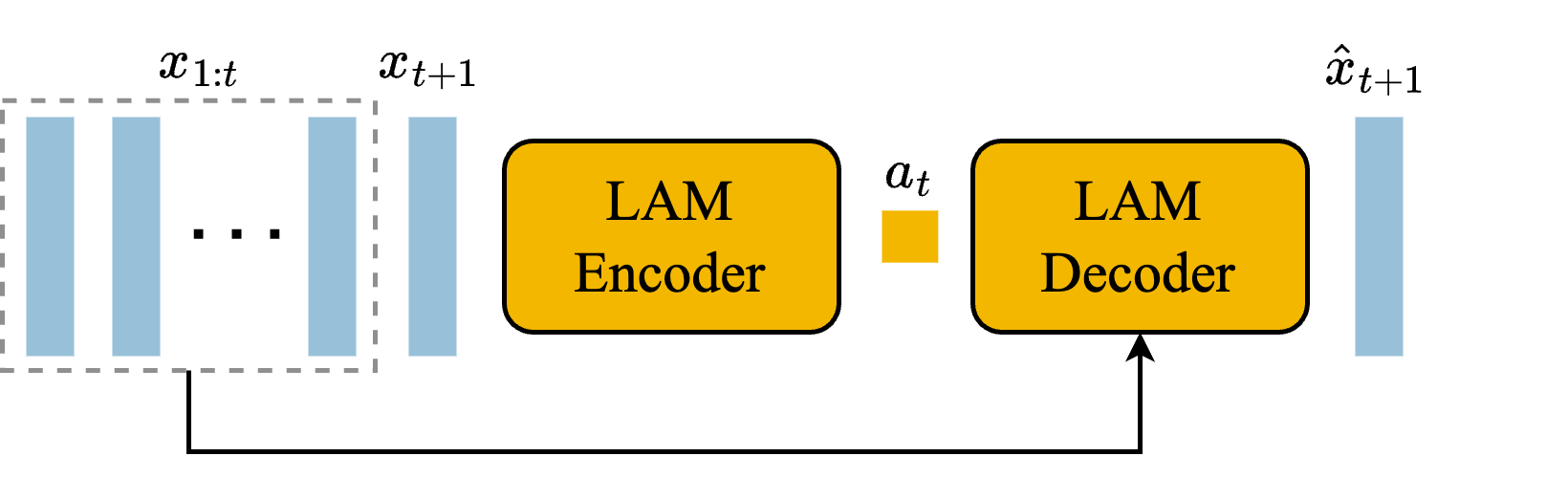
First, an encoder takes as inputs all previous frames
首先,编码器接收所有先前帧
To train the model, we leverage a VQ-VAE-based objective, which enables us to limit the number of predicted actions to a small discrete set of codes. We limit the vocabulary size
为了训练该模型,我们采用基于 VQ-VAE 的目标,使预测动作的数量能够限制在一个较小的离散代码集合中。 我们将 VQ 码本的词表大小
We utilize our ST-transformer architecture for the latent action model. The causal mask in the temporal layer allows us to take the entire video
我们在潜在动作模型中使用 ST-Transformer 架构。 时间层中的因果掩码使我们能够将完整视频
Video Tokenizer. Following prior work, we compress videos into discrete tokens to reduce dimensionality and enable higher quality video generation (see Figure 5). We again make use of VQ-VAE, which takes in
视频分词器。 沿用先前工作,我们将视频压缩为离散词元,以降低维度并实现更高质量的视频生成(见 图5)。 我们再次使用 VQ-VAE,它接收

Unlike prior works that focus on spatial-only compression in the tokenization phase, we utilize the ST-transformer in both the encoder and decoder to incorporate temporal dynamics in the encodings, which improves the video generation quality. By the causal nature of the ST-transformer, each discrete encoding
先前工作在分词阶段主要关注纯空间压缩;与之不同,我们在编码器和解码器中都使用 ST-Transformer,将时间动力学纳入编码,从而提高视频生成质量。 由于 ST-Transformer 具有因果性质,每个离散编码
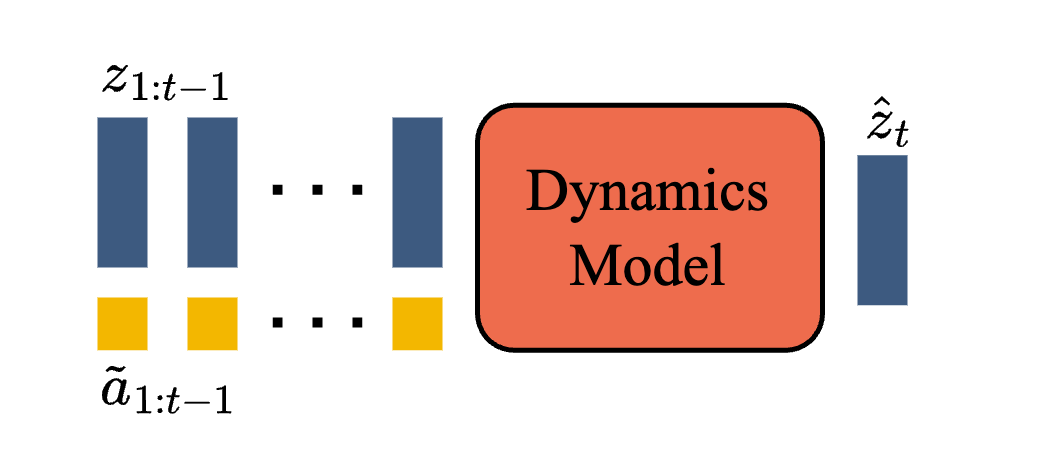
Dynamics Model. The dynamics model is a decoder-only MaskGIT transformer (Figure 6). At each time step
动力学模型。 动力学模型是一个仅含解码器的 MaskGIT Transformer(图6)。 在每个时间步
2.2 Inference: Action-Controllable Video Generation
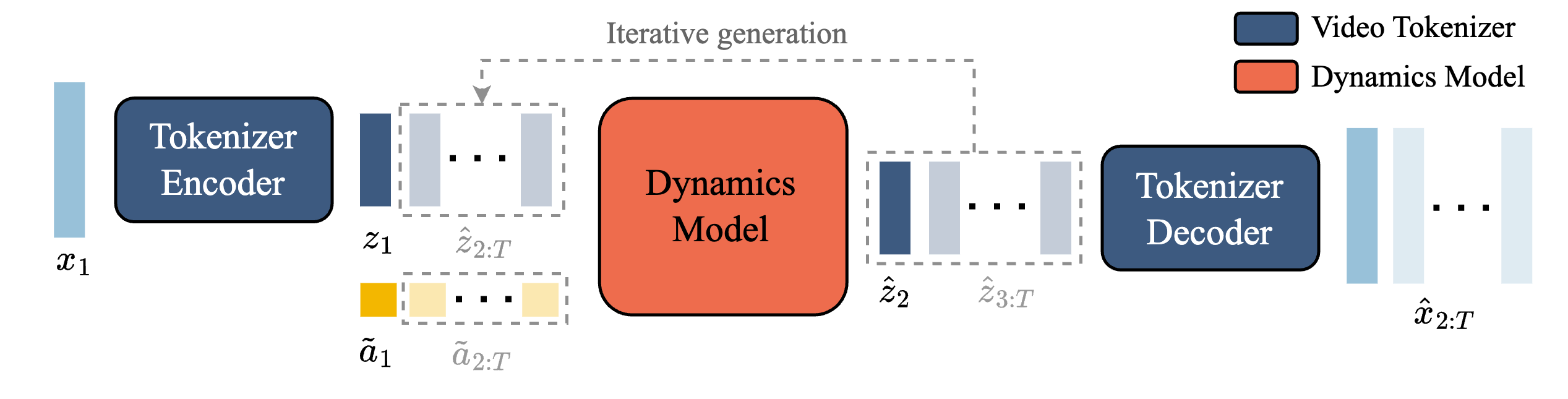
We now describe how to use Genie for action-controllable video generation at inference time (see Figure 7). A player first prompts the model with an image
下面介绍如何在推理时使用 Genie 进行动作可控的视频生成(见 图7)。 玩家首先用图像
The dynamics model takes the frame tokens
动力学模型接收帧词元
3. Experimental Results
Datasets. We train Genie on a large-scale dataset collected from publicly available Internet videos of 2D Platformer games (referred to from here on as “Platformers”). We construct the Platformers dataset by filtering publicly available videos for keywords relating to platformers, yielding 55M 16s video clips at 10FPS, with 160x90 resolution. The final dataset contains 6.8M 16s video clips (30k hours), within an order of magnitude of other popular Internet video datasets. More details can be found in the appendix. Unless otherwise specified, results are with a 11B-parameter model trained on this dataset.
数据集。 我们使用从公开互联网二维平台游戏视频中收集的大规模数据集训练 Genie,下文将该数据集称为“Platformers”。 我们根据与平台游戏相关的关键词筛选公开视频,构建 Platformers 数据集,得到 5500 万段时长 16 秒、帧率 10 FPS、分辨率 160×90 的视频片段。 最终数据集包含 680 万段 16 秒视频片段,共计 3 万小时,其规模与其他常用互联网视频数据集处于同一个数量级。 更多细节见附录。 除非另有说明,所有结果都来自在该数据集上训练的 110 亿参数模型。
To verify the generality of our method, we also consider the robotics datasets used to train RT1, combining their dataset of
为了验证我们方法的通用性,我们还考虑用于训练 RT1 的机器人数据集,将其中约 13 万段机器人示范,与一个独立的模拟数据集及先前工作中的 20.9 万段真实机器人数据合并。 需要注意的是,我们不使用这些数据集中的任何动作,而只是将它们视为视频。 为简洁起见,下文将该数据集称为“Robotics”。
Metrics. We examine the video generation performance of Genie via two factors, namely video fidelity, i.e. the quality of video generation, and controllability, i.e. how much impact the latent actions have in video generation. For video fidelity we use the Frechet Video Distance (FVD), a video-level metric, which has been shown to have a high level of alignment to human evaluation on video quality. For controllability, we devise a metric based on peak signal-to-noise ratio (PSNR) which we call
指标。 我们从两个因素考察 Genie 的视频生成性能,即 视频保真度,也就是视频生成质量,以及 可控性,也就是潜在动作对视频生成的影响程度。 对于视频保真度,我们使用 Fréchet 视频距离(FVD),这是一项视频级指标,已被证明与人类对视频质量的评价高度一致。 对于可控性,我们设计了一项基于峰值信噪比(PSNR)的指标,称为
Here
其中,
Training Details. Our video tokenizer uses 200M parameters, a patch size of 4 and a codebook with embedding size 32 and 1024 unique codes, which we found to be the most effective given the trade-off between reconstruction quality of the tokenizer and downstream performance of video prediction. The latent action model has 300M parameters, a patch size of 16, and a codebook with embedding size 32 and 8 unique codes (latent actions). For all modelling components we use a sequence length of 16 frames with an FPS of 10. Further, we employ bfloat16 and QK norm for training our dynamics model, which has been shown to stabilize training at large scale. At inference time, we perform 25 MaskGIT steps for the sampling of each frame with a temperature of 2 using random sampling. See the appendix for more details.
训练细节。 我们的视频分词器包含 2 亿参数,补丁大小为 4,码本嵌入维度为 32,并包含 1024 个唯一代码;考虑分词器重建质量与下游视频预测性能之间的权衡,我们发现这一配置最为有效。 潜在动作模型包含 3 亿参数,补丁大小为 16,码本嵌入维度为 32,并包含 8 个唯一代码,即潜在动作。 所有建模组件都使用 16 帧序列长度和 10 FPS 帧率。 此外,我们使用 bfloat16 和 QK 归一化训练动力学模型,这已被证明能够稳定大规模训练。 推理时,我们采用随机采样,以温度 2 对每一帧执行 25 步 MaskGIT 采样。 更多细节见附录。
3.1 Scaling Results
In this section, we investigate the scaling behavior of our model. To this end, we conduct studies that explore the impact of both model size and batch size. See the appendix for more details on architecture and compute usage.
本节研究模型的扩展行为。 为此,我们开展实验,探索模型规模和批大小的影响。 有关架构和计算资源使用的更多细节见附录。
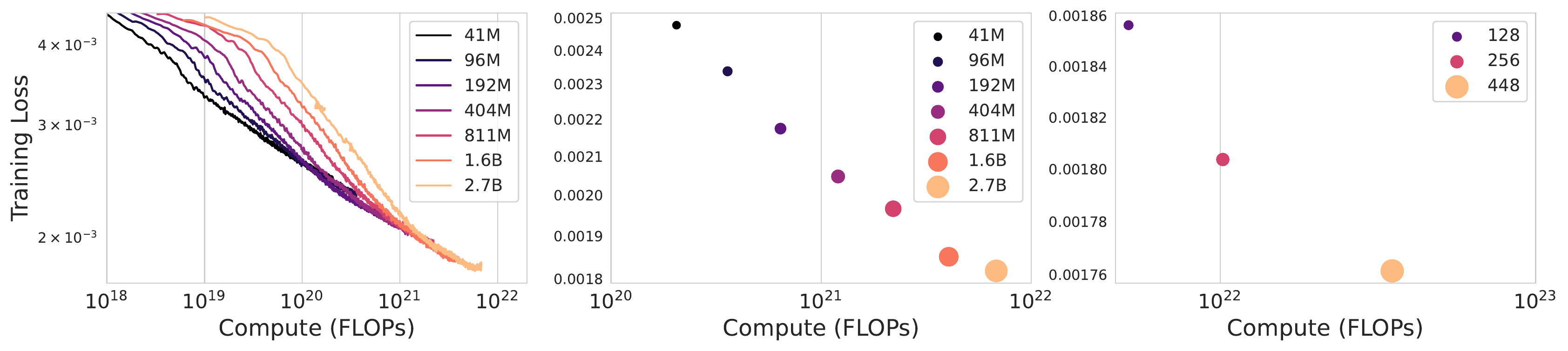
Scaling Model Size. Given a fixed video tokenizer and action model architecture, we train a series of dynamics models ranging from 40M to 2.7B parameters. Figure 8 shows our architecture scales gracefully with model parameters, with each increase in size corresponding to a consistent decrease in the final training loss. This is a strong indication that our approach benefits from scaling, which we exploit with our main Genie model.
扩展模型规模。 在固定视频分词器和动作模型架构的情况下,我们训练了一系列参数量从 4000 万到 27 亿的动力学模型。 图8 表明,我们的架构能够随模型参数平稳扩展,每次增大规模都会使最终训练损失稳定下降。 这强有力地说明我们的方法能够从规模扩展中受益,并被我们用于主 Genie 模型。
Scaling Batch Size. We also investigate the effect of scaling the batch size, considering a 2.3B model with batch sizes of 128, 256, and 448, equating to 1.9M, 3.8M and 6.6M tokens. As shown in Figure 8, increasing the batch size leads to a similarly favorable gain in terms of model performance.
扩展批大小。 我们还研究了扩大批大小的影响,在一个 23 亿参数模型上分别使用 128、256 和 448 的批大小,对应 190 万、380 万和 660 万个词元。 如 图8 所示,增大批大小同样能带来有利的模型性能提升。
Genie Model. It is clear that increasing both model size and batch size helps improve model performance. As a result, for our final model, we train a 10.1B dynamics model with a batch size of 512, for a total of 125k steps, using 256 TPUv5p. When combined with the tokenizer and action model this brings the total to 10.7B parameters, trained on 942B tokens, which we refer to as the Genie model. For our website, we train a larger decoder mapping tokens to 360p videos, adding additional parameters.
Genie 模型。 显然,同时增大模型规模和批大小有助于改善模型性能。 因此,对于最终模型,我们使用 256 个 TPUv5p,以 512 的批大小训练一个 101 亿参数的动力学模型,共进行 12.5 万步训练。 结合分词器和动作模型后,总参数量达到 107 亿,并在 9420 亿个词元上训练;我们将其称为 Genie 模型。 对于项目网站,我们还训练了一个更大的解码器,将词元映射为 360p 视频,因此增加了额外参数。
3.2 Qualitative Results
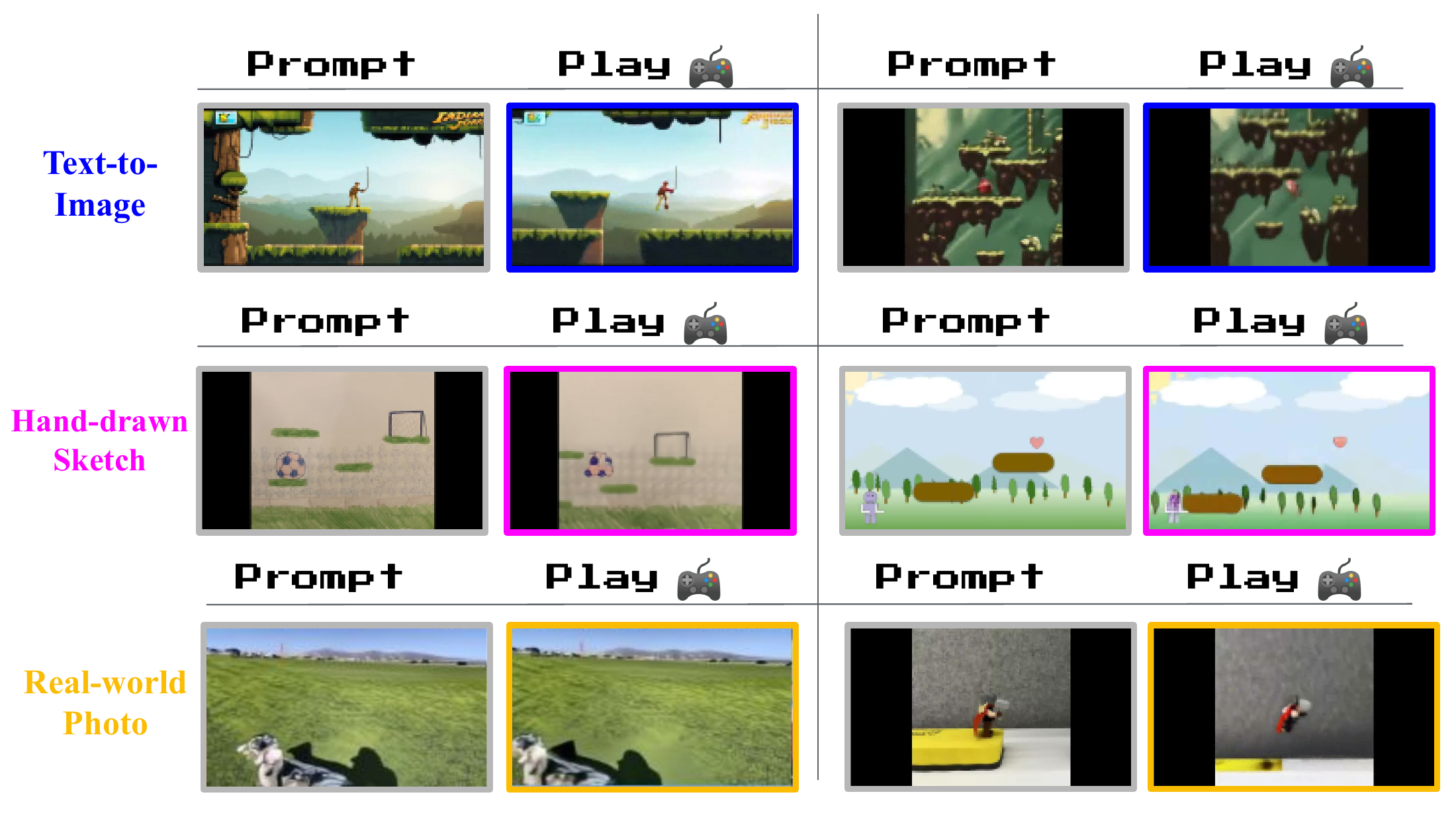
We now present qualitative results from the Genie model. We showcase a 11B parameter model trained on the Platformers dataset and a smaller model trained on the Robotics dataset. Our model generates high-quality, controllable videos across diverse domains. Notably, we qualitatively evaluate our Platformers-trained model using only out-of-distribution (OOD) image prompts, including those generated from text-to-image models, hand-drawn sketches, and even realistic photos. The ability to generalize to such significantly OOD inputs underscores the robustness of our approach and the value of training on large-scale data, which would not have been feasible with real actions as input.
下面展示 Genie 模型的定性结果。 我们展示一个在 Platformers 数据集上训练的 110 亿参数模型,以及一个在 Robotics 数据集上训练的较小模型。 我们的模型能够跨多种领域生成高质量、可控的视频。 值得注意的是,我们 只使用分布外(OOD)图像提示 对 Platformers 训练模型进行定性评估,其中包括文生图模型生成的图像、手绘草图,甚至真实照片。 对这种差异显著的 OOD 输入进行泛化的能力,凸显了我们方法的稳健性和大规模数据训练的价值;如果将真实动作作为输入,这种训练将无法实现。

Platformers-trained model. Figure 9 showcases examples of our model's generations prompted from OOD images, including (top row) images generated from Imagen2, (second row) hand-drawn sketches and (bottom row) real-world photos. Genie is able to bring these imagined worlds to life, as we see game-like behaviour when interacting with each example. We showcase more generations by our model in the appendix, additionally highlighting the consistency of the latent actions.
Platformers 训练模型。 图9 展示了由 OOD 图像提示得到的模型生成示例,其中包括 Imagen2 生成的图像(第一行)、手绘草图(第二行)和真实照片(最后一行)。 Genie 能够让这些想象世界鲜活起来,因为与每个示例交互时都能观察到类似游戏的行为。 附录展示了模型的更多生成结果,并进一步突出潜在动作的一致性。
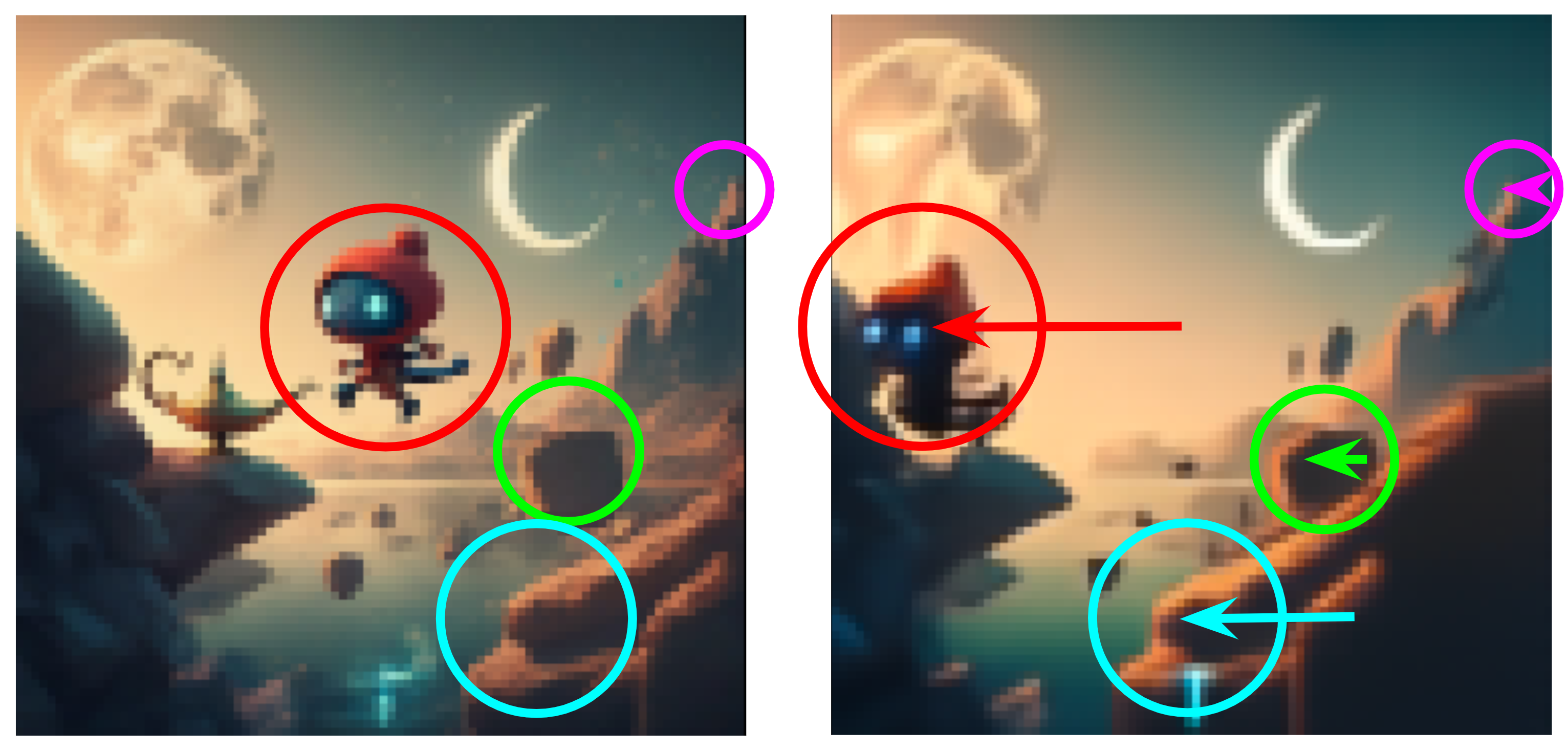
Another emergent capability of our model is its ability to understand 3D scenes and emulate parallax, which is commonly seen in platformer games. In Figure 11 we show an image generated by Imagen2, where taking a latent action moves the foreground at a different rate to the background (as indicated by the length of different colored arrows).
我们模型的另一项涌现能力是理解三维场景并模拟平台游戏中常见的视差。 图11 展示了一张由 Imagen2 生成的图像;执行某一潜在动作时,前景与背景以不同速率移动,这由不同颜色箭头的长度表示。
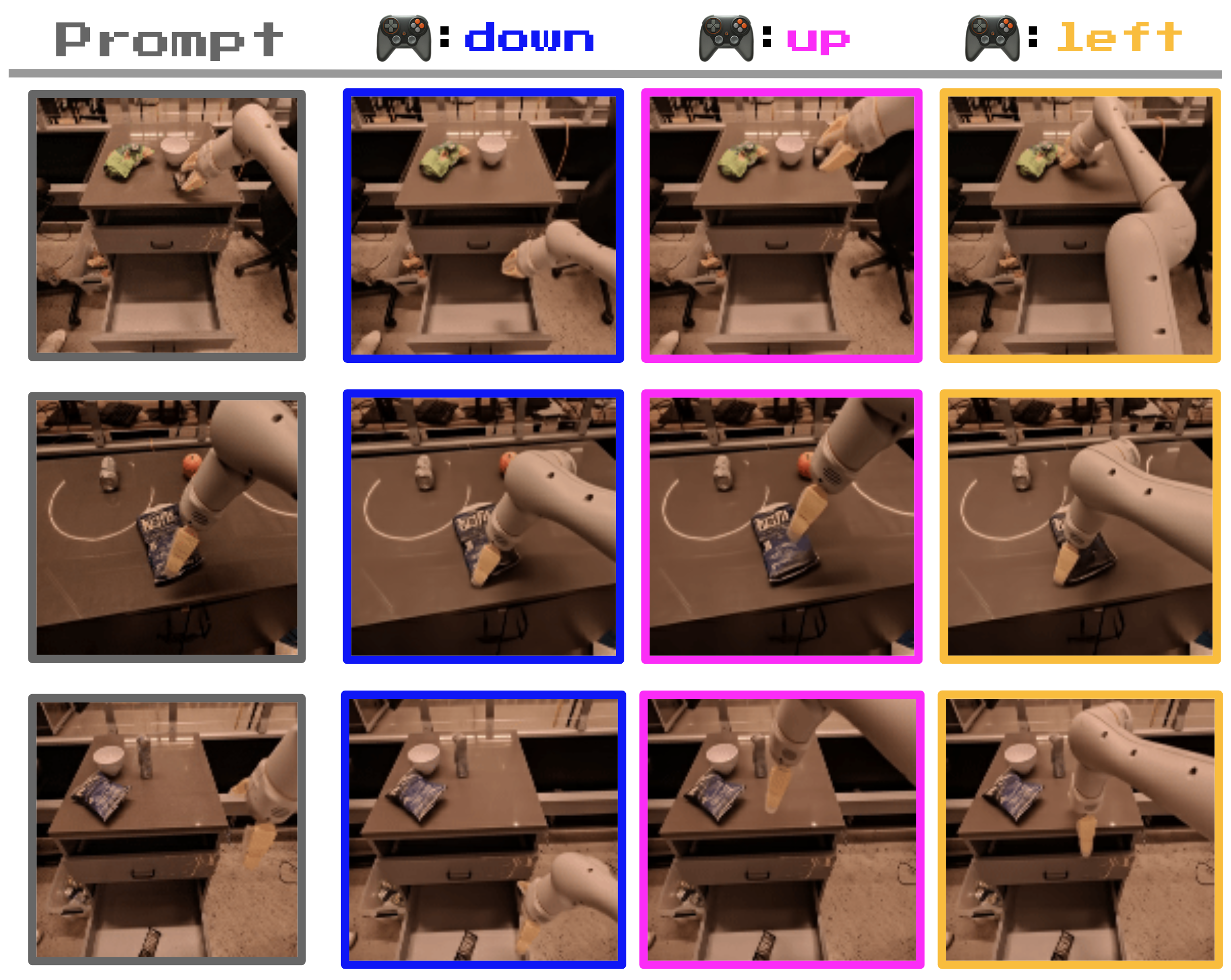
Robotics-trained model. We trained a 2.5B-parameter model on the Robotics dataset using the same hyperparameters found to be best on Platformers, achieving an FVD of 82.7 on the test split. As shown in Figure 12, this model successfully learns distinct and consistent actions from video data, requiring neither text nor action labels. Notably, our model learns not only the controls of the robotic arm but also the interactions and deformations of various objects (Figure 10). We believe this shows our approach presents a path to using larger video datasets from the Internet to create a foundational world model for robotics, with low-level controllable simulation that could be used for a variety of applications.
Robotics 训练模型。 我们使用在 Platformers 上表现最佳的相同超参数,在 Robotics 数据集上训练了一个 25 亿参数模型,并在测试集上取得 82.7 的 FVD。 如 图12 所示,该模型成功地从视频数据中学习到相互区分且保持一致的动作,不需要文本标签或动作标签。 值得注意的是,我们的模型不仅学习机器人手臂的控制,还学习各种物体的交互与变形(图10)。 我们认为,这表明我们的方法为利用更大规模的互联网视频数据创建机器人基础世界模型提供了一条路径;该模型具备低层次可控模拟能力,可用于多种应用。
3.3 Training Agents
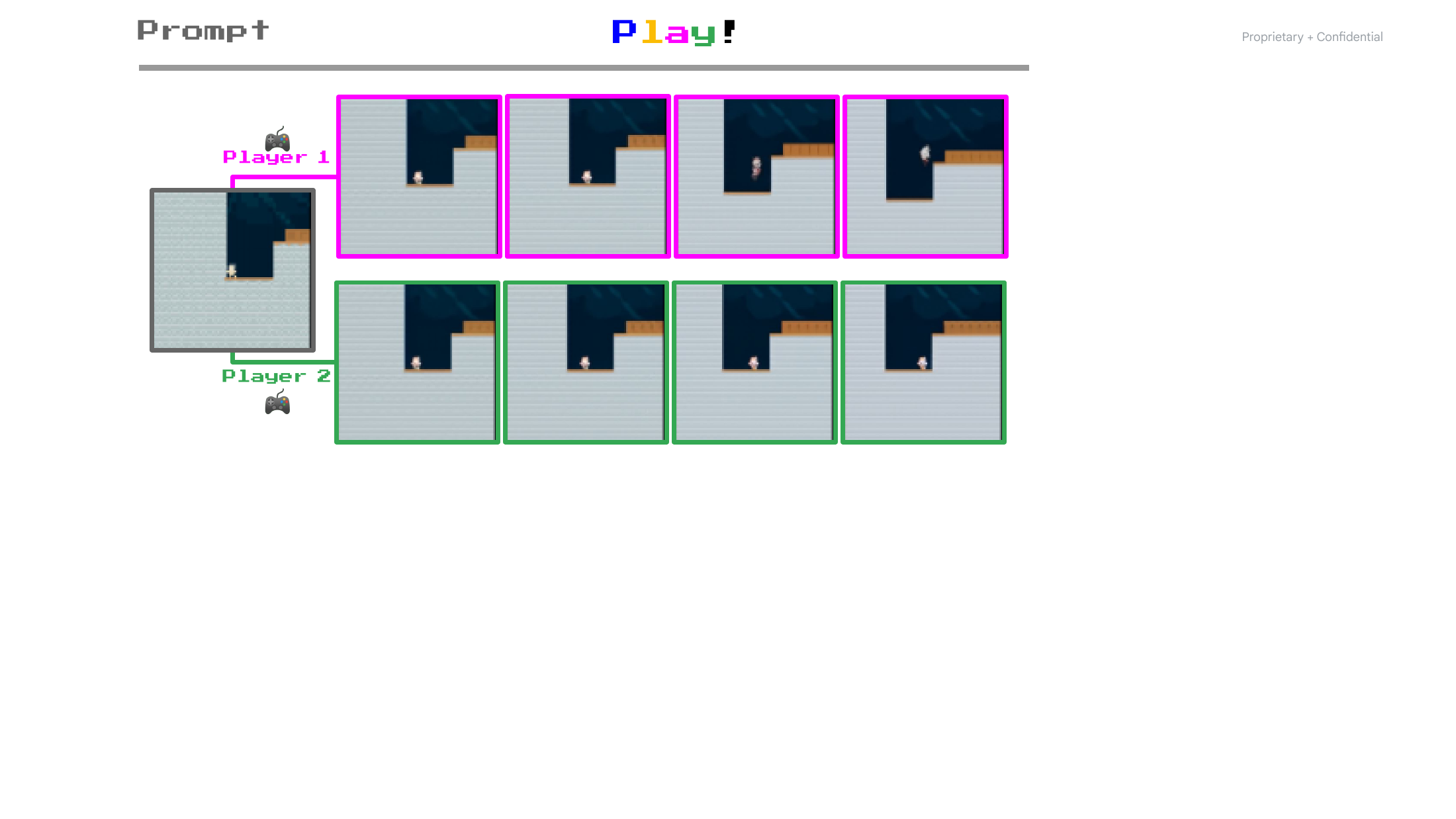
We believe Genie could one day be used as a foundation world model for training generalist agents. In Figure 13 we show that the model can already be used for generating diverse trajectories in unseen RL environments given starting frames. We further investigate if latent actions learnt from Internet videos can be used for imitating behaviors from unseen videos. We use a frozen LAM to label a sequence of expert videos from a target environment with discrete latent actions and then train a policy that predicts the likelihood of the expert taking a latent action given an observation. We then use a small dataset with expert ground-truth actions for mapping latent to real actions (see the appendix for more details).
我们相信,Genie 有朝一日可以作为训练通用智能体的基础世界模型。 图13 表明,给定起始帧,该模型已经可以在未见过的强化学习环境中生成多样化轨迹。 我们进一步研究从互联网视频中学习到的潜在动作能否用于模仿未见视频中的行为。 我们使用冻结的 LAM,以离散潜在动作标注来自目标环境的一系列专家视频,然后训练一个策略,使其根据观测预测专家采取某一潜在动作的可能性。 随后,我们使用包含专家真实动作的小型数据集,将潜在动作映射到真实动作,更多细节见附录。
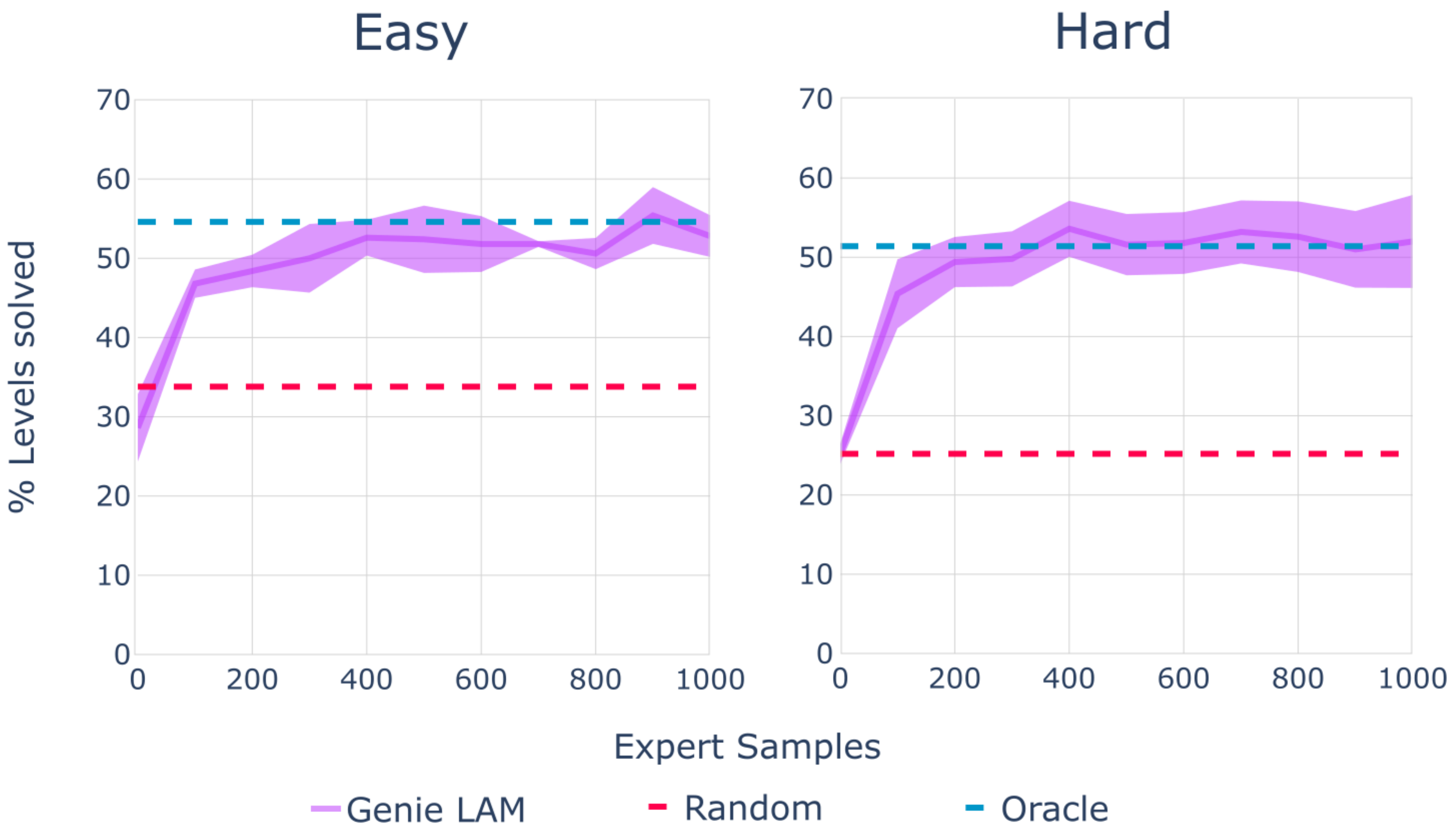
We evaluate in both hard and easy settings of a procedurally generated 2D-platformer environment, CoinRun, and compare against an oracle behavioral cloning (BC) model that has access to expert actions as an upper bound, and a random agent as a lower bound (Figure 14). The LAM-based policy achieves the same score as the oracle given as few as 200 expert samples to adapt, despite almost certainly never seeing CoinRun before. This provides evidence that the learnt latent actions are consistent and meaningful for transfer, as the mapping from latent to real contains no information about the current observation.
我们在程序生成的二维平台环境 CoinRun 的困难和简单设置中进行评估,并与两种基线比较:能够访问专家动作的预言机行为克隆(BC)模型作为上界,随机智能体作为下界(图14)。 尽管 LAM 几乎肯定从未见过 CoinRun,但基于 LAM 的策略只需 200 个专家样本进行适配,便能取得与预言机相同的分数。 这证明学习到的潜在动作具有一致性和有意义的迁移能力,因为从潜在动作到真实动作的映射不包含当前观测的任何信息。
3.4 Ablation Studies
Design choices for latent action model. In designing our latent action model, we carefully considered the type of input to use. While we ultimately chose to use the original images (pixels), we evaluated this choice against the alternative of using tokenized images (replacing x with z in Figure 4). We refer to this alternative approach as the “token-input” model (see Table 2).
潜在动作模型的设计选择。 在设计潜在动作模型时,我们仔细考虑了应使用哪种输入。 尽管最终选择使用原始图像,即像素,但我们也将其与使用分词图像的替代方案进行比较,后者相当于在 图4 中用 z 替换 x。 我们将这一替代方法称为“词元输入”模型(见 表2)。
While this model achieved a slightly lower FVD score on the Platformers dataset, it did not maintain this advantage on the Robotics dataset. More importantly, in both environments, the token-input model exhibited worse controllability (as measured by
尽管该模型在 Platformers 数据集上取得略低的 FVD 分数,但在 Robotics 数据集上未能保持这一优势。 更重要的是,在两个环境中,词元输入模型都表现出更差的可控性,这由
| Dataset | #Params | FVD ↓ | ΔtPSNR ↑ | |
|---|---|---|---|---|
| Token-input | Platformers | 2.3B | 38.8 | 1.33 |
| Pixel-input (Genie) | Platformers | 2.5B | 40.1 | 1.91 |
| Token-input | Robotics | 1B | 257.8 | 1.65 |
| Pixel-input (Genie) | Robotics | 1B | 136.4 | 2.07 |
Tokenizer architecture ablations. We compare the performance of three choices of tokenizers, including 1) (spatial-only) ViT, 2) (spatial-temporal) ST-ViViT and 3) (spatial-temporal) C-ViViT (Table 3). For comparison we use similar number of parameters for all tokenizers, with patch size 10, batch size 128 and sequence length 16. We then train the same dynamics and latent action model on these three different tokenizers, and report their FVD as well as
分词器架构消融。 我们比较三种分词器的性能,包括 1)仅使用空间信息的 ViT,2)使用时空信息的 ST-ViViT,以及 3)使用时空信息的 C-ViViT(表3)。 为便于比较,所有分词器都使用相近的参数量,补丁大小为 10,批大小为 128,序列长度为 16。 随后,我们在这三种不同分词器上训练相同的动力学模型和潜在动作模型,并报告其 FVD 和
| #Params | Memory | FVD ↓ | ΔtPSNR ↑ | |
|---|---|---|---|---|
| ViT | 230M | 0.3GB | 114.5 | 1.39 |
| C-ViViT | 225M | 1.6GB | 272.7 | 1.37 |
| ST-ViViT (ours) | 205M | 0.9GB | 81.4 | 1.66 |
Our proposed ST-ViViT architecture provides both improved video generation (FVD) and
与 C-ViViT 和仅使用空间信息的 ViT 相比,我们提出的 ST-ViViT 架构在合理的内存权衡下,同时改善了视频生成性能(FVD)和
4. Related Work
World models. Generative interactive environments can be considered a class of World Models, which enable next-frame prediction that is conditioned on action inputs. Such models can be useful for training agents, as they can be used for learning policies without direct environment experience at agent training time. However, learning the models themselves typically requires action-conditioned data obtained directly from the environment. In contrast, our approach seeks to learn a world model in an unsupervised fashion from videos alone. Recently, there has been renewed emphasis on scaling world models. GAIA-1 and UniSim learn world models for autonomous driving and robotic manipulation respectively. These approaches require both text and action labels, while we focus on training from video-only data from publicly available Internet videos.
世界模型。 生成式交互环境可以被视为一类 世界模型,它能够以动作输入为条件预测下一帧。 此类模型有助于训练智能体,因为在智能体训练阶段,无需直接体验环境即可用它们学习策略。 然而,学习模型本身通常需要直接从环境中获得以动作为条件的数据。 相比之下,我们的方法试图仅从视频中以无监督方式学习世界模型。 近期,世界模型的规模扩展再次受到重视。 GAIA-1 和 UniSim 分别学习用于自动驾驶和机器人操控的世界模型。 这些方法同时需要文本和动作标签,而我们专注于只使用公开互联网视频数据进行训练。
Video models. Our work is related to video models, which typically condition on initial frames (or text) and predict the remaining frames in a video. Our approach most resembles recent transformer based models such as Phenaki, TECO and MaskViT, as we use MaskGIT and an ST-Transformer over tokenized images. While video models are becoming increasingly controllable, we seek a more agentic goal and explicitly learn a latent action space from data, allowing users or agents to “play” the model using latent action-conditioned predictions.
视频模型。 我们的工作与 视频模型 相关;此类模型通常以初始帧或文本为条件,预测视频中的其余帧。 我们的方法与 Phenaki、TECO 和 MaskViT 等近期基于 Transformer 的模型最为相似,因为我们在分词图像上使用 MaskGIT 和 ST-Transformer。 尽管视频模型正变得越来越可控,但我们追求更具智能体性质的目标,并显式地从数据中学习 潜在动作空间,使用户或智能体能够使用以潜在动作为条件的预测来“游玩”模型。
Playable Video Generation. Genie generalizes beyond Playable Video Generation (PVG), where latent actions are used for controlling world models learnt directly from videos. In contrast to Genie, PVG considers domain-specific static examples, rather than generating entirely new environments via prompting. Thus, scaling beyond this setting required non-trivial architectural changes, dropping inductive biases in exchange for a general method.
可游玩视频生成。 Genie 的适用范围超越了可游玩视频生成(PVG);后者使用潜在动作控制直接从视频中学习到的世界模型。 与 Genie 不同,PVG 考虑领域特定的固定示例,而不是通过提示生成全新的环境。 因此,要超越这一设置进行扩展,需要进行非平凡的架构改动,以舍弃归纳偏置换取通用方法。
Environment generation. Our work is also related to Procedural Content Generation (PCG) where machine learning has proven highly effective for generating game levels, recently via language models that directly write game code. Language models themselves can also be considered to be interactive environments, albeit lacking a visual component. By contrast in our setting the levels can be learnt and generated directly from pixels, which enables us to utilize the diversity of Internet video data.
环境生成。 我们的工作还与 程序化内容生成(PCG)相关;机器学习已被证明在生成游戏关卡方面非常有效,近期方法还使用语言模型直接编写游戏代码。 语言模型本身也可以被视为交互环境,只是缺少视觉组件。 相比之下,在我们的设置中,可以直接从像素学习并生成关卡,从而利用互联网视频数据的多样性。
Training agents with latent actions. Prior works have used latent actions for imitation from observation, planning and pre-training RL agents. These approaches have similar objectives to our latent action model, though have not been applied at scale. VPT is a recent approach that uses an inverse dynamics model learnt from human-provided action labeled data, to label Internet-scale videos with actions that can then be used for training a policy. We showed, in contrast, that we can use latent actions learnt from Internet videos to infer policies for arbitrary environments, avoiding the need for ground-truth actions that are costly and may not generalize.
使用潜在动作训练智能体。 先前工作已将潜在动作用于观测模仿、规划和强化学习智能体预训练。 这些方法与我们的潜在动作模型具有相似目标,但尚未得到大规模应用。 VPT 是一种近期方法,它从人类提供的带动作标签数据中学习逆动力学模型,再用该模型为互联网规模的视频标注动作,随后用于训练策略。 相比之下,我们表明,可以使用从互联网视频中学习到的 潜在 动作为任意环境推断策略,从而避免依赖成本高昂且可能无法泛化的真实动作。
5. Conclusion and Future Work
We proposed Genie, a new form of generative AI that enables anyone, even children, to dream up, create, and step into generated worlds as we can with human-designed simulated environments. Genie can be prompted to generate a diverse set of interactive and controllable environments despite training from video-only data.
我们提出 Genie,这是一种新的生成式人工智能形式,使任何人,甚至儿童,都能像进入人类设计的模拟环境一样,构想、创建并进入生成的世界。 尽管只使用视频数据训练,Genie 仍可在提示下生成多种交互式、可控环境。
There are clear improvements that can be made to the model. Genie inherits some of the weaknesses of other autoregressive transformer models, and can hallucinate unrealistic futures. And while we have made progress with spatiotemporal representations, we are still limited to 16 frames of memory which makes it challenging to get consistent environments over long horizons. Finally, Genie currently operates around 1FPS and requires future advances to achieve an efficient frame rate for interaction.
该模型显然仍有改进空间。 Genie 继承了其他自回归 Transformer 模型的部分弱点,可能会产生不真实的未来幻觉。 尽管我们在时空表示方面取得了进展,但记忆仍局限于 16 帧,这使长时间跨度内保持环境一致性颇具挑战。 最后,Genie 当前运行速度约为 1 FPS,未来仍需进一步发展才能达到适合交互的高效帧率。
Still, we believe Genie opens up vast potential for future research. Given its generality, the model could be trained from an even larger proportion of Internet videos to simulate diverse, realistic, and imagined environments. Furthermore, we only briefly touched upon the capabilities of using Genie for training agents, but given that the lack of rich and diverse environments is one of the key limitations in RL, we could unlock new paths to creating more generally capable agents.
尽管如此,我们相信 Genie 为未来研究开启了巨大潜力。 鉴于其通用性,该模型可以在更大范围的互联网视频上训练,以模拟多样、真实和想象中的环境。 此外,我们对使用 Genie 训练智能体的能力只做了简要探索;考虑到缺少丰富且多样的环境是强化学习的关键限制之一,这项工作可能为创建能力更加通用的智能体开辟新路径。
Broader Impact
Societal Impact. Genie could enable a large amount of people to generate their own game-like experiences. This could be positive for those who wish to express their creativity in a new way, for example children who could design and step into their own imagined worlds. We also recognize that with significant advances, it will be critical to explore the possibilities of using this technology to amplify existing human game generation and creativity---and empowering relevant industries to utilize Genie to enable their next generation of playable world development.
社会影响。 Genie 可以使大量用户生成自己的类游戏体验。 这会给希望以新方式表达创造力的人带来积极影响,例如儿童可以设计并进入自己想象的世界。 我们也认识到,随着技术取得重大进展,探索如何使用该技术放大人类现有的游戏创作与创造力,并赋能相关产业利用 Genie 开发下一代可游玩世界,将至关重要。
Training Data and Weights. We have chosen not to release the trained model checkpoints, the model's training dataset, or examples from that data to accompany this paper or the website. We would like to have the opportunity to further engage with the research (and video game) community and to ensure that any future such releases are respectful, safe and responsible.
训练数据与权重。 我们选择不随论文或网站发布训练后的模型检查点、模型训练数据集或该数据中的示例。 我们希望有机会进一步与研究界及电子游戏社区交流,并确保未来任何此类发布都尊重相关群体,同时安全且负责任。
Reproducibility. We understand that it may be challenging for researchers with fewer computational to reproduce our main results. In order to mitigate this issue, we describe a smaller scale, fully reproducible example in the appendix that can run on a single mid-range TPU (or GPU). Given that many design choices translate between the two settings, we believe this will make it possible for the broader community to investigate future architectural improvements as well as additional research directions resulting from our work.
可复现性。 我们理解,计算资源较少的研究者可能难以复现我们的主要结果。 为了缓解这一问题,我们在附录中描述了一个规模更小、完全可复现的示例,它可以在单个中端 TPU 或 GPU 上运行。 由于许多设计选择可以在两种设置之间迁移,我们相信这将使更广泛的研究社区能够探索未来的架构改进,以及由本工作引出的其他研究方向。