
United Minds or Isolated Agents? Exploring Coordination of LLMs under Cognitive Load Theory
AgentMulti-AgentTMLR 2026香港科技大学加州大学圣迭戈分校香港理工大学联合心智还是孤立智能体?认知负荷理论下的 LLM 协作探索
Abstract
Large Language Models (LLMs) exhibit a notable performance ceiling on complex, multi-faceted tasks. As practitioners increasingly rely on heavy context engineering---curating intricate instructions, tool schemas, and multi-turn histories---the processing demands often exceed the LLM's effective attention budget, leading to context rot. Drawing an analogy to Cognitive Load Theory (CLT) in cognitive science, we propose that this bottleneck is functionally analogous to the bounded working memory of the human mind. Rather than relying on heuristic prompt engineering, we use CLT as a principled design lens for LLM system design.
大语言模型(LLM)在复杂、多面向任务上呈现出显著的性能上限。 随着实践者越来越依赖重度上下文工程,即精心组织复杂指令、工具模式和多轮历史,处理需求往往会超过 LLM 的有效注意力预算,从而导致上下文腐化。 通过类比认知科学中的认知负荷理论(CLT),我们提出,这一瓶颈在功能上类似于人类心智中容量有限的工作记忆。 我们不依赖启发式提示工程,而是把 CLT 用作 LLM 系统设计的一种原则性设计视角。
To operationalize this insight, we introduce CoThinker, an instantiation of a CLT-driven multi-agent framework. CoThinker operationalizes CLT principles by distributing intrinsic cognitive load through agent specialization and managing transactional load via structured communication and a collective working memory. We empirically evaluate CoThinker on complex problem-solving tasks and fabricated high cognitive load scenarios. Our results are consistent with a CLT-informed account of multi-agent coordination: gains concentrate on reasoning-heavy tasks where cognitive load is high, while coordination overhead dominates on low-intrinsic-load tasks such as instruction-following---a boundary predicted by the cognitive-load-profile view. Our analysis reveals characteristic interaction patterns that cast insights from collective cognition and load management into a principled approach to agent system design.
为了将这一洞见付诸实践,我们提出 CoThinker,它是由 CLT 驱动的多智能体框架的一种具体实现。 CoThinker 通过智能体专业化来分配内在认知负荷,并通过结构化通信和集体工作记忆来管理交互负荷,从而将 CLT 原则落实到系统中。 我们在复杂问题求解任务和构造的高认知负荷场景上对 CoThinker 进行了实证评估。 我们的结果与 CLT 所解释的多智能体协作一致:收益集中在认知负荷较高的重推理任务上,而在指令遵循等低内在负荷任务上,协作开销占据主导地位;这一边界正是认知负荷画像视角所预测的。 我们的分析揭示了具有代表性的交互模式,并将集体认知与负荷管理的洞见转化为一种有原则的智能体系统设计方法。
1. Introduction
As Large Language Models (LLMs) are deployed on increasingly complex real-world tasks, practitioners increasingly rely on context engineering---the careful curation of information presented to a model so that its finite attention budget is spent effectively. To steer LLM behavior for complex agentic workflows, developers aggressively pack the context window with intricate system instructions, few-shot demonstrations, exhaustive tool specifications, and expanding multi-turn histories. While this context-heavy paradigm shapes thinking patterns similarly to finetuning while avoiding the cost of parameter updates, the question of why heavily engineered contexts often degrade model performance on complex real-world tasks---and how to systematically manage the resulting bottleneck---remains a critical challenge.
随着大语言模型(LLM)被部署到日益复杂的现实任务中,实践者越来越依赖上下文工程,即仔细组织呈现给模型的信息,使其有限的注意力预算得到有效利用。 为了引导 LLM 在复杂智能体工作流中的行为,开发者会把复杂系统指令、少样本示例、详尽工具规范和不断增长的多轮历史大量塞入上下文窗口。 这种重上下文范式无需承担参数更新成本,却能以类似微调的方式塑造思维模式;然而,经过重度工程设计的上下文为何经常降低模型在复杂现实任务上的表现,以及如何系统管理由此产生的瓶颈,仍是一项关键挑战。
Concretely, aggressively engineered contexts suffer from a performance ceiling---recently termed context rot in engineering practice---when applied to multi-faceted tasks requiring the integration of diverse information sources. This is distinct from simple long-context retrieval: while models can excel at needle-in-a-haystack style localization, integrating many densely interacting constraints still strains effective processing. Even when information fits easily within the physical limits of massive context windows, LLMs frequently suffer from attention diffusion, getting “lost in the middle” when forced to process dense, highly interactive context. The same bottleneck widens as agents increasingly rely on protocol-heavy tool usage and complex memory management.
具体而言,当经过重度工程设计的上下文用于需要整合多种信息来源的多面向任务时,会遭遇一种性能上限;工程实践最近将其称为上下文腐化。 这不同于简单的长上下文检索:模型虽然可能擅长大海捞针式定位,但整合大量密集交互的约束仍会给有效处理带来压力。 即使信息轻易落在巨大上下文窗口的物理限制之内,LLM 在被迫处理密集且高度交互的上下文时,也常常出现注意力扩散并“迷失在中间”。 随着智能体越来越依赖协议繁重的工具使用和复杂记忆管理,同一瓶颈还会进一步扩大。
In such scenarios, when overwhelmed by extensive in-context information, LLM agents frequently exhibit degeneration of thought, hallucination of constraints, sycophantic agreement, or an inability to follow multiple interacting requirements. Despite increasing empirical studies on the limitations of long contexts and attention budgets, the root causes remain underexplored. Concurrently, multi-agent LLM systems are increasingly popular for task distribution, yet many still coordinate through dense chat histories without explicit cognitive grounding, often exacerbating rather than mitigating context overload.
在这类场景中,当大量上下文信息令模型不堪重负时,LLM 智能体经常出现思维退化、约束幻觉、迎合式同意,或无法遵循多个相互作用的要求。 尽管针对长上下文和注意力预算局限的实证研究不断增多,其根本原因仍未得到充分探索。 与此同时,多智能体 LLM 系统越来越多地被用于任务分配,但其中许多系统仍通过密集聊天历史进行协调,缺乏明确的认知依据,因而往往加剧而非缓解上下文过载。
To address this gap, we turn to cognitive science for explanatory insight. Similar patterns of performance degradation under high informational demands have long been studied through the framework of Cognitive Load Theory (CLT). To better understand this phenomenon in LLMs, we first conduct a pilot study (Section 3). This study provides theoretical grounding by establishing the cognitive load framework for LLM performance limits and empirically examines this analogy through measurable proxies.
为弥补这一空白,我们转向认知科学寻求解释性洞见。 在高信息需求下出现的类似性能下降模式,长期以来一直通过认知负荷理论(CLT)框架加以研究。 为了更好地理解 LLM 中的这一现象,我们首先开展了一项试点研究(第 3 节)。 该研究建立了用于解释 LLM 性能上限的认知负荷框架,并通过可测量的代理指标对这一类比进行实证检验,从而提供理论依据。
Specifically, following CLT, we define an agent's Working Memory (WM) as its intrinsic, capacity-limited attention budget---the ability to simultaneously hold, filter, and process information active in its context window. Correspondingly, Cognitive Load (CL) is the demand that an engineered context places on an agent's WM, largely determined by the complexity and element interactivity of the prompt. When the CL imposed by a task exceeds the agent's WM capacity, a state of cognitive overload occurs. We conduct experiments measuring attention entropy and perplexity as proxies for context processing fluency and sparsity, demonstrating that LLMs exhibit patterns consistent with CLT predictions.
具体而言,遵循 CLT,我们把智能体的 工作记忆(WM) 定义为其内在的、容量有限的注意力预算,即同时保存、筛选和处理上下文窗口中活跃信息的能力。 相应地,认知负荷(CL) 是经过工程设计的上下文对智能体工作记忆提出的需求,主要由提示的复杂度和元素交互性决定。 当任务施加的认知负荷超过智能体的工作记忆容量时,就会发生认知过载。 我们通过实验测量注意力熵和困惑度,将其作为上下文处理流畅性和稀疏性的代理指标,并表明 LLM 呈现出与 CLT 预测一致的模式。
Furthermore, recent evidence that LLMs exhibit bounded, human-like WM characteristics supports reading the performance ceiling of heavy context engineering through a CLT lens: when the processing demands of in-context information approach the LLM's effective attention budget, performance degrades in ways functionally analogous to---not mechanistically identical to---the theoretical limits described by CLT. We treat CLT as a design lens yielding testable predictions about when multi-agent coordination helps (high intrinsic load) versus hurts (low intrinsic load), and evaluate both.
此外,近期证据表明 LLM 具有容量受限、类似人类的工作记忆特征,这支持我们从 CLT 视角理解重度上下文工程的性能上限:当上下文信息的处理需求接近 LLM 的有效注意力预算时,性能会以一种与 CLT 所述理论限制在功能上类似、但机制并不相同的方式下降。 我们把 CLT 视为一种设计视角,它能够对多智能体协作何时有益(高内在负荷)、何时有害(低内在负荷)给出可检验预测,并对两种情况均进行评估。
To translate these cognitive insights into actionable system design, we present CoThinker, a proof-of-concept multi-agent framework built to probe the utility of CLT as a design lens for managing context complexity. Instead of relying on heuristic coordination, CoThinker systematically operationalizes CLT principles through three key functions: (i) dynamic thinking style assignment that adapts to task demands, distributing the intrinsic cognitive load (task context complexity) across specialized agents, (ii) a transactive memory system that acts as context compression by maintaining shared knowledge, reducing the extraneous load of re-reading long raw histories, and (iii) a communication moderator that functions as information routing, limiting the influx of peer messages to protect each agent's attention budget while maintaining small-world network connectivity.
为了把这些认知洞见转化为可操作的系统设计,我们提出 CoThinker,这是一种概念验证型多智能体框架,用于探究 CLT 作为设计视角管理上下文复杂度的效用。 CoThinker 不依赖启发式协调,而是通过三项关键功能系统落实 CLT 原则:(i) 适应任务需求的动态思维风格分配,将内在认知负荷(任务上下文复杂度)分散给专业化智能体;(ii) 通过维护共享知识发挥上下文压缩作用的交互记忆系统,减少反复读取冗长原始历史所产生的外在负荷;(iii) 发挥信息路由作用的通信调节器,限制同伴消息涌入,在维持小世界网络连通性的同时保护每个智能体的注意力预算。
In sum, rather than merely proposing another multi-agent framework, this work provides a cognitive grounding for LLM coordination. Our key contributions are:
- We frame the failures of heavy context engineering through a CLT lens that maps human working memory constraints to LLM attention limits, supported by diagnostic empirical proxies (Section 3).
- We provide a principled, CLT-guided paradigm for multi-agent system design, instantiated through CoThinker, which operationalizes context compression, load distribution, and structured routing.
- We empirically evaluate CoThinker and find performance gains concentrated on reasoning-heavy, high-intrinsic-load tasks, with coordination overhead dominating on low-intrinsic-load instruction-following---consistent with the cognitive-load-profile prediction (Section 5.2).
2. Related Work
2.1 Multi-Agent LLM Collaboration
The rise of LLMs has spurred research into multi-agent systems (MAS), where LLMs collaborate to tackle complex problems beyond the scope of single agents. Current approaches include multi-agent debates for idea exchange and critique, iterative reflection for self-correction, and functional specialization, where agents divide tasks in complex domains. Architecturally, research explores dynamic agent networks, mental set diversity, and hierarchical coordination. However, these designs often rely on intuition or communication efficiency, with limited grounding in cognitive theories of processing constraints.
LLM 的兴起推动了多智能体系统(MAS)研究;在这类系统中,LLM 通过协作处理超出单个智能体能力范围的复杂问题。 当前方法包括用于观点交换和批评的多智能体辩论、用于自我纠正的迭代反思,以及由智能体在复杂领域中分工的功能专业化。 在架构层面,研究探索了动态智能体网络、心智定势多样性和层级协调。 然而,这些设计往往依赖直觉或通信效率,对处理约束的认知理论缺乏充分依据。
In fact, naive multi-agent communication often increases extraneous context load, as each agent is forced to append the raw, lengthy outputs of all its peers into its own context window. Our work, CoThinker, directly addresses this gap. By treating multi-agent coordination as a distributed context processing problem, CoThinker actively manages what information enters each agent's context window to prevent cognitive overload.
事实上,朴素的多智能体通信往往会增加外在上下文负荷,因为每个智能体都被迫把所有同伴冗长的原始输出追加到自己的上下文窗口中。 我们的 CoThinker 直接解决了这一空白。 CoThinker 把多智能体协调视为一个分布式上下文处理问题,主动管理进入每个智能体上下文窗口的信息,从而防止认知过载。
2.2 LLM for Human Simulation
The capacity of LLMs to exhibit human-like intelligence and emulate nuanced social behaviors is foundational to their use as artificial agents. Research has demonstrated LLMs' ability to simulate human decision-making, generate believable individual and collective behaviors, and adopt distinct personas. Critically, these parallels extend to cognitive characteristics; recent studies suggest LLMs possess bounded working memory and exhibit failure modes under cognitive overload akin to humans. Furthermore, interactions between LLM agents can mirror social psychological phenomena. This confluence of human-like cognitive traits, including processing limitations and social capabilities, provides a strong rationale for applying Cognitive Load Theory to design more effective, load-aware collaborative LLM systems.
LLM 展现类人智能并模拟细腻社会行为的能力,是将其用作人工智能体的基础。 研究已经证明,LLM 能够模拟人类决策、生成可信的个体与集体行为,并采用不同的人格画像。 关键在于,这些相似性还延伸到了认知特征;近期研究表明,LLM 具有容量受限的工作记忆,并会在认知过载下表现出类似人类的失败模式。 此外,LLM 智能体之间的互动还可以映射社会心理现象。 这些类人认知特征,包括处理限制和社会能力,共同为应用认知负荷理论设计更有效、更具负荷感知能力的协作式 LLM 系统提供了有力依据。
3. Cognitive Foundations for Enhanced LLM Performance
This section presents our pilot study, which establishes the theoretical foundation for our approach by linking human cognitive limitations to performance ceilings in LLMs. We introduce a cognitive load model based on working memory (WM) and attention budget analogies (Section 3.1), examine this analogy empirically (Section 3.2), and demonstrate how Cognitive Load Theory (CLT) can address individual limitations and guide LLM system design (Section 3.3).
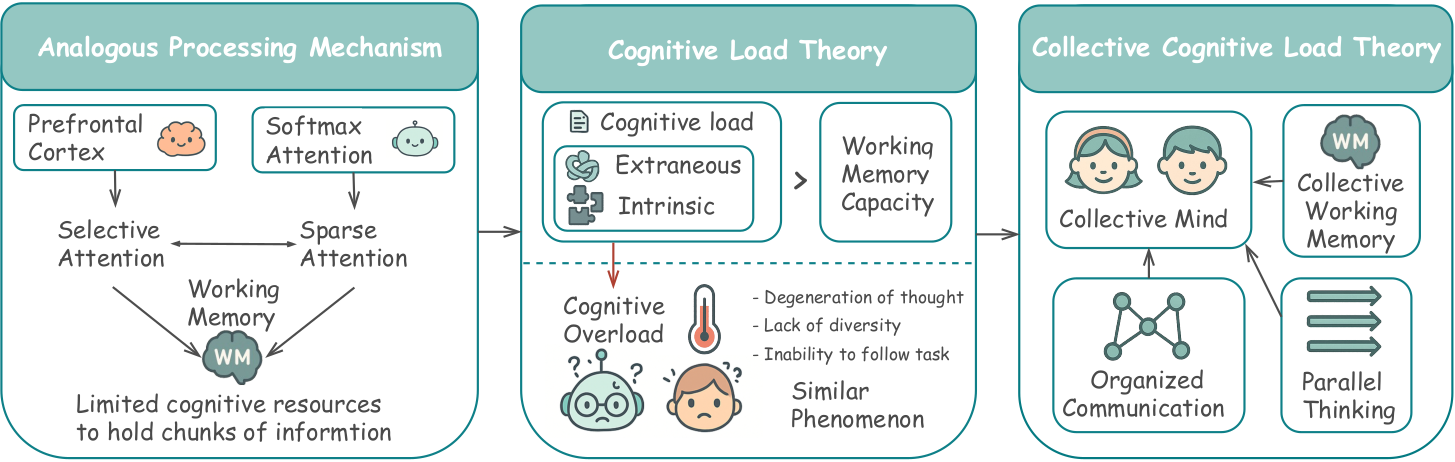
3.1 A Cognitive Load Framework for LLM Performance Limits
As depicted in the first and second blocks of Figure 1, we propose a model that draws parallels between human cognitive limitations and the context processing ceilings in LLMs.
如 图1 的第一和第二部分所示,我们提出一个模型,用于类比人类认知限制与 LLM 的上下文处理上限。
Analogous Processing Mechanisms. Human cognition relies fundamentally on working memory, a capacity-limited cognitive system associated with the prefrontal cortex that employs selective attention to filter and prioritize information during complex cognitive tasks. LLMs exhibit structural parallels we treat as a design analogy rather than a mechanistic claim about transformer internals: their softmax attention mechanisms perform selective focus on input data, with attention heads specializing in distinct processing patterns. Crucially, while modern LLMs possess massive physical context windows, their active processing capacity---their attention budget---remains strictly bounded.
类似的处理机制。 人类认知从根本上依赖工作记忆;工作记忆是一种与前额叶皮层相关、容量有限的认知系统,在复杂认知任务中利用选择性注意力筛选信息并确定其优先级。 LLM 呈现出结构上的相似性,我们把它视为一种设计类比,而非关于 Transformer 内部机制的主张:它们的 softmax 注意力机制会对输入数据进行选择性聚焦,不同注意力头则专门处理不同模式。 关键在于,现代 LLM 虽然拥有巨大的物理上下文窗口,但其主动处理容量,即注意力预算,仍受到严格限制。
Recent studies provide direct evidence that LLMs possess human-like WM characteristics, exhibiting clear limitations on concurrent information processing with performance degrading predictably as cognitive demands increase. More discussion in the appendix.
近期研究提供了直接证据,表明 LLM 具有类似人类的工作记忆特征:它们在并发信息处理方面存在明显限制,而且随着认知需求增加,性能会以可预测的方式下降。 更多讨论见附录。
Cognitive Load Theory. Building upon these working memory analogies, we apply CLT to interpret LLM performance patterns under heavy context engineering. CLT distinguishes Cognitive Load (CL) between intrinsic load (determined by task complexity and element interactivity) and extraneous load (arising from how instructions and information are presented). When the combined load exceeds working memory capacity, cognitive overload ensues.
认知负荷理论。 在这些工作记忆类比的基础上,我们应用 CLT 来解释重度上下文工程下的 LLM 性能模式。 CLT 把认知负荷(CL)区分为内在负荷(由任务复杂度和元素交互性决定)与外在负荷(源于指令与信息的呈现方式)。 当两种负荷之和超过工作记忆容量时,就会发生认知过载。
LLM agents demonstrate analogous performance degradation when tasked with complex problems via dense context engineering: tasks requiring extensive multi-step reasoning, exhaustive tool constraints, or long multi-agent dialogue histories can lead to degeneration of thought, lack of diversity, or inability to follow multiple requirements. We contend that such performance ceilings represent cognitive overload, where the total context processing demands surpass the LLM's effective attention budget. Examples are provided in the appendix.
当通过密集上下文工程为 LLM 智能体布置复杂问题时,它们也会出现类似的性能下降:需要大量多步推理、详尽工具约束或冗长多智能体对话历史的任务,可能导致思维退化、多样性不足或无法遵循多项要求。 我们认为,这类性能上限代表认知过载,即上下文处理总需求超过了 LLM 的有效注意力预算。 相关示例见附录。
3.2 Understanding Cognitive Load and Working Memory in LLMs
We empirically examine the analogy of CL and WM in LLMs. We probe into measurable proxies for cognitive load effects by definition and examine key CLT predictions regarding task and instruction complexity effects. By definition, WM handles information processing, and cognitive load represents the attention required to handle information within WM, which determines the easiness of task completion. We identified two proxies corresponding to these key characteristics:
我们对 LLM 中认知负荷与工作记忆的类比进行实证检验。 我们依据定义探究认知负荷效应的可测量代理指标,并检验 CLT 关于任务复杂度和指令复杂度效应的关键预测。 根据定义,工作记忆负责信息处理,而认知负荷代表在工作记忆中处理信息所需的注意力,它决定任务完成的容易程度。 我们识别出两个对应这些关键特征的代理指标:
Attention Entropy measures the diversity of the model's attention distribution. Higher entropy indicates more distributed attention across input tokens, suggesting the model must consider multiple aspects of the engineered context simultaneously, corresponding to a saturated attention budget and higher cognitive load. Perplexity measures the model's certainty of solutions, serving as a proxy for the fluency of context processing.
注意力熵衡量模型注意力分布的多样性。 熵越高,表示注意力在输入 token 之间分布得越广,说明模型必须同时考虑经过工程设计的上下文的多个方面,对应于饱和的注意力预算和更高的认知负荷。 困惑度衡量模型对解答的确定程度,可作为上下文处理流畅性的代理指标。
Both proxies are diagnostic rather than runtime signals---perplexity requires ground-truth answers and attention entropy is model-internal---and we use them as supporting evidence for the analogy rather than as operational controls; identifying inference-time cognitive-load metrics that work without ground truth remains an open direction. For the Task Complexity Effect experiment, we construct Q&A pairs from AMPS with 4 difficulty levels (simple to complex arithmetics), controlling input length for fair comparison. For the Instruction Complexity Effect experiment, we select Q&A pairs from FLASK with varying instruction complexity, measuring perplexity on answers for both hard and easy tasks. See the appendix for details of the experimental setup, results, and discussion of these proxies.
这两个代理指标都属于诊断信号而非运行时信号:困惑度需要真实答案,而注意力熵是模型内部量;因此,我们将其作为支持该类比的证据,而非操作控制量。如何识别无需真实答案、可在推理时使用的认知负荷指标,仍是一个开放方向。 在任务复杂度效应实验中,我们从 AMPS 构造包含 4 个难度级别(从简单到复杂算术)的问答对,并控制输入长度以实现公平比较。 在指令复杂度效应实验中,我们从 FLASK 选择具有不同指令复杂度的问答对,并测量困难任务和简单任务答案的困惑度。 实验设置、结果和这些代理指标的讨论细节见附录。
| Task | Attention Entropy |
|---|---|
| Level 1 | 4.44 |
| Level 2 | 4.80 |
| Level 3 | 5.04 |
| Instruction | PPL (Hard) | PPL (Easy) |
|---|---|---|
| Level 1 | 120.50 | 3.37 |
| Level 2 | 88.97 | 3.42 |
| Level 3 | 85.35 | 3.45 |
The results are consistent with our CLT-LLM analogy. Attention entropy increases with task complexity (表1, left), which is consistent with harder tasks requiring the model to process more information chunks simultaneously and saturating its attention budget. For perplexity (表1, right), hard tasks show decreasing perplexity with instruction complexity, which suggests well-engineered instructions help the model focus and reduce cognitive load.
这些结果与我们的 CLT–LLM 类比一致。 注意力熵随任务复杂度上升(表1 左侧),这与困难任务要求模型同时处理更多信息块并使注意力预算饱和的情况一致。 对于困惑度(表1 右侧),困难任务的困惑度随指令复杂度增加而下降,这表明经过良好设计的指令有助于模型聚焦并降低认知负荷。
Easy tasks show increasing perplexity, indicating overly complex instructions provide no benefit and may introduce extraneous load---a pattern matching CLT's redundancy effect where additional context impairs performance when task demands are already within capacity. We treat these proxy patterns as design-time evidence for the analogy rather than proof of a CLT mechanism inside the model.
简单任务的困惑度则会上升,说明过度复杂的指令没有益处,反而可能引入外在负荷;这一模式符合 CLT 的冗余效应,即当任务需求已经处于容量范围内时,额外上下文会损害性能。 我们把这些代理模式视为支持该类比的设计期证据,而不是模型内部存在 CLT 机制的证明。
3.3 Collective Intelligence Principles for Cognitive Load Management
With this proxy evidence in hand, we can now leverage CLT principles to address context rot and cognitive overload in LLMs. As depicted in the final block of Figure 1, when humans encounter tasks that exceed individual WM capacity, we employ two strategies: external tools or collective intelligence. For complex tasks where external tools are insufficient, humans naturally form collaborative cognitive systems that exceed individual capabilities, leading to the emergence of a collective mind. CLT provides principled guidance for managing cognitive load within such collective systems, particularly addressing how the introduction of new agents or coordination mechanisms can introduce extraneous load that must be carefully balanced. The appendix provides discussion from cognitive science.
有了这些代理证据,我们现在可以利用 CLT 原则来应对 LLM 中的上下文腐化和认知过载。 如 图1 最后一部分所示,当人类遇到超出个人工作记忆容量的任务时,会采用两种策略:外部工具或集体智能。 对于外部工具不足以解决的复杂任务,人类会自然形成超越个体能力的协作认知系统,从而涌现出一种集体心智。 CLT 为管理这类集体系统中的认知负荷提供了原则性指导,尤其关注引入新智能体或协调机制时可能产生、且必须谨慎平衡的外在负荷。 附录提供了认知科学视角的讨论。
This collective intelligence effectively manages cognitive load through three core mechanisms guided by CLT principles: (i) Division of Cognitive Labor through parallel thinking, allowing individuals to focus on specialized aspects of problems, thereby reducing intrinsic load per individual; (ii) Collective Working Memory, often through Transactive Memory Systems where knowledge and responsibilities are distributed. This acts as a natural form of context compression, enabling individuals to rely on each other for information sharing while managing the extraneous load of coordination; and (iii) Structured Communication that efficiently integrates diverse insights through organized information flow, preventing each individual's attention budget from being overwhelmed by coordination overhead. Since LLMs face analogous attention limitations and our pilot study indicates measurable context load effects, systematically operationalizing these CLT principles into a multi-agent architecture is a promising route to bypass the single-agent context bottleneck.
这种集体智能通过 CLT 原则引导的三项核心机制有效管理认知负荷:(i) 通过并行思考实现认知劳动分工,让个体专注于问题的特定方面,从而降低每个个体的内在负荷;(ii) 集体工作记忆,通常通过交互记忆系统实现,其中知识和责任得到分配。 这是一种自然的上下文压缩形式,使个体能够相互依赖以共享信息,同时管理协调产生的外在负荷;(iii) 结构化通信,通过有组织的信息流高效整合多样洞见,防止每个个体的注意力预算被协调开销压垮。 鉴于 LLM 面临类似的注意力限制,而且我们的试点研究表明上下文负荷效应是可测量的,把这些 CLT 原则系统落实到多智能体架构中,是绕过单智能体上下文瓶颈的一条有前景的路径。
4. CoThinker: Instantiating CLT in Multi-Agent Design
CoThinker is not merely a conversational framework, but a structural instantiation of the CLT principles and collective intelligence mechanisms outlined in Section 3. Simply aggregating outputs from LLM agents often proves insufficient for complex tasks, as naive collaboration introduces massive transactional costs---forcing each agent to append raw, lengthy peer outputs into its own context window. As CLT predicts, this extraneous load quickly leads to cognitive overload, negating the benefits of parallel computing. CoThinker translates cognitive insights into a practical architecture to explicitly distribute and compress context load rather than scaling collaboration by brute-force context expansion.
CoThinker 不只是一个对话框架,而是 第 3 节 所述 CLT 原则和集体智能机制的一种结构化实现。 对于复杂任务,简单聚合 LLM 智能体的输出往往不够,因为朴素协作会引入巨大的交互成本,迫使每个智能体把同伴冗长的原始输出追加到自己的上下文窗口中。 正如 CLT 所预测的,这种外在负荷很快会导致认知过载,抵消并行计算的收益。 CoThinker 把认知洞见转化为实用架构,显式分配并压缩上下文负荷,而不是通过暴力扩展上下文来扩大协作规模。
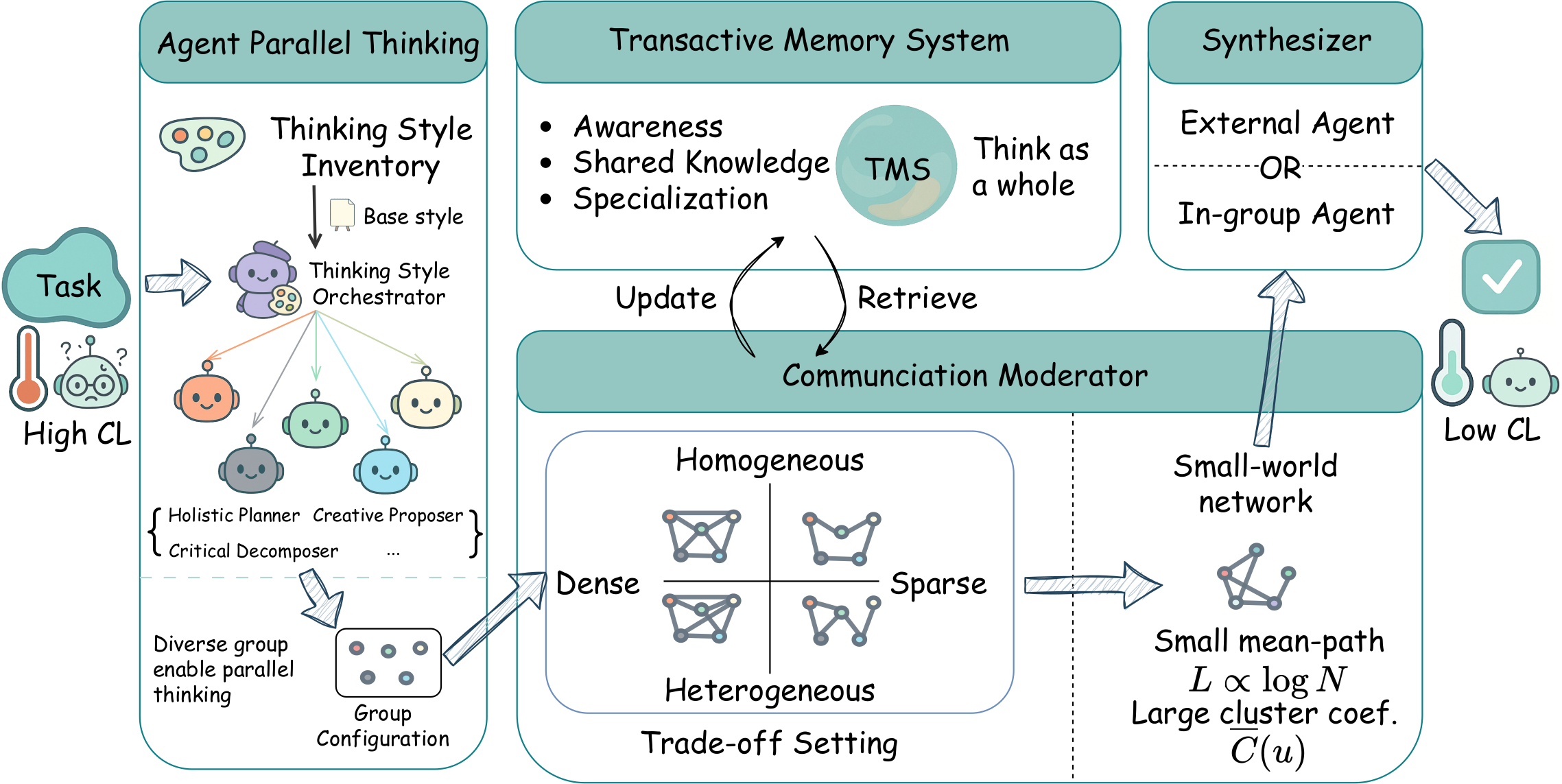
To operationalize these insights, the CoThinker architecture (Figure 2) comprises four main modules: Agent Parallel Thinking (Section 4.1), Transactive Memory System (Section 4.2), Communication Moderator (Section 4.3), and Synthesizer (Section 4.4). Each module is directly guided by CLT principles to emulate aspects of the human collective mind. Agent Parallel Thinking addresses intrinsic load through division of cognitive labor. The Transactive Memory System provides context compression, reducing extraneous load from redundant raw history.
The Communication Moderator enforces information routing and caps peer influx into each agent's context. Finally, the Synthesizer integrates refined collective insights. Let
通信调节器实施信息路由,并限制进入每个智能体上下文的同伴信息量。 最后,综合器整合经过提炼的集体洞见。 令
4.1 Agent Parallel Thinking
This module addresses intrinsic cognitive load by promoting a division of cognitive labor: each agent focuses its limited attention budget on a task-specific thinking dimension rather than juggling all aspects of the problem in one monolithic prompt. Unlike assigning pre-defined roles, which require domain-specific foresight and impose extraneous CL from role adherence, CoThinker uses an adaptive approach. A Thinking Style Orchestrator generates a task-specific style
该模块通过推动认知劳动分工来应对内在认知负荷:每个智能体把有限的注意力预算集中在特定于任务的思维维度,而不是在一个庞大的提示中同时处理问题的所有方面。 预定义角色需要领域特定的前瞻判断,而且遵守角色会施加额外的外在认知负荷;与此不同,CoThinker 采用自适应方法。 思维风格编排器根据通用基础思维风格清单
This yields diverse thinking styles
由此产生的多样化思维风格
4.2 Transactive Memory System (TMS)
This module addresses extraneous cognitive load through context compression. Human groups effectively manage complex information by developing Transactive Memory Systems (TMS), which involve a shared understanding of who knows what, how to access information held by others, and a collective agreement on the information itself. This distributed cognitive system allows individuals to specialize and rely on others, reducing individual CL and enhancing group problem-solving.
该模块通过上下文压缩来应对外在认知负荷。 人类群体通过形成交互记忆系统(TMS)来有效管理复杂信息;这类系统包括对谁知道什么、如何访问他人所持信息,以及对信息本身的集体共识。 这种分布式认知系统使个体能够专业化并依赖他人,从而降低个人认知负荷并增强群体问题求解能力。
In CoThinker, TMS replaces the need for every agent to re-read full raw chat transcripts each round: an evolving structured summary
在 CoThinker 中,TMS 取代了每个智能体每轮重新阅读完整原始聊天记录的做法:不断演化的结构化摘要
4.3 Communication Moderator
This module further manages extraneous load via information routing. Effective inter-agent communication is crucial, yet it incurs transactional costs---the cognitive effort for message processing and integration---imposing extra extraneous CL. The moderator selects only
该模块进一步通过信息路由来管理外在负荷。 有效的智能体间通信至关重要,但它会产生交互成本,即处理和整合消息所需的认知努力,从而施加额外的外在认知负荷。 调节器只为每个智能体
The latter involves balancing the ease of integrating cognitively similar inputs (low extraneous load but risk of echo chambers) against the benefits of diverse perspectives for distributing intrinsic load.
后者需要在整合认知相似输入的便利性(外在负荷较低,但存在回音室风险)与多样化视角在分配内在负荷方面的收益之间取得平衡。
Communication Topology and Algorithm: The selection of references defines a directed communication graph
通信拓扑与算法: 参考消息的选择为每一轮定义了一个有向通信图
- Fixed In-Degree (
): Each agent (node ) has an in-degree of , capping its processing load and respecting LLM WM. - Define Cognitive Distance between Agent Outputs: The cognitive distance
is based on the semantic similarity of previous outputs. - Re-connection via Probabilistic Rewiring (
): For each agent , its incoming edges (references ) are chosen from cognitively similar peers (low distance), but with a probability , “rewiring” some connections to randomly chosen, diverse peers.
- 固定入度(
): 每个智能体 (节点 )的入度均为 ,以限制其处理负荷并尊重 LLM 的工作记忆容量。 - 定义智能体输出之间的认知距离: 认知距离
基于上一轮输出的语义相似度。 - 通过概率重连(
)重新连接: 对于每个智能体 ,其 条入边(参考集合 )从认知相似的同伴(距离较低)中选取,但会以概率 将部分连接“重连”到随机选择的多样化同伴。
Resulting Network Properties and Cognitive Balance: It fosters dynamic communication networks with small-world properties, with high local clustering (facilitating efficient refinement of similar ideas, reducing extraneous load locally) and short average path lengths (enabling rapid global propagation of diverse insights, aiding intrinsic load distribution). This structure offers a balance between focused collaboration and broad information access, managing CL more effectively than random or regular lattice networks. Further details are in the appendix.
形成的网络属性与认知平衡: 该方法形成具有小世界属性的动态通信网络,既有较高的局部聚类(促进相似观点的高效完善,降低局部外在负荷),又有较短的平均路径长度(使多样洞见能够快速全局传播,帮助分配内在负荷)。 这种结构在专注协作与广泛信息访问之间取得平衡,比随机网络或规则格状网络更有效地管理认知负荷。 更多细节见附录。
4.4 Synthesizer
The Synthesizer consolidates all agents' answers and TMS into a final answer (details in the appendix). CoThinker Process Flow. The process for task
综合器把所有智能体的答案和 TMS 整合为最终答案(细节见附录)。 CoThinker 流程。 对于任务
Initialization:
Iterative Refinement for agent
Final Synthesis:
Compared to existing multi-agent debate frameworks that scale by adding agents and broadcasting peer outputs into every agent's context, three choices in the design above follow directly from the CLT lens: thinking styles are generated adaptively for each task rather than fixed as personas (so role adherence consumes less of the attention budget), peer input is routed through a moderator that caps how much each agent must integrate per round, and the resulting system is expected to help only where intrinsic load is high enough to justify the coordination cost---a task-dependent boundary the “more agents are better” view does not predict and which our experiments are consistent with in Section 5.2.
与通过增加智能体数量并把同伴输出广播到每个智能体上下文来扩展规模的现有多智能体辩论框架相比,上述设计中的三项选择直接源于 CLT 视角:思维风格针对每项任务自适应生成,而不是固定为人格画像(因此遵守角色占用的注意力预算更少);同伴输入通过调节器路由,对每个智能体每轮必须整合的信息量设定上限;只有当内在负荷高到足以抵消协调成本时,系统才有望提供帮助。这一任务相关边界是“智能体越多越好”的观点无法预测的,而我们的实验与该边界一致,见 第 5.2 节。
5. Experiments and Results
This section details our experimental methodology and empirically evaluates the CLT-driven design instantiated in CoThinker. We outline the experimental setup, present main results on LiveBench and CommonGen-Hard, followed by ablations and discussion through the lens of Cognitive Load Theory (CLT).
本节详细介绍实验方法,并对 CoThinker 所实现的 CLT 驱动设计进行实证评估。 我们首先概述实验设置,随后给出 LiveBench 和 CommonGen-Hard 上的主要结果,并从认知负荷理论(CLT)视角开展消融与讨论。
5.1 Experimental Setup
Models and Configuration. For main experiments, we use three Gemini models with varying capacities: Gemini-1.5-Flash-8B (lightweight), Gemini-1.5-Flash (mid-tier), and Gemini-1.5-Pro (high-capacity). Evaluation Benchmarks. We evaluate on two challenging benchmarks: (1) LiveBench, a broad-coverage benchmark of real-world tasks with periodic task updates, providing evaluation across math, reasoning, data analysis, and related domains; and (2) CommonGen-Hard, a controlled experimental challenge designed to test information interactivity, by forcing models to integrate target concepts from large pools of distractors. Baselines. We compare CoThinker with both single-agent and multi-agent approaches: Single Agent (IO), Single Agent (CoT), Single Agent (Self-Refine), Multi-Agent Debate (MAD), and Diverse MAD (DMAD). Complete details are in the appendices.
模型与配置。 在主要实验中,我们使用三种能力不同的 Gemini 模型:Gemini-1.5-Flash-8B(轻量级)、Gemini-1.5-Flash(中等能力)和 Gemini-1.5-Pro(高能力)。 评估基准。 我们在两个具有挑战性的基准上进行评估:(1) LiveBench,一个覆盖广泛并定期更新任务的现实任务基准,评估数学、推理、数据分析和相关领域;(2) CommonGen-Hard,一个用于检验信息交互性的受控实验挑战,它迫使模型从大量干扰项中整合目标概念。 基线。 我们将 CoThinker 与单智能体和多智能体方法进行比较:单智能体(IO)、单智能体(CoT)、单智能体(Self-Refine)、多智能体辩论(MAD)和多样化 MAD(DMAD)。 完整细节见附录。
| Task | Gemini-1.5-Flash-8B | Gemini-1.5-Flash | Gemini-1.5-Pro | |||||||||||||||
|---|---|---|---|---|---|---|---|---|---|---|---|---|---|---|---|---|---|---|
| IO | CoT | SR | MAD | DMAD | Ours | IO | CoT | SR | MAD | DMAD | Ours | IO | CoT | SR | MAD | DMAD | Ours | |
| Math | 33.8[1.00] (±2.5) | 34.1[1.04] (±2.6) | 31.7[0.92] (±2.5) | 38.6[1.13] (±2.6) | 35.2[1.13] (±2.8) | 37.7[1.11] (±2.7) | 48.6[1.47] (±2.8) | 48.6[1.47] (±2.8) | 47.6[1.45] (±2.8) | 49.5[1.51] (±2.8) | 49.2[1.49] (±2.7) | 51.2[1.57] (±2.9) | 60.9[2.00] (±2.6) | 62.4[1.86] (±2.7) | 61.4[1.93] (±2.6) | 69.4[2.29] (±2.3) | 70.0[2.31] (±2.4) | 75.3[2.40] (±3.7) |
| Data | 14.0[1.00] (±1.9) | 12.6[0.90] (±2.0) | 4.9[0.34] (±0.7) | 8.1[0.58] (±1.8) | 8.9[0.64] (±1.4) | 18.4[1.32] (±3.1) | 25.5[2.03] (±3.0) | 26.4[2.07] (±3.3) | 18.0[0.90] (±3.3) | 21.9[1.46] (±2.9) | 27.6[2.51] (±3.5) | 27.5[2.44] (±3.4) | 40.7[2.92] (±4.7) | 38.0[2.72] (±4.3) | 18.6[1.33] (±3.5) | 43.9[3.15] (±4.5) | 46.4[3.32] (±4.4) | 47.3[3.39] (±4.8) |
| Reas. | 23.5[1.00] (±3.1) | 20.9[1.11] (±3.0) | 15.8[0.80] (±2.7) | 24.8[1.21] (±3.1) | 17.1[0.85] (±2.9) | 28.5[1.22] (±3.4) | 38.3[1.63] (±3.4) | 41.0[1.74] (±3.4) | 36.5[1.55] (±3.3) | 45.0[1.92] (±3.5) | 44.9[1.94] (±3.5) | 45.3[1.97] (±3.5) | 43.0[1.87] (±3.8) | 42.0[1.82] (±3.8) | 36.9[1.80] (±3.6) | 40.9[1.78] (±3.7) | 42.7[1.88] (±3.8) | 44.7[1.95] (±3.7) |
| Lang. | 16.1[1.00] (±2.8) | 19.4[1.09] (±3.1) | 18.0[0.89] (±3.2) | 20.1[1.03] (±3.3) | 26.5[1.02] (±3.7) | 29.4[0.98] (±3.9) | 32.2[1.41] (±3.9) | 29.1[1.30] (±3.8) | 28.7[1.06] (±3.7) | 33.0[1.46] (±4.0) | 36.2[1.44] (±3.8) | 40.2[1.52] (±4.1) | 37.4[1.43] (±3.8) | 34.9[1.54] (±3.8) | 42.8[1.22] (±3.9) | 46.1[1.58] (±3.4) | 52.1[1.74] (±4.1) | 52.6[1.76] (±3.9) |
| Instr. | 84.3[1.00] (±1.5) | 83.5[1.02] (±1.6) | 69.9[0.81] (±2.0) | 78.1[0.87] (±1.9) | 78.6[0.89] (±1.9) | 68.1[0.80] (±3.4) | 87.1[1.10] (±1.5) | 87.1[1.10] (±1.6) | 73.4[0.87] (±2.0) | 81.4[1.01] (±1.9) | 87.3[1.06] (±1.6) | 80.2[0.99] (±2.9) | 84.4[1.03] (±1.2) | 83.6[1.02] (±1.3) | 61.5[0.72] (±1.6) | 67.6[0.77] (±1.6) | 83.1[1.02] (±1.3) | 81.8[0.95] (±1.3) |
5.2 Main Results on LiveBench
表2 reports CoThinker accuracy on LiveBench across three Gemini models alongside five baselines. Since we use greedy decoding (temperature
表2 报告了 CoThinker 与五种基线在三种 Gemini 模型上的 LiveBench 准确率。 由于我们使用贪心解码(温度为
Several near-significant comparisons (e.g., vs. DMAD on Reasoning and Data Analysis) miss Holm at
若干接近显著的比较(例如在推理和数据分析上与 DMAD 的比较)未通过
Concretely, the cognitive-load profile sorts a task by how much working-memory pressure it imposes before any coordination overhead: high-intrinsic-load tasks are reasoning-heavy and decomposable into distinct sub-problems (Math, Data Analysis, Reasoning, Language), while low-intrinsic-load tasks are execution-focused and rubric-following (Instruction-Following), so a single agent already handles them well. High intrinsic CL tasks scale with model capability and benefit from distributing load across agents through moderated routing and shared memory, while low intrinsic CL tasks gain little from stronger models and CoThinker's coordination overhead introduces extraneous CL that outweighs the collaboration benefit. This split is the boundary the CLT lens predicts: coordination helps where intrinsic load is high and hurts where extraneous overhead dominates. Details appear in the appendix.
具体而言,认知负荷画像按照任务在产生任何协调开销之前施加的工作记忆压力来划分任务:高内在负荷任务以推理为主,并且可以分解为不同子问题(数学、数据分析、推理和语言);低内在负荷任务则聚焦执行和遵循评分规则(指令遵循),因此单个智能体已经能够良好处理。 高内在认知负荷任务会随模型能力提升而扩展,并受益于通过受控路由和共享记忆在智能体之间分配负荷;而低内在认知负荷任务几乎无法从更强模型中获益,CoThinker 的协调开销反而会引入超过协作收益的外在认知负荷。 这种划分正是 CLT 视角预测的边界:内在负荷高时协调有益,而外在开销占主导时协调有害。 详细结果见附录。
5.3 Main Results on CommonGen-Hard
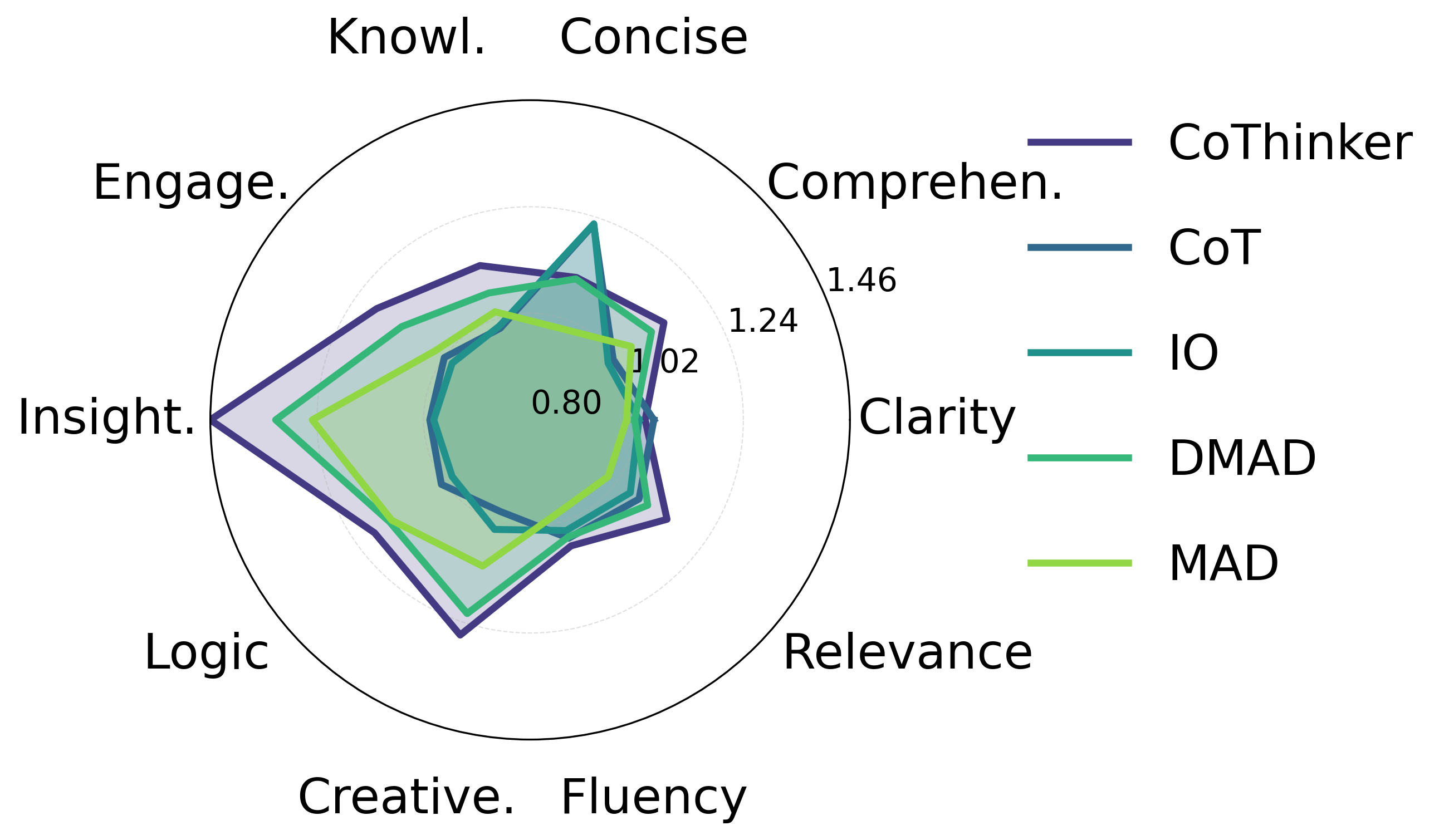
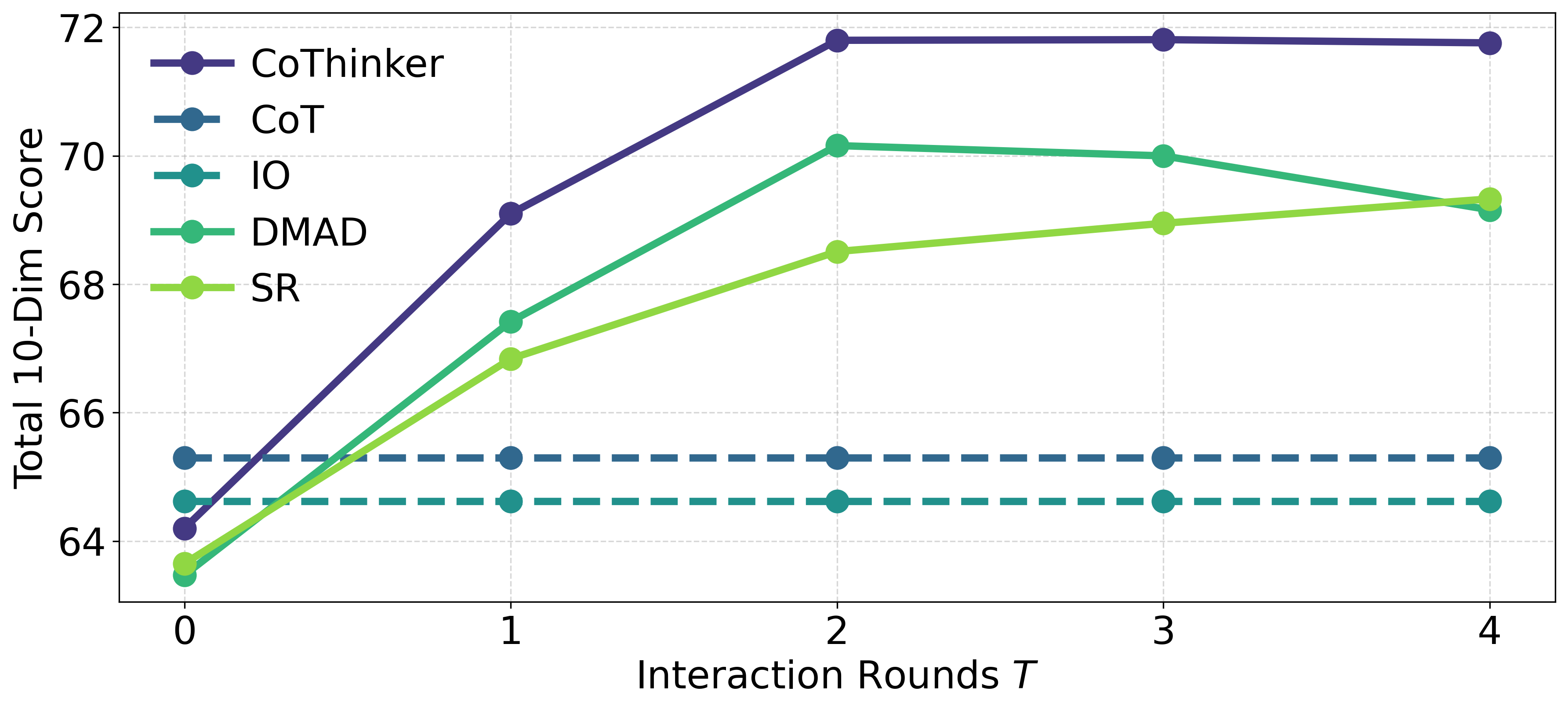
CoThinker shows measurable improvements on CommonGen-Hard, a task designed to probe high-CL management. Figure 3 shows performance across evaluation dimensions through (a) a radar plot with normalized by dividing the min scores and (b) an interaction rounds plot tracking performance evolution. Relative to heuristic multi-agent debate-style protocols, the CLT instantiation in CoThinker---partitioning intrinsic load, compressing shared state, and routing peer input---better preserves reasoning quality as rounds accumulate.
CoThinker 在 CommonGen-Hard 上取得了可测量的改进;该任务用于检验高认知负荷管理。 图3 通过两种方式展示各评估维度的表现:(a) 用最小得分归一化的雷达图;(b) 跟踪性能演化的交互轮次图。 相较于启发式多智能体辩论协议,CoThinker 对 CLT 的具体实现,即划分内在负荷、压缩共享状态并路由同伴输入,能够在轮次累积时更好地保持推理质量。
The radar plot (Figure 3a) reveals strengths in coherence and concept integration, with minor trade-offs in conciseness. The rounds plot (Figure 3b) shows sustained improvement across multiple interaction rounds: baseline methods degrade as unstructured coordination overhead (extraneous CL) accumulates.
雷达图(图3a)显示 CoThinker 在连贯性和概念整合方面具有优势,但在简洁性上存在轻微权衡。 轮次图(图3b)显示,多轮交互期间性能持续提升;而随着非结构化协调开销(外在认知负荷)累积,基线方法会出现退化。
5.4 Cross-Model Generalization
To check that the observed gains are not Gemini-specific, we evaluated across multiple LLM families: GPT-5-Nano, Qwen3-30B-A3B, GPT-OSS-20B, Gemini-2.5-Flash, GPT-4.1-Mini, Qwen3-32B, and DeepSeek-R1-8B (partial results in tbl:cothinker-cross-model). We examine two scenarios: (1) standard setting with IO baselines using maximum reasoning steps with temperature 0.25 and (2) constrained setting with token budget of 8192 with greedy decoding (temperature = 0). Complete results are in the appendix.
为了检验观察到的收益并非 Gemini 特有,我们在多个 LLM 家族上进行了评估:GPT-5-Nano、Qwen3-30B-A3B、GPT-OSS-20B、Gemini-2.5-Flash、GPT-4.1-Mini、Qwen3-32B 和 DeepSeek-R1-8B(部分结果见 tbl:cothinker-cross-model)。 我们考察两种场景:(1) 标准设置,其中 IO 基线使用最大推理步数和 0.25 的温度;(2) 受限设置,其中 token 预算为 8192,并使用贪心解码(温度为 0)。 完整结果见附录。
| Model | Method | Math | Reason. |
|---|---|---|---|
| GPT-5 | CoThinker | 88.57 | 81.88 |
| GPT-5 | IO | 82.63 | 68.38 |
| Qwen3 | CoThinker | 80.62 | 89.50 |
| Qwen3 | IO | 77.50 | 76.00 |
| Model | Method | Math | Reason. |
|---|---|---|---|
| Gemini-2.5 | CoThinker | 76.3 | 69.2 |
| Gemini-2.5 | IO | 59.3 | 31.0 |
| GPT-4.1 | CoThinker | 40.0 | 70.8 |
| GPT-4.1 | IO | 34.0 | 40.8 |
5.5 CoThinker Ablation of Communication Moderator
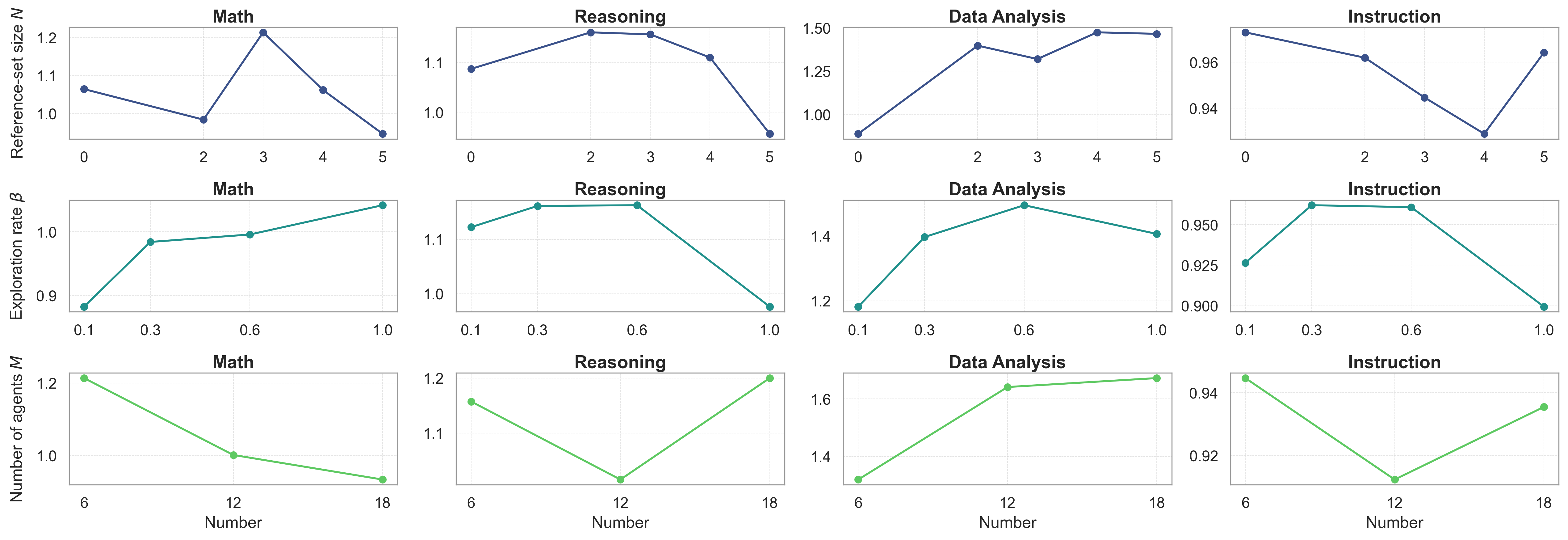
We ablate the Communication Moderator's key parameters—reference set size (
我们在 Gemini-1.5-Flash-8B 上,对通信调节器的关键参数——参考集合大小(
Exploration rate (
探索率(
5.6 CoThinker Ablation on Other Components
We conducted component ablation on Transactive Memory System (TMS) and Thinking Style Orchestrator (Style) a subset of LiveBench Math tasks. We also examine the proxy, perplexity (PPL), to reflect the CL management effects of our components.
我们在 LiveBench 数学任务的一个子集上,对交互记忆系统(TMS)和思维风格编排器(Style)进行了组件消融。 我们还考察困惑度(PPL)这一代理指标,以反映各组件的认知负荷管理效果。
Component Ablation. Communication Moderator is fixed ON for all runs. We test configurations: TMS
组件消融。 所有实验均固定开启通信调节器。 我们测试以下配置:TMS
Investigating their output, we find that they often refuse to give intermediate results, responding with “I can't provide step-by-step reasoning.” This is counterproductive, as it discourages the detailed reasoning used to build TMS. This is a practical deployment consideration: backbones that suppress intermediate reasoning traces (common in newer safety-tuned models) degrade TMS effectiveness, and the right fix is to design TMS prompts that synthesise from the agents' final-answer content rather than asking the backbone to expose its reasoning, since the latter triggers the suppression behaviour.
通过考察其输出,我们发现它们经常拒绝给出中间结果,并回答“我无法提供逐步推理”。 这会产生反作用,因为它抑制了构建 TMS 所需的详细推理。 这是一个实际部署时需要考虑的问题:抑制中间推理轨迹的骨干模型(常见于较新的安全微调模型)会降低 TMS 的有效性;正确的修复方式是设计能够从智能体最终答案内容中进行综合的 TMS 提示,而不是要求骨干模型暴露推理过程,因为后者会触发这种抑制行为。
| Configuration | Qwen3-30B-A3B | GPT5-Nano | GPT-OSS-20B |
|---|---|---|---|
| TMS: ON, Styles: ON | 81.87 | 55.97 | 57.15 |
| TMS: ON, Styles: OFF | 69.79 | 49.02 | 48.21 |
| TMS: OFF, Styles: ON | 76.41 | 62.36 | 58.37 |
PPL proxy as Evidence. We conducted perplexity (PPL) studies on weaker models to demonstrate how our components helps weaker models reduce CL in understanding stronger models' outputs. We choose Math and Reasoning tasks for our analysis. Lower PPL indicates higher easiness and effective CL reduction (See tbl:cothinker-ppl). For more interesting ablation with PPL proxy, see the appendix.
以 PPL 代理指标作为证据。 我们在较弱模型上开展困惑度(PPL)研究,以说明我们的组件如何帮助较弱模型降低理解较强模型输出时的认知负荷。 我们选择数学和推理任务进行分析。 PPL 越低,表示任务越容易处理,并且认知负荷得到有效降低(见 tbl:cothinker-ppl)。 更多使用 PPL 代理指标的消融见附录。
| Model | Baseline | Styles | TMS | References (N=3) |
|---|---|---|---|---|
| Qwen3-8B | 6.56 | 3.58 | 1.69 | 3.10 |
| Mistral-7B | 6.63 | 5.04 | 1.58 | 2.86 |
5.7 Cost and Latency
Output tokens per question are reported in tbl:cothinker-cost. CoThinker uses output tokens on the same order as MAD/DMAD on every backbone (within
每个问题的输出 token 数见 tbl:cothinker-cost。 在每种骨干模型上,CoThinker 使用的输出 token 与 MAD/DMAD 处于同一数量级(为 MAD 的
| Metric | Model | IO | CoT | SR | MAD | DMAD | Ours |
|---|---|---|---|---|---|---|---|
| Tokens/q | Flash-8B | 706 | 619 | 2,086 | 12,389 | 10,482 | 13,688 |
| Tokens/q | Flash | 638 | 643 | 2,566 | 16,104 | 13,688 | 14,323 |
| Tokens/q | Pro | 660 | 666 | 2,521 | 14,116 | 12,513 | 13,558 |
| API calls/q | all | 1 | 1 | 3 | 18 | 18 | ~25 |
6. Conclusion
This work interprets the performance ceilings of heavy context engineering through a Cognitive Load Theory (CLT) lens, treating the CLT-LLM correspondence as a functional analogy rather than a mechanistic claim. We draw parallels between human working memory constraints and LLM attention budgets, with diagnostic load proxies for support. More importantly, we describe how these theoretical insights can systematically guide system design.
本工作从认知负荷理论(CLT)视角解释重度上下文工程的性能上限,把 CLT 与 LLM 的对应关系视为功能类比,而非机制层面的主张。 我们类比人类工作记忆约束与 LLM 注意力预算,并以诊断性负荷代理指标提供支持。 更重要的是,我们说明了这些理论洞见如何系统指导系统设计。
By instantiating CoThinker---a framework that utilizes agent specialization, context compression (TMS), and information routing---we observe that mitigating intrinsic and extraneous load improves collective problem-solving over heuristic multi-agent baselines on reasoning-heavy tasks, while coordination overhead dominates on low-intrinsic-load instruction-following tasks---a boundary the cognitive-load-profile view predicts (Section 5.2). Our findings suggest that as LLM agent systems scale in complexity, relying on heuristic prompt engineering and unstructured chat protocols is insufficient. Future multi-agent architectures should embrace cognitively grounded, load-managed designs to fully unlock the collaborative potential of large language models.
通过实现 CoThinker——一个使用智能体专业化、上下文压缩(TMS)和信息路由的框架——我们观察到,在重推理任务上,缓解内在和外在负荷能够使集体问题求解优于启发式多智能体基线;而在低内在负荷的指令遵循任务上,协调开销占据主导地位。这一边界正是认知负荷画像视角所预测的(第 5.2 节)。 我们的发现表明,随着 LLM 智能体系统的复杂度不断扩展,仅依赖启发式提示工程和非结构化聊天协议是不够的。 未来的多智能体架构应采用具有认知依据、能够管理负荷的设计,充分释放大语言模型的协作潜力。
When to reach for CoThinker. A rough practitioner heuristic: (i) single-agent CoT suffices when intrinsic load is low (e.g., instruction-following with a clear rubric); (ii) multi-agent coordination pays off when the task decomposes into distinct reasoning styles or sub-problems; (iii) the moderator matters most when raw peer output would otherwise dominate each agent's context window.
何时使用 CoThinker。 一条粗略的实践启发式规则是:(i) 当内在负荷较低时(例如评分规则明确的指令遵循任务),单智能体 CoT 已经足够;(ii) 当任务可以分解为不同推理风格或子问题时,多智能体协作能够带来收益;(iii) 当同伴原始输出原本会占据每个智能体的大部分上下文窗口时,调节器最为重要。